Living Earth College - Prospectus
A New Paradigm for Living Systems Design Education
Vision
Living Earth College seeks to contribute a new paradigm to international design education, one in which design is understood as the cultivation of relationships between people, place and the living world. We believe the defining challenge of the twenty-first century is not simply to design better products, services or technologies, but to restore the ecological, social and cultural relationships upon which all life depends.
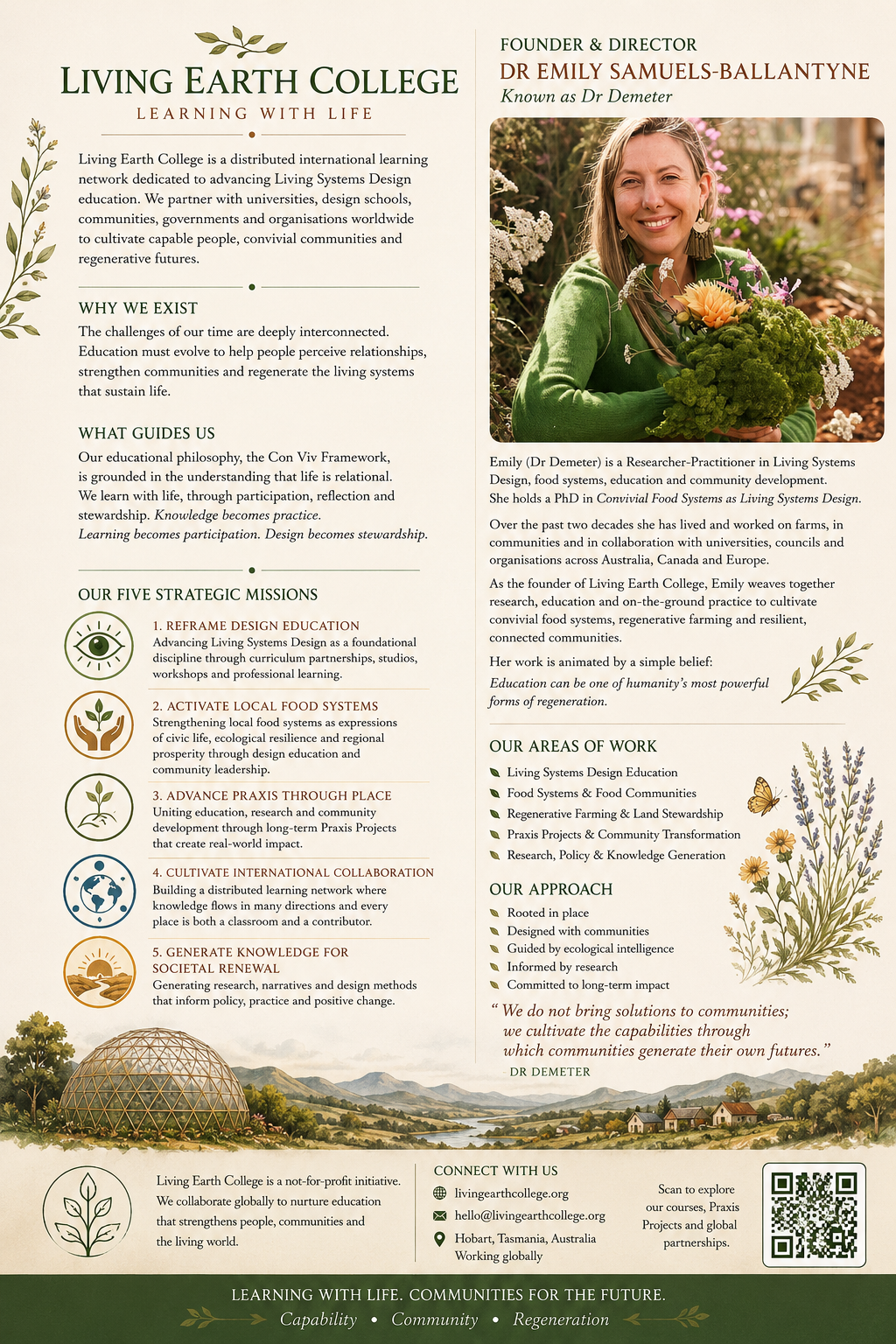
Our purpose is to cultivate designers, educators, policy makers, farmers, community leaders and citizens who possess the capacity to perceive, steward and regenerate living systems. Through education, research and place-based practice, Living Earth College contributes to the emergence of more resilient communities, regenerative economies and flourishing landscapes.
Rather than operating as a conventional campus-based institution, Living Earth College is conceived as a distributed international college. We collaborate with universities, design schools, governments, communities and organisations across the world, bringing Living Systems Design into existing educational ecosystems while remaining deeply grounded in local places. Education, in this sense, is not separate from society. It becomes an active participant in its renewal.
Our Educational Philosophy
The educational philosophy of Living Earth College is expressed through the Con Viv Framework, an original contribution to Living Systems Design developed through doctoral research into convivial food systems as living systems design. Con Viv begins from the understanding that life is not a collection of separate parts, but a web of living relationships. It recognises that every community, landscape, food system and organisation exists within a dynamic ecology where social, cultural, economic and ecological processes continually shape one another. Design, therefore, is understood not simply as the creation of objects, services or systems, but as the cultivation of the conditions through which life can flourish.
Con Viv invites learners to move beyond designing for people towards designing with people, communities and the more-than-human world. It encourages an attitude of careful observation before intervention, participation before prescription, and relationship before solution. In doing so, it reframes design as a practice of stewardship, reciprocity and shared responsibility.
Drawing upon Living Systems Thinking, ecological literacy, Goethean observation, participatory design, food systems, social ecology and place-based learning, the Con Viv Framework cultivates the capacity to perceive patterns, relationships and potential before seeking to change them. Learners are encouraged to develop not only technical competence, but also the judgement, imagination and practical wisdom required to work responsibly within living complexity.
For Living Earth College, education is not the transmission of information from teacher to student. It is the cultivation of capacities that enable people to participate more consciously in the life of their communities and the places they inhabit. Knowledge finds its fullest expression when it is embodied through practice, reflection and meaningful contribution. Through Con Viv, learning becomes a living practice and knowledge becomes a relationship. Design becomes about stewardship and education becomes the cultivation of life.
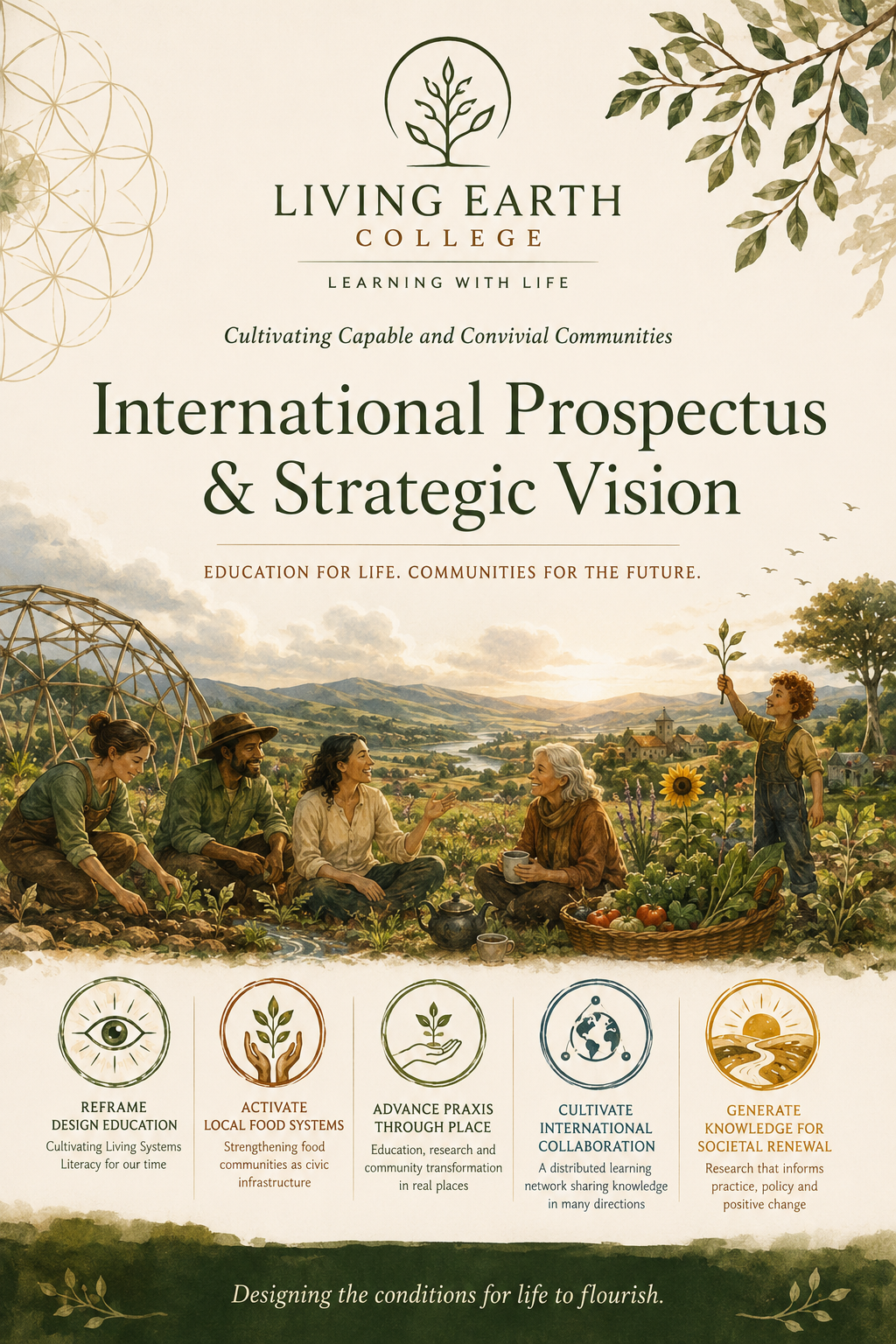
Five Strategic Missions
Mission One: Reframe Design Education
Living Earth College contributes to the evolution of design education by advancing Living Systems Design as a foundational discipline for the twenty-first century. We believe the challenges of our time, including ecological decline, food insecurity, social fragmentation and climate uncertainty, cannot be addressed through technical expertise alone. They require designers who are able to perceive relationships, work with complexity and cultivate the conditions through which life can flourish.
Our educational philosophy is expressed through the Con Viv Framework, an original contribution to design education developed through doctoral research into convivial food systems as living systems design. Con Viv invites learners to move beyond designing for people towards designing with people, communities and the more-than-human world. It integrates ecological literacy, systems thinking, Goethean observation, participatory design and place-based learning into a coherent educational philosophy grounded in both scholarship and practice.
The Con Viv Foundations programme forms the cornerstone of Living Earth College's educational pathway. It develops the inner capacities required for Living Systems Design through careful observation, reflective practice, relational thinking and Living Systems Literacy. Before learners seek to transform the world around them, they first cultivate the capacity to perceive it more deeply.
Living Earth College partners with universities, design schools and educators internationally through curriculum partnerships, visiting studios, intensive workshops, professional education and collaborative teaching. Our purpose is not to replace existing design programmes, but to enrich them with the knowledge, perspectives and capabilities needed for an era in which design is increasingly called upon to contribute to ecological regeneration, civic renewal and the flourishing of life.
By reframing design as the cultivation of relationships rather than simply the production of outcomes, Living Earth College seeks to contribute to a future in which design education prepares graduates not only to solve problems, but to steward the living systems upon which communities and cultures depend.
Mission Two: Activate Local Food Systems
Food is one of humanity's most powerful design materials because it connects people, place, ecology, culture, health and economy through the everyday act of nourishment. Living Earth College recognises local food systems not simply as agricultural systems, but as living civic systems capable of strengthening community resilience, ecological stewardship and regional prosperity.
Through the Activating Local Food Systems programme, students, educators, local governments, farmers, community organisations and citizens work together to explore how design can cultivate healthier and more connected food futures. Learning takes place within communities, where local knowledge, lived experience and collaborative inquiry become the foundation for meaningful transformation.
Participants learn not only how local food systems function, but how they can be activated through relationship-building, participation, community leadership and place-based design. In this process, design shifts from creating isolated interventions to cultivating the conditions through which communities can strengthen their own food cultures and local economies.
Living Earth College sees design schools as powerful civic institutions with the potential to contribute directly to the places they inhabit. Through curriculum partnerships, design studios, immersive workshops and collaborative field projects, education becomes an active participant in community life. Students graduate not only with new knowledge, but with practical experience of working alongside communities to co-create lasting ecological, social and economic value. By positioning education within the living context of place, the Activating Local Food Systems programme demonstrates how design education can become a catalyst for long-term community transformation, generating both capable practitioners and healthier, more resilient regions.
Mission Three: Advance Praxis Through Place
Living Earth College believes that the deepest learning emerges through meaningful participation in real places. We understand praxis as the living integration of thought and action, where education, research and community development continually inform one another. Rather than separating learning from practice, we cultivate educational experiences that contribute to the long-term vitality of the communities in which they occur.
Our Praxis Projects provide the bridge between educational philosophy and lived transformation. They are designed as long-term partnerships that enable students, educators, researchers, community organisations, local governments and citizens to work together on challenges that matter to place. In this way, learning extends beyond the classroom and becomes a practical contribution to ecological regeneration, civic participation and community resilience.
Current Praxis Projects include Regenerative Farming Certification, which cultivates the knowledge and capabilities required for regenerative land stewardship; Community Farm Activation, supporting farms as centres of learning, health, culture and community life; and Food Communities as Civic Infrastructure, a strategic vision demonstrating how local food systems can strengthen health, democracy, ecological resilience and regional prosperity while reconnecting people with one another and the places they inhabit.
Each Praxis Project becomes a living laboratory where education, research and implementation unfold together. Every initiative generates practical outcomes for communities while contributing new knowledge, case studies and design methodologies that strengthen the evolving field of Living Systems Design. In this way, every place becomes both a site of learning and a source of innovation, enabling Living Earth College to build an international body of knowledge grounded in local action.
Mission Four: Cultivate International Collaboration
Living Earth College is a distributed international learning network, founded on the belief that the most meaningful educational innovation emerges through relationships rather than institutional boundaries. Rather than concentrating expertise within a single campus, we cultivate partnerships with universities, design schools, governments, community organisations, farmers, researchers and practitioners across the world. In doing so, we create opportunities for ideas, methods and experiences to move freely between places, enriching both local practice and global understanding.
We see every place as both a classroom and a contributor. Every landscape, community and culture offers unique knowledge that can deepen our collective understanding of Living Systems Design. Learning therefore becomes an exchange rather than a one-way transfer of information, where educators, students and communities become co-creators of knowledge.
Our educational model enables Living Earth College to work alongside existing institutions, contributing specialist programmes, workshops, studio intensives, professional development and collaborative research while remaining responsive to the aspirations and challenges of each place. Rather than asking communities to adapt to a predetermined model, we seek to cultivate educational partnerships that emerge from local conditions and strengthen local capability.
Through these collaborations we aspire to weave an international community of practice dedicated to Living Systems Design, one in which knowledge is continually renewed through dialogue, shared inquiry and place-based action. Together, these partnerships contribute to the emergence of an educational movement that recognises design as a living practice, capable of strengthening the relationships between people, place and the living world.
Mission Five: Generate Knowledge for Societal Renewal
Living Earth College understands research as an ongoing dialogue between theory and practice. Every course, workshop, partnership and Praxis Project becomes an opportunity to generate new knowledge that informs education, policy and community development.
Our aspiration is to contribute original scholarship, design methods and educational models that assist societies to respond creatively to the interconnected challenges of food security, ecological regeneration, civic participation and cultural renewal. Research is not separate from practice, it grows from life itself.
Our Educational Model
Living Earth College operates through a distributed model of education. Our programmes are delivered through university partnerships, design schools, community organisations, governments, professional development, intensive workshops and place-based learning experiences. This flexible model enables education to respond to the needs of diverse regions while remaining connected through a shared educational philosophy. Learning therefore becomes simultaneously local and international, theoretical and practical, reflective and active.
Looking Forward
Living Earth College seeks to become an internationally recognised contributor to the future of design education. Our aspiration is to work alongside organisations such as the Cumulus Association, universities, design schools and international partners to cultivate the knowledge, relationships and capabilities required for societies to flourish within the limits and possibilities of living systems.
We believe that education can become one of humanity's most powerful forms of civic infrastructure, not simply transmitting knowledge, but cultivating the wisdom, imagination and practical capability required to regenerate the relationships upon which life depends. The future of design lies not only in what we create, but in the quality of the relationships we cultivate. The future of education lies not only in what we teach, but in the life we enable to flourish.