
A Global Food Community Vision
From household purchasing to regenerative regional economies
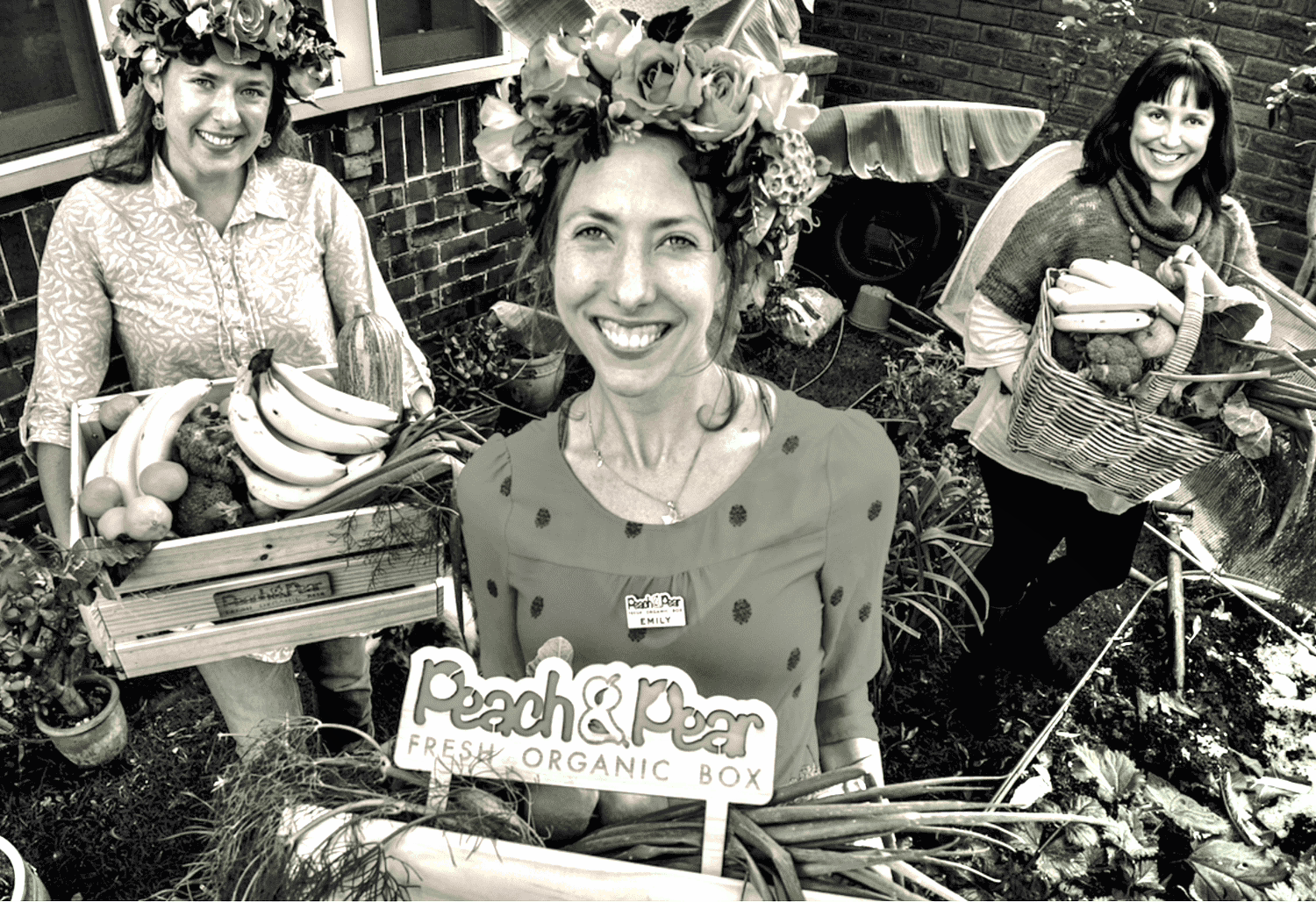
Emily and her Food Community Peach N Pear in 2015
Executive Summary
Across the world there is growing recognition that food systems must change. Yet much of the policy conversation remains focused on large strategies and complex infrastructure while overlooking the smallest yet most powerful unit of a food system: the relationship between households and farmers.
This position paper introduces the concept of food communities as a simple relational model for rebuilding local food economies. When around twenty five households organise their weekly food purchasing directly with a local farmer, approximately $61,875 per year can flow directly into a farm economy.
The model draws on the Peach n Pear food community experiment, a decade long initiative in which households coordinated seasonal food boxes with nearby farmers. Over time participants shifted away from supermarket purchasing and became part of a living local food economy organised around farms, seasons, and community relationships. The infrastructure required was minimal, often operating through simple neighbourhood pickup points such as verandahs or driveways.
From a policy perspective food communities function as distributed civic infrastructure, strengthening regional food economies through everyday purchasing relationships.
If 50,000 food communities were established across industrialised food economies, billions of dollars could circulate directly into regenerative farm economies while reconnecting citizens with the sources of their food.
The transition toward resilient food systems may therefore begin with a simple civic act:
twenty five households choosing to organise their food together.
The quiet architecture of food systems
Across the world there is increasing recognition that food systems must change. Governments commission strategies, cities develop food plans, and institutions publish reports describing the need for more resilient and regenerative food economies. Yet despite this growing awareness many food systems remain structurally fragile, dependent on long supply chains and increasingly disconnected from the farmers and landscapes that sustain them.
Part of the difficulty lies in where we begin the conversation. Policy discussions often start with large infrastructure investments, national frameworks, or complex governance reforms. While these approaches may have their place, they frequently overlook the smallest yet most powerful unit of any food system: the relationship between households and farmers.
Food systems are ultimately built through the everyday act of communities organising how they feed themselves. When this organisation becomes visible and intentional, a quiet but powerful form of civic infrastructure begins to emerge.
The simple pattern: one farmer and twenty five households
A remarkably consistent pattern appears across many successful local food initiatives. When approximately twenty five households organise to purchase food directly from one farmer, a small yet economically meaningful system forms.
If each household spends around fifty five dollars per week on a seasonal food box for forty five weeks of the year, the result is approximately $61,875 flowing directly into a local farm economy annually.
At first glance this number may appear modest. Yet its significance lies in the reliability of the income stream and the relationships it sustains. Instead of anonymous transactions within distant supply chains, households begin participating in a shared local food economy anchored in place.
A community organiser coordinates the orders and distribution. Farmers gain predictable revenue and direct feedback from the people they feed. Households receive seasonal food and develop relationships with the farms and landscapes around them. In this way everyday purchasing power becomes a form of community economic design.
The Peach n Pear experiment
The potential of this model is not theoretical. It has been explored in practice through a decade long community food initiative known as Peach n Pear. Peach n Pear began as a simple food box system connecting local households with nearby farmers. Around thirty households participated in the initiative, receiving seasonal food boxes every fortnight. What emerged over time was far more than a convenient way to purchase vegetables.
Participants reported that they gradually stopped purchasing fresh produce from supermarkets altogether. Their primary relationship with food had shifted. Instead of navigating anonymous retail systems, they became part of a living local economy organised around farms, seasons, and community relationships.
Peach n Pear also demonstrated something important from a policy perspective. The infrastructure required to operate the system was minimal. Distribution often occurred from a verandah, a driveway, or a simple neighbourhood gathering point where cars arrived to collect food and exchange conversation.
The essential infrastructure was not technological or logistical, it was relational.
Food communities as relational civic infrastructure
Seen from a systems perspective these food communities function as a form of distributed civic infrastructure. Rather than relying solely on centralised supply chains, regions cultivate many small networks connecting households and farmers. Each network may appear modest, yet collectively they form a resilient web of relationships capable of strengthening regional food economies.
From an economic perspective the implications are significant. If one food community generates approximately $61,875 annually for a farmer, then multiple communities across a town or region begin to create measurable economic activity.
Three food communities in a town could generate more than $185,000 flowing directly into local agriculture each year. Ten communities would generate more than $600,000 circulating locally. Over time these flows support farm viability, strengthen regional value circulation, and rebuild the social foundations that healthy food systems depend upon. See diagram for wider macro economic implications:
This is what foundational economics looks like when applied to food systems. Instead of extracting value from regions through distant supply chains, money circulates locally through relationships between producers and communities.
Scaling through networks
The deeper opportunity emerges when this simple pattern is replicated across many regions. If 50,000 food communities were activated across towns and cities within industrialised food economies, each linking households with farmers through simple coordination systems, billions of dollars could begin circulating directly through regenerative farm economies.
Yet the significance of this model is not only economic. It restores visibility to the food system itself. Farmers become known again. Households reconnect with seasonal rhythms. Children grow up understanding where nourishment comes from. Food becomes relational rather than abstract. At scale these networks begin forming the foundations of regional food resilience.
A new policy orientation
For policy makers the implications are profound.
Rather than focusing exclusively on large structural reforms, governments and institutions could enable the conditions that allow food communities to emerge and flourish. This may include small grants for community organisers, supportive procurement frameworks, and educational initiatives that help citizens organise neighbourhood food systems.
Such interventions require relatively modest investment yet can catalyse significant economic and social transformation. Policy in this context becomes less about managing supply chains from above and more about cultivating the conditions in which communities can organise their food systems from within.
Designing food systems with life
At its heart this vision invites a deeper shift in perspective. Food systems are not merely logistical supply chains. They are living systems composed of relationships between people, land, culture, and economy.
When communities consciously design how they feed themselves these relationships become visible again. The food system becomes something citizens actively participate in rather than something that simply happens beyond their control. The future of resilient food systems may therefore begin with a surprisingly simple act.
Twenty five households choosing to organise their food together. From that small beginning an entirely different food economy can grow.
To Join the How to Make a Food Community Course at Living Earth College visit this link: How to Create a Food Community - Online Workshop — Living Earth College
Contact Dr Emily Samuels-Ballantyne
Founder, Living Earth College
connect@livingearthcollege.org