
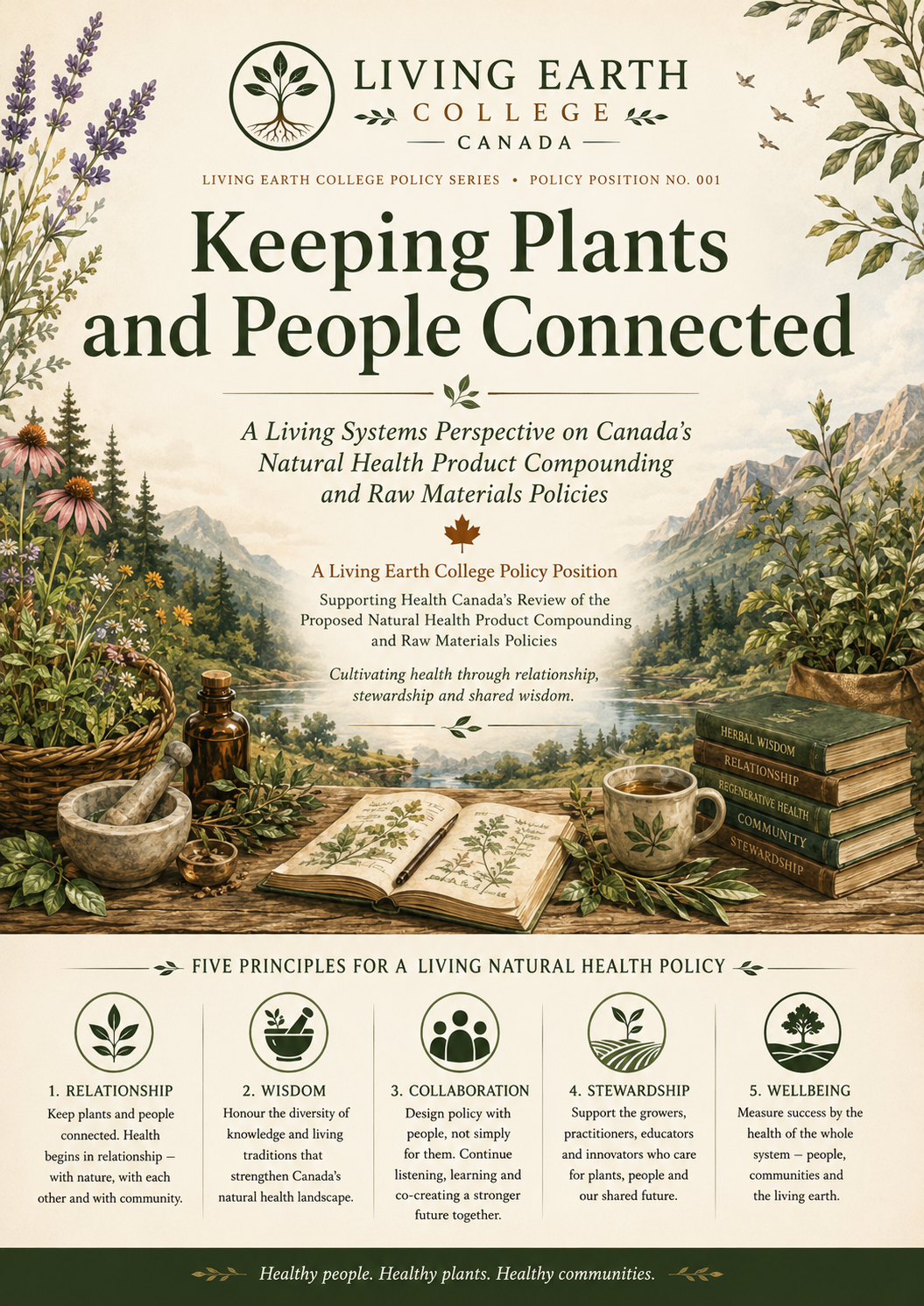
A Living Systems Perspective for Health Canada's Review
Dear Health Canada Consultation Team,
Thank you for inviting Canadians to contribute to this important review of the proposed Natural Health Product Compounding Policy and Natural Health Product Raw Materials Policy. I would like to begin by expressing my sincere appreciation for the opportunity to participate in this consultation. At a time when many people feel increasingly disconnected from public decision-making, the willingness of Health Canada to invite dialogue, listen to diverse perspectives and consider the lived experience of practitioners, educators, growers, manufacturers and citizens is itself an important act of public stewardship. Good government depends not only upon sound science and effective regulation, but also upon the quality of its relationships with the communities it serves, and I am grateful for the opportunity to contribute to that relationship through this submission.
I write as a Canadian and Australian citizen, researcher-practitioner, herbalist, educator and Founder of Living Earth College. For more than two decades my work has explored the relationship between healthy people, healthy communities and healthy ecosystems, and the ways in which public policy can either strengthen or weaken those relationships. While my doctoral research focused on local food systems and regenerative development, the questions that have guided my work are equally relevant to natural health. How do we create policies that protect people while also nurturing the living systems upon which health ultimately depends? How do we regulate wisely without unintentionally diminishing the knowledge, diversity and relationships that enable communities to flourish?
These questions have become increasingly important as our understanding of public health continues to evolve. Across many fields there is growing recognition that health is not created by medicine alone. It is influenced by our relationships with one another, with our communities, with culture, with food, with nature and with the places we call home. The emerging science of nature connection, ecological health and community wellbeing increasingly points towards something that many traditional knowledge systems have understood for generations: that human wellbeing is inseparable from the wellbeing of the living world. In this sense, medicinal plants are not simply ingredients within regulated products; they are part of a much larger relationship that has supported human health throughout history.
For this reason, I warmly welcome Health Canada's commitment to protecting Canadians through appropriate regulation and quality assurance. Public confidence in natural health products is important, and clear standards play a valuable role in maintaining that confidence. At the same time, I hope this review presents an opportunity to widen the conversation beyond products and processes to include the living relationships that make natural health possible in the first place. Every policy, whether intentionally or not, shapes relationships. It influences how practitioners care for patients, how growers cultivate medicinal plants, how knowledge is passed between generations, how communities access healthcare and how future practitioners are encouraged to enter the profession. These relationships deserve thoughtful consideration because they form part of Canada's public health infrastructure.
Earlier this year I had the privilege of attending the Canadian Herb Conference on Vancouver Island. While I learned a great deal from the presentations, what stayed with me most was the spirit of the community itself. Herbalists, pharmacists, educators, growers, researchers, manufacturers and students gathered not as competing interests, but as people united by a shared commitment to caring for others and to stewarding the remarkable knowledge that medicinal plants continue to offer. I came away with a profound respect for the professionalism, generosity and integrity of Canada's herbal community. It struck me that this community represents something far greater than an industry. It is a living tradition of care, sustained through relationships of trust, observation, learning and stewardship, and one that contributes quietly but significantly to the health and resilience of communities across the country.
My own work has been guided by a simple principle: healthy systems are relational systems. Whether we are speaking about food, education, health or ecological restoration, resilience grows through diversity, cooperation, trust, continual learning and the willingness to listen deeply to those who hold lived experience. This understanding is reflected in ecological systems thinking, in many First Nations ways of knowing, and increasingly in contemporary public health research, all of which recognise that wellbeing emerges not from isolated parts but from healthy relationships within the whole. I believe public policy can embody these same qualities. Rather than seeing regulation only as a mechanism for managing risk, we might also see it as an opportunity to cultivate trust, strengthen community capability and protect the relationships that enable people and nature to thrive together.
It is with this spirit of respect, collaboration and hope that I offer the following seven recommendations for consideration. They are offered not as criticism of the proposed policies, but as an invitation to continue building a natural health framework that protects public safety while also nurturing the people, plants, traditions and communities that have always been at the heart of natural health. My hope is that these recommendations contribute to a conversation that honours both scientific rigour and practical wisdom, recognising that Canada's greatest strength lies not simply in its regulatory systems, but in the living relationships that continue to sustain the health of its people.
Five Guiding Principles
A Living Earth College Framework for Relational Public Policy
This policy position is guided by five principles that, in my view, can strengthen both public health and Canada's natural health sector. Together they reflect a living systems approach to policy, one that recognises that health is created not only through effective regulation, but also through healthy relationships between people, plants, knowledge and place.
1. Relationship
Keep plants and people connected.
Healthy communities begin with healthy relationships between people, medicinal plants, practitioners and the natural world. Public policy should protect these relationships while ensuring public safety.
2. Living Knowledge
Honour diverse ways of knowing.
Canada's natural health landscape is enriched by First Nations wisdom, traditional herbal practice, practitioner experience and contemporary scientific research. Together these knowledge systems strengthen resilience, innovation and community wellbeing.
3. Listening
Design policy through collaboration.
The strongest policy grows through listening, learning and genuine collaboration. Practitioners, growers, pharmacists, educators, researchers, manufacturers and communities should be recognised as partners in creating practical and trusted public policy.
4. Stewardship
Support those who care for plants.
Healthy natural health systems depend upon the people who cultivate, harvest, research, teach and prepare medicinal plants. Supporting these stewards helps protect biodiversity, local economies, traditional knowledge and community health.
5. Flourishing Wellbeing
Measure success by the health of the whole.
The success of public policy should be measured not only through compliance, but by healthier people, thriving communities, resilient ecosystems and enduring relationships between people and the living world.
Seven Recommendations
Recommendation 1
Keep Plants and People Connected
Health Canada's regulatory framework should protect public health while ensuring Canadians continue to have safe and reasonable access to medicinal plants, practitioner-guided herbal care and natural health products. Future policy should recognise that healthy relationships with nature are themselves an important contributor to physical, mental and community wellbeing.
Recommendation 2
Honour the Diversity of Knowledge Systems
Canada's natural health sector is strengthened through the diversity of knowledge that informs it. Future policy should continue to respect First Nations knowledge systems, traditional herbal medicine, contemporary scientific research and practitioner experience as complementary sources of understanding. These diverse ways of knowing contribute to innovation, resilience and better health outcomes for Canadians.
Recommendation 3
Design Policy Through Listening and Collaboration
I encourage Health Canada to continue developing policy through genuine dialogue with practitioners, Indigenous knowledge holders, pharmacists, growers, educators, researchers, manufacturers and consumers. Good policy grows through listening, shared learning and ongoing collaboration. The people who work with medicinal plants every day are not simply stakeholders; they are partners in creating practical and effective public policy.
Recommendation 4
Recognise Practitioner Compounding as Personalised Healthcare
Practitioner compounding should continue to be clearly distinguished from commercial manufacturing. Individualised herbal formulations are prepared within a therapeutic relationship and respond to the unique needs of an individual. Maintaining this distinction supports personalised healthcare while continuing to uphold appropriate standards of quality, safety and professional responsibility.
Recommendation 5
Support the People Who Steward Canada's Herbal Sector
Healthy natural health systems depend upon the collective contribution of growers, wild harvesters, herbalists, pharmacists, educators, researchers, manufacturers and small businesses. These individuals are not only producers and practitioners but also custodians of biodiversity, traditional knowledge and community wellbeing. Future policy should support their ongoing contribution to Canada's health and resilience.
Recommendation 6
Keep Regulation Practical, Proportionate and Accessible
Regulation should be proportionate to the level of risk and practical for those required to implement it. Clear, accessible and workable regulatory requirements encourage compliance, maintain public confidence and avoid placing unnecessary administrative burdens on practitioner-led and community-based enterprises that provide valuable health services.
Recommendation 7
Measure Success by the Health of the Whole System
The success of these policies should be evaluated not only through regulatory compliance but through their contribution to healthier people, healthier communities and healthier ecosystems. Indicators such as continued access to qualified practitioners, the vitality of Canada's herbal sector, biodiversity stewardship, public confidence and community resilience provide a broader understanding of whether policy is strengthening the living system it seeks to support.
Closing Reflection
Public policy shapes relationships.
It shapes the relationship between government and citizens, practitioners and patients, growers and communities, people and medicinal plants.
When these relationships are built on trust, stewardship, shared responsibility and mutual learning, regulation becomes more than a mechanism for managing risk. It becomes a means of strengthening the living systems that sustain public health.
My hope is that these proposed policies will not only continue to protect Canadians through appropriate standards of quality and safety, but also contribute to a natural health system that remains diverse, resilient and deeply connected to the people and places it serves.
"All flourishing is mutual." — Robin Wall Kimmerer
About the Author
Dr Emily Samuels-Ballantyne, PhD is a researcher-practitioner, educator, herbalist and Founder of Living Earth College, a Canadian organisation dedicated to regenerative development, living systems design and community capacity building. For more than twenty years she has worked across Australia, Canada and Europe, bringing together public policy, ecological systems thinking, education and practical implementation to strengthen healthy relationships between people, place and the living world.
Emily's doctoral research explored local food systems as living systems, leading to the development of the Con Viv Framework, an approach that views health, communities and economies as interconnected relationships rather than isolated sectors. While her research began with food systems, her work now extends across natural health, regenerative agriculture, community resilience, policy innovation and organisational development. She is the author of Con Viv Companion (2026), a practical guide exploring living systems design, regenerative development and community-led transformation.
Her professional experience spans the energy sector, local government, higher education, environmental organisations and international collaboration. She has taught at university level, led award-winning regional development initiatives, contributed to environmental and food policy, and worked alongside practitioners, communities and institutions to translate ideas into meaningful action.
Emily believes that the best public policy does more than regulate, it strengthens the relationships that enable people and communities to flourish. Her work is inspired by ecological thinking, traditional knowledge, systems science and a deep respect for the wisdom held within communities themselves. Through Living Earth College, she continues to explore how thoughtful policy, education and collaboration can cultivate healthier people, healthier communities and healthier landscapes.
"When we strengthen the relationships between people, plants, knowledge and place, we strengthen health itself."
— Dr Emily Samuels-Ballantyne
Email: connect@livingearthcollege.org