THE FOOD SYSTEMS DESIGN LAB - Frequently Asked Questions
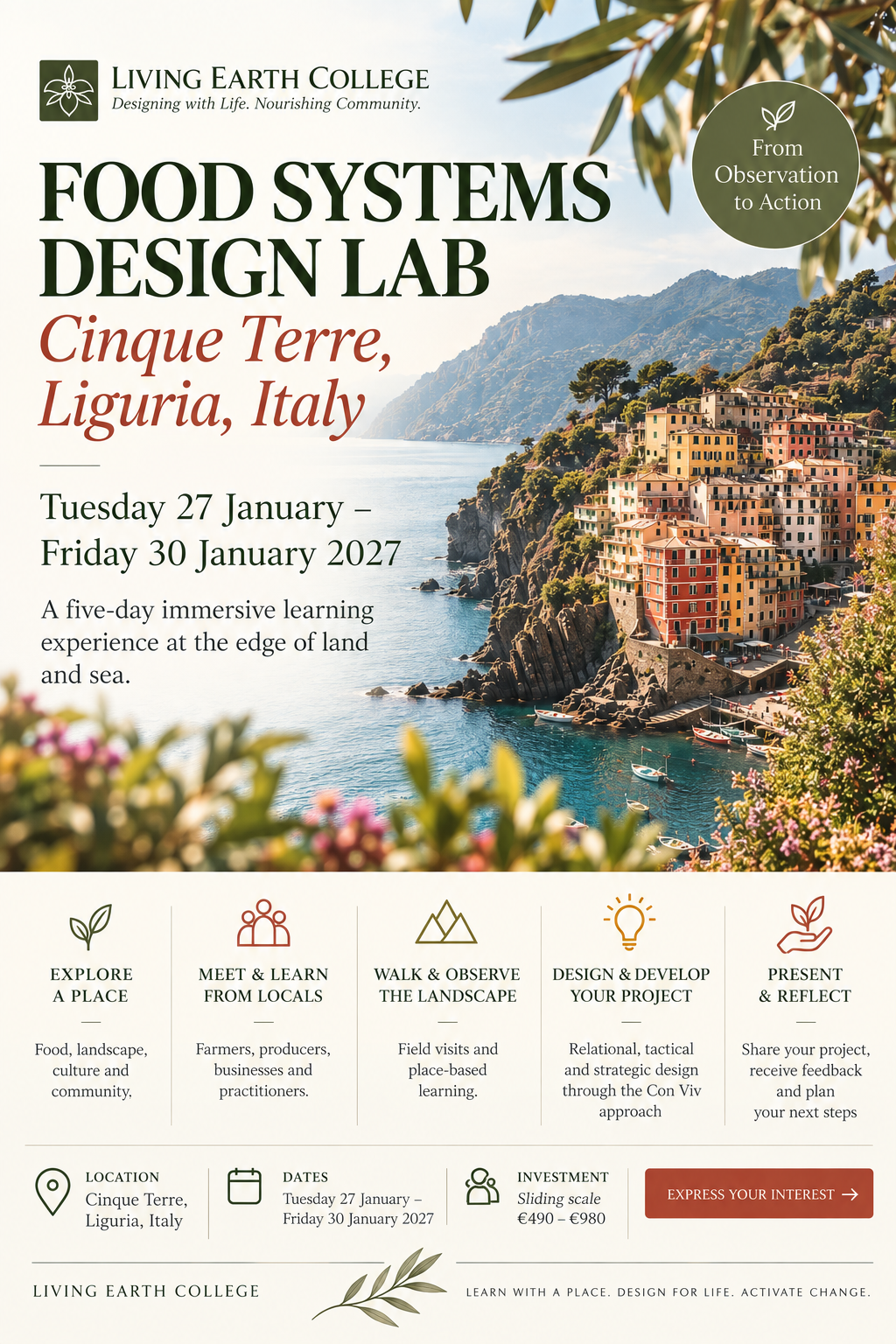
Riomaggiore, Cinque Terre | 27–30 January 2027
Frequently Asked Questions
The Riomaggiore Food Systems Design Lab is a five-day immersive learning experience from 27–30 January 2027, with participants arriving on 26 January. It is designed as a place-based design laboratory, bringing together food systems, living systems thinking, policy, community development and convivial design. Rather than studying a place from the outside, we learn with the place itself , through observation, walking, conversation, local relationships, field visits and practical project development.
1. Who leads and facilitates the Lab?
The Lab is led by Dr Emily Samuels-Ballantyne, founder of Living Earth College, with Cecilia Alessandrini, Service and Systems Designer, contributing to the design and project-development process.
Dr Emily Samuels-Ballantyne
Founder, Living Earth College | Living Systems & Policy Designer
Emily is a researcher-practitioner working across food systems, living systems design, policy, place and community development in Australia, Europe and North America. She developed the Con Viv approach through her doctoral research into convivial food systems as living systems design and has worked for more than a decade on food, community and place-based projects. Her practice brings together systems thinking, policy design, community participation, food systems and practical implementation. She is also developing her work through Goethean learning and observation, exploring how we can learn to perceive and understand the living qualities and relationships of a place through direct encounter.
If you would like to ask questions regarding the course, reach out to Emily connect@livingearthcollege.org
Cecilia Alessandrini
Service & Systems Designer
Cecilia brings expertise in service and systems design, strategy, innovation and design-led approaches to complex challenges, together with experience and knowledge of place-based work in Liguria. Her contribution to the Lab complements Emily's food systems, policy and living-systems perspective with a strong design and systems practice. Together, the facilitators support participants to move from observation and inquiry towards practical project development.
2. Who else will be involved?
The Lab is intentionally connected to the living food, cultural and ecological systems of the Cinque Terre. We will be joined by farmers • food producers • local businesses • shopkeepers • practitioners • community members • local knowledge holders
These relationships are an important part of the programme. Participants will encounter people who live and work within the place and hold knowledge of its food, landscape, culture and changing economy. It is low season and a great time to connect. The Lab is therefore as much about relationship and listening as it is about formal teaching.
3. Are there academics involved?
The Lab is not designed as a conventional academic conference or university course. It is a practitioner-led professional learning experience, drawing on research, design practice, food systems, policy and place-based knowledge.
Emily's doctoral research and the Con Viv framework provide an intellectual foundation for the Lab, while invited practitioners and local actors bring practical and situated knowledge. The intention is to bring together theory, practice and lived knowledge rather than separating them.
4. What is the balance between teaching, fieldwork and practical design?
The programme moves through several different ways of learning.
FACILITATED LEARNING
Introductions to Con Viv, living systems, food systems, place, policy and design.
PLACE-BASED OBSERVATION
Walking, observing and learning to read the landscape and relationships of place, including elements of Goethean observation.
FIELD EXPLORATION
Exploring Riomaggiore, Manarola, the surrounding agricultural landscape and the Cinque Terre.
LOCAL ENCOUNTERS
Conversations with farmers, food producers, businesses, practitioners and other people connected to the village.
DESIGN WORKSHOPS
Systems thinking, project development, relational design, tactical action and strategic pathways.
MENTORING
Participants receive individual guidance and feedback as their projects develop.
PEER LEARNING
A deliberately small cohort of up to 15 participants, allowing substantial conversation, exchange and relationship-building. The programme begins with seeing and understanding place and progressively moves towards design and implementation. By the latter part of the Lab, the emphasis is strongly on developing each participant's project.
5. Is this a study tour?
No.
There will be walks, hikes, field visits and opportunities to explore the Cinque Terre, but these are not tourism activities added to a classroom course. They are part of the learning methodology. We will explore how landscape, agriculture, food culture, community, economy, conservation and tourism have evolved together over time. The village becomes our classroom and laboratory.
The deeper question is: How do we learn to design with a place rather than design for it?
6. Will I develop a project during the Lab?
Yes. This is a central part of the experience. Participants will develop a place-based project proposition connected to a food-system, community, policy, landscape or local development question that is relevant to their own work.
You do not need to arrive with a fully formed project. The first part of the Lab provides the opportunity to observe, listen and explore the place and its systems. From there, participants develop their own project through a facilitated design process. The project is explored through relational, tactical and strategic convivial design.
This means asking:
Who needs to be in relationship?
What already exists that can be activated?
What needs to change?
What is possible now?
What could be tested or prototyped?
What is the first practical action?
What longer-term strategy might be required?
Which people, organisations, policies or resources need to come together?
The aim is to move from understanding a problem to designing a pathway for action.
7. What happens with the projects at the end?
The final morning is a significant part of the Lab. Each participant will present their project to the group.
The presentations will be followed by feedback, discussion and design reflection, allowing participants to test their ideas and consider how they might strengthen their approach. The final project is therefore not simply an academic presentation. It is an opportunity to articulate:
the place → the system → the possibility → the design → the relationships → the tactical action → the strategic pathway → the next step.
The intention is that participants leave with a project they can continue developing when they return home.
8. What is Con Viv Design?
Con Viv Design is the design approach developed through Emily's work and research into convivial food systems as living systems design. It asks us to move beyond designing solutions for people and instead consider how we can design the conditions, relationships and capacities through which people and places can flourish.
The approach brings together:
place • relationship • participation • imagination • systems thinking • policy • design • action
The Riomaggiore Lab is an opportunity to experience this approach directly rather than simply learning about it.
9. Is this part of Activating Local Food Systems?
Yes, but the Lab is deliberately more than the Activating Local Food Systems course. It is Professional Training in the Con Viv Design Framework.
Activating Local Food Systems introduces the Con Viv framework and provides a foundation for understanding and activating local food systems. The Place-Based Design Labs take that learning into a real place. Participants experience the methodology through observation, relationships, fieldwork, design and project development. The Lab is therefore closer to an immersive professional design studio and practitioner-development experience. The intention is not simply to teach people a body of knowledge. It is to help people develop the capacity to work with the Con Viv approach in their own places and professional contexts.
10. Is this teacher training?
It is not a formal teacher-training qualification. However, the Lab has an important practitioner-development dimension. Participants learn a way of observing, facilitating, designing and working with place that they can carry into their own organisations, communities, projects and educational work. For people working in government, education, community development, food systems, design or sustainability, this can become a foundation for facilitating their own place-based work through a Con Viv lens. Over time, Living Earth College intends for the Place-Based Labs to contribute to a wider community of Con Viv practitioners working in different places and contexts.
11. Is there a certificate or formal recognition?
Yes.
Participants receive a:
Certificate in Activating Local Food Systems
certificate professional training in Con Viv Place-Based Design & Practice
The certificate recognises completion of the intensive Lab, including participation in the place-based inquiry, design process, project development and final presentation. Participants also receive a Con Viv Project Development Manual, providing a practical framework for continuing to develop Con Viv projects in their own place. Where appropriate, Living Earth College can also provide a professional reference recognising participation and project development.
12. What is included in the €980 (full course fee)?
The fee includes the complete five-day learning experience:
facilitated teaching and learning
Con Viv Design sessions
place-based and Goethean observation
field visits and local explorations
guided walks and selected hikes
local practitioner and food-system encounters
contribution from local food knowledge holders
design and project-development workshops
individual mentoring
project feedback and final presentation
Con Viv learning materials
Certificate in Activating Local Food Systems: Con Viv Place-Based Design & Practice
Con Viv Project Development Manual
breakfast
lunch
coffee and morning refreshments
final group dinner on 30 January
13. Is accommodation included?
No.
Accommodation and travel to and from Riomaggiore are not included in the €980fee. Participants arrange their own accommodation. We recommend arriving on 26 January and staying approximately four nights, through the end of the programme on 31 January. January is low season in the Cinque Terre, so accommodation in the village is generally available at more accessible rates than during the summer. We strongly encourage participants to stay in Riomaggiore itself where possible. This allows the learning to continue beyond the formal workshop: walking through the village, eating locally, encountering people and experiencing the rhythms of the place.
14. Where does the Lab take place?
The main workshop base will be in one of the old church spaces in Riomaggiore, near the upper part of the village. The setting gives us a dedicated space for workshops while allowing us to step directly into the village and surrounding landscape. We will work across Riomaggiore and the wider Cinque Terre through walking, field visits and selected excursions.
15. What about food?
We have developed a relationship with a friendly local café, Old School Café, which will cater the programme.
The course fee includes:
Breakfast • Lunch • Coffee & morning refreshments
as well as the final group dinner on 30 January.
Other dinners are optional and can be enjoyed independently or organised informally with other participants.
16. When should I arrive?
Participants should plan to arrive in Riomaggiore on 26 January 2027. The formal programme begins on the morning of 27 January. The programme concludes after lunch at approximately 3.00pm on 30 January. This allows participants to experience the village before and after the formal programme and gives the group time to settle into place.
17. Who is the Lab for?
The Lab is designed for people working across or interested in:
food systems
food security
local government
community development
environmental sustainability
agriculture
local economic development
policy
education
design
planning
place-making
social innovation
community food systems
organisational and systems change
You do not need to come from a particular discipline. What matters is an interest in how places can become more capable of nourishing people, communities, economies and ecological life.
THE DEEPER PURPOSE
The Riomaggiore Food Systems Design Lab is ultimately an inquiry into place.
How do we learn to see what is already there?
How do we understand the layers of a place over time?
How do we recognise relationships, knowledge and capacities that are often invisible?
How do we work with a place rather than impose a solution upon it?
And how do we turn that understanding into something practical?
Riomaggiore is not the end point.
It is the living laboratory from which the work begins and a Tasmanian Lab is cooking - Stay Tuned! :)