Ode to the Women Who Work With Life

You arrive without fanfare, with sleeves rolled and eyes awake,
carrying the science of attention into soil and society,
so the farm becomes more than production,
it becomes a place where human hearts can learn their rhythm.

Maye Emily Bruce, you remind me the flower needs no advertisement,
only the courage to be seen as itself,
the intelligence of nature held in plain language,
a kindness that does not dilute innate genius.


Lady Eve Balfour, you press your ear to the ground and say: listen,
the earth is not a resource, it is a relation,
and every economy begins where humus is made.

Elisabeth Vreede, mathematician and astronomer, who was star-wise and exact,
you keep the heavens honest,
so our thinking can be clear without becoming cold,
and our wonder can be lawful without becoming abstract.


Ita Wegman, healer of thresholds,
you show that medicine is also social courage,
a practice of meeting another human being without fear,
and letting the future enter through care.

Julia Yelton, mentor of my hands and seasons,
you taught me to trust the rhythm, the soil, atmosphere and everything in between; to do the next right task,
and to let the land educate me without rushing its answers.

And Sophia Montefiore, with colour and form,
you make the planets speak in the language of plants,
so biodynamics can be embodied,
so the cosmic becomes real,
so the farmer can remember the sky without leaving the compost heap.

In the Goetheanum, Dornach, the home of holism,
I sat beside Sophia and felt the lineage breathing,
not as hierarchy, but as companionship, reflection, brilliance and joy:
women who keep the impulse warm, workable, and free.

Here is my vow, Dr Demeter’s devotional practice:
to steep yarrow, to wait, to speak with care,
to weave boundaries that do not harden,
to cultivate warmth as a field, not a demand.

May our islands, valleys, schools, clinics, gardens, committees,
become cultural farms of the future,
where healing, education, agriculture, and social art
meet each other in truthfulness,
and the world remembers: we are ‘with life’.

With Life ‘Con Viv’ and Love,

Dr Demeter

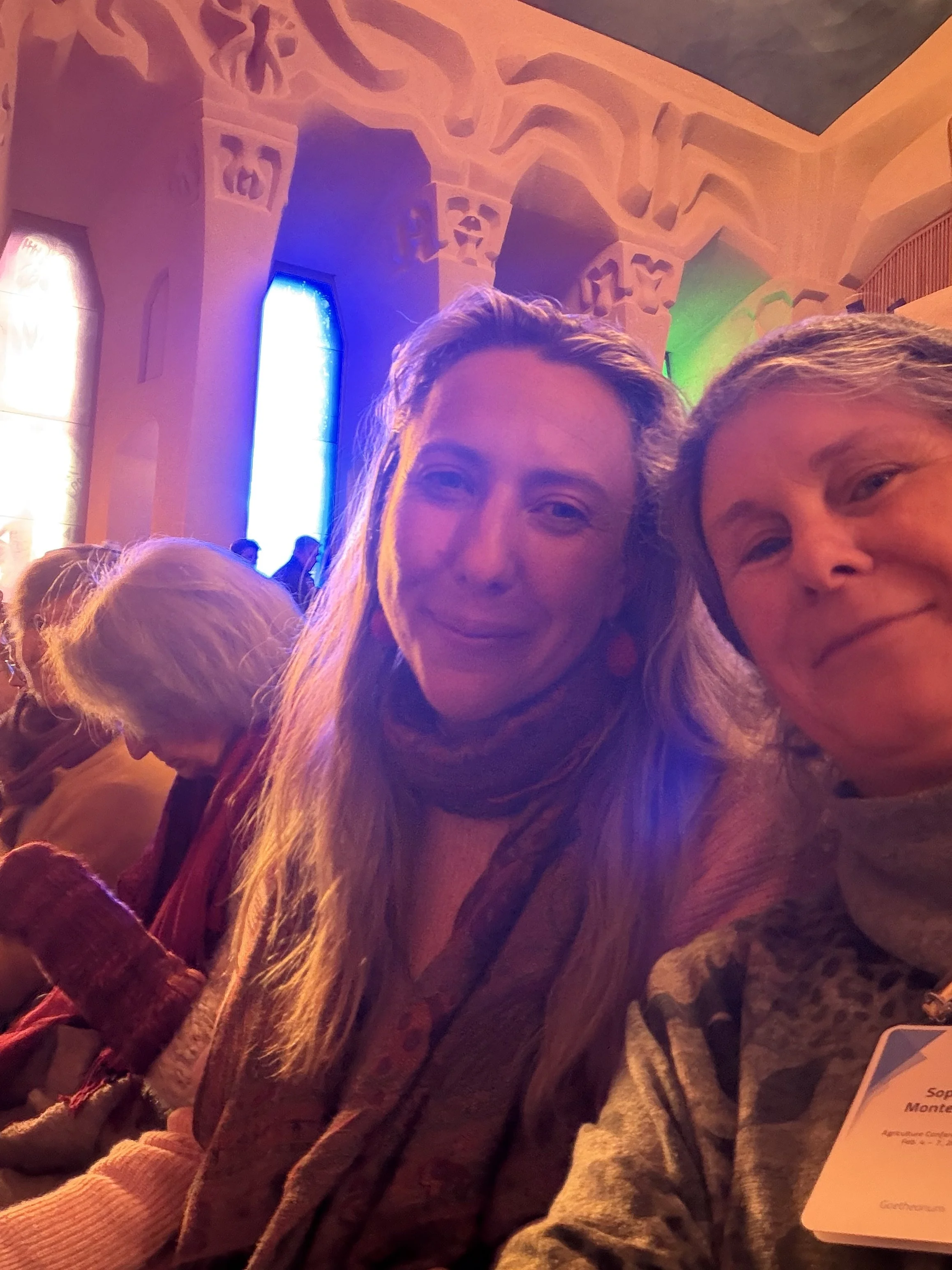
Dr Demeter / Emily Samuels-Ballantyne and Sophia Montefiore in the Goetheanum at the 2026 Agriculture Conference

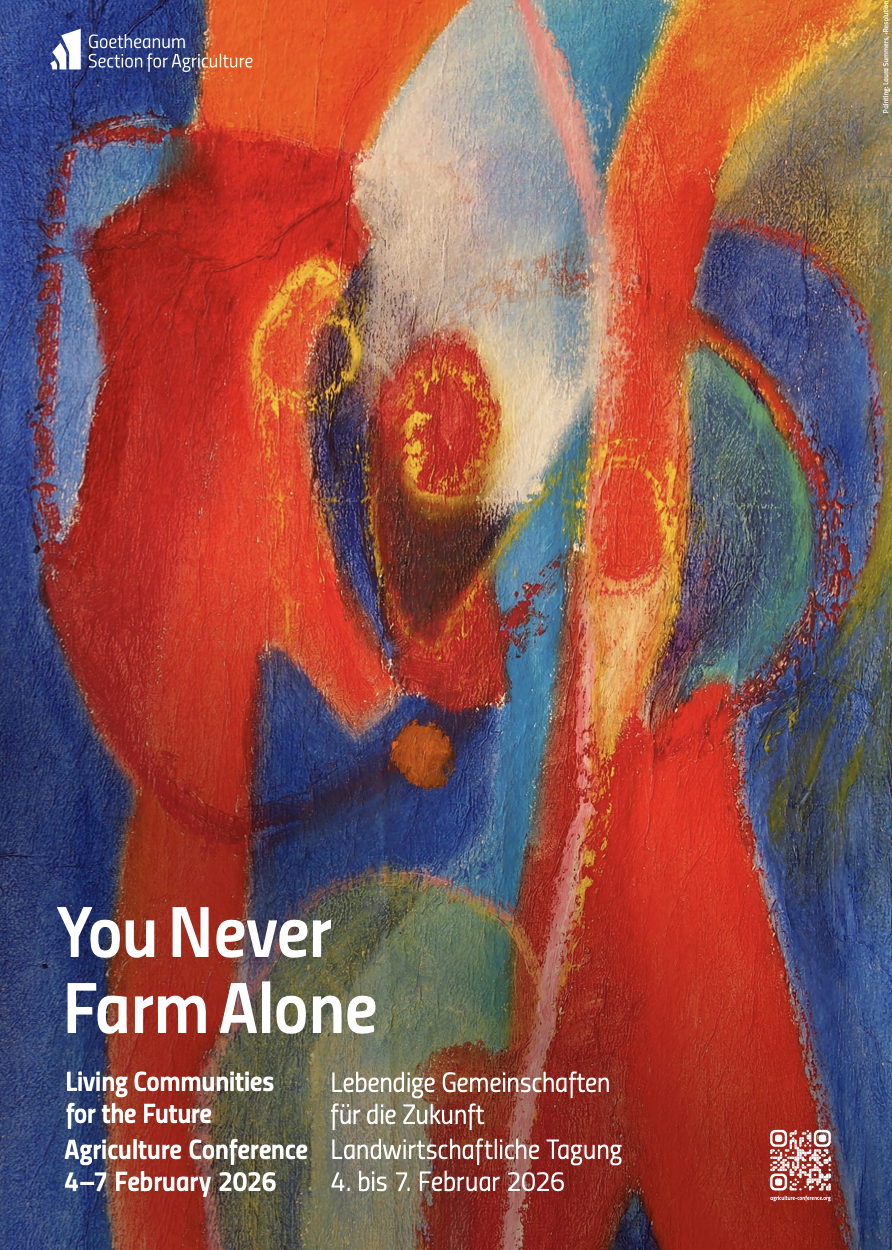
You Never Farm Alone: Collaboration from Free Will, and the cultural farms of the future

Feature on the Agriculture Conference in Dornach, Switzerland at the Goetheanum, 4–7 February 2026.

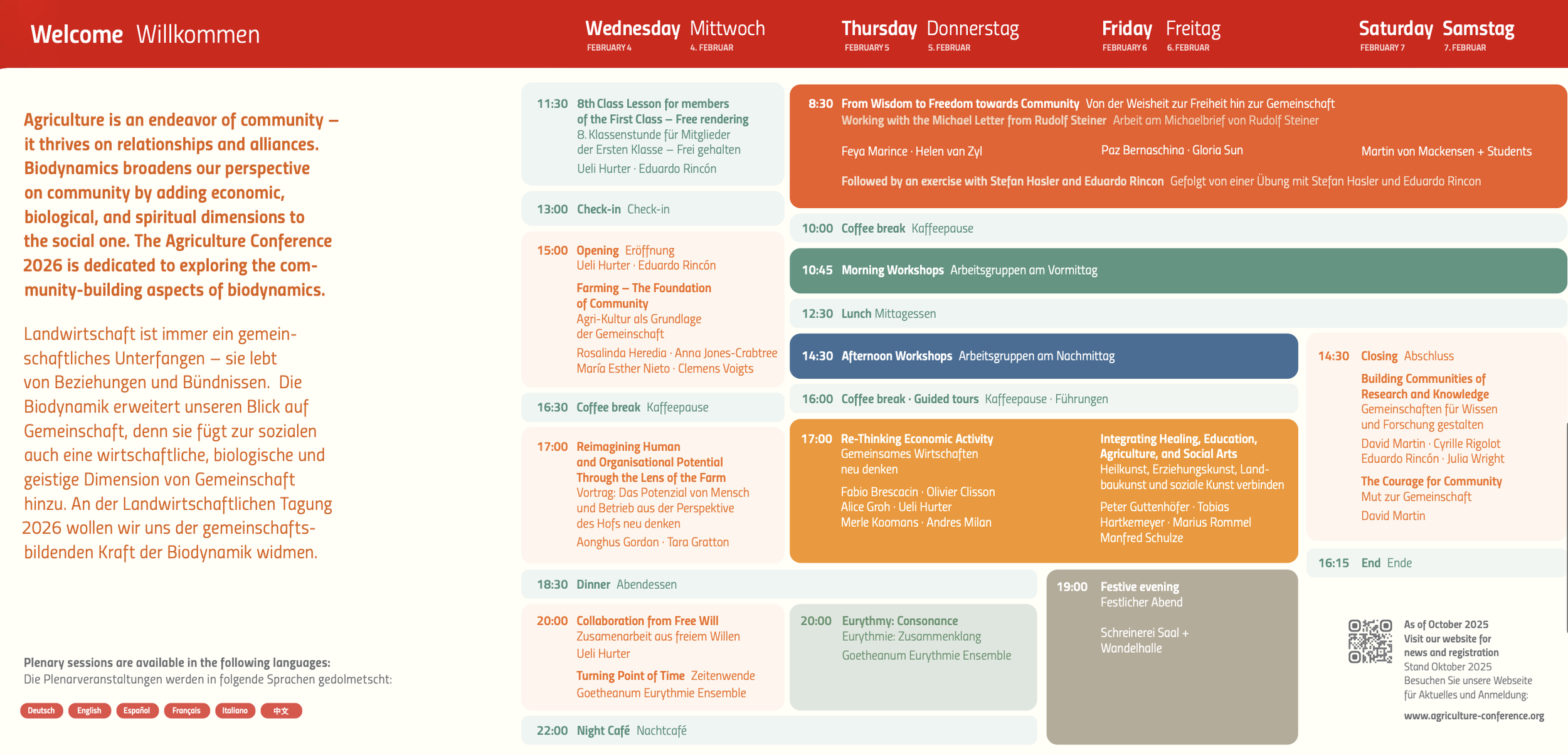
We gathered at the Goetheanum for the agriculture conference titled You Never Farm Alone, and I left feeling that what was being cultivated was not only agriculture, but relationship and a praxis of courage. Approximately 750 people came from every continent, yet the gathering felt intimate. Each morning began with Michael Letters readings, conversation, and a strengthening eurythmy practice with Stefan Hasler and Eduardo Rincon. In anthroposophic terms it felt like the “I” learning to stand inside community, without losing warmth. On one of the last evenings we all joyfully danced together in the large hall, which was such a delight.

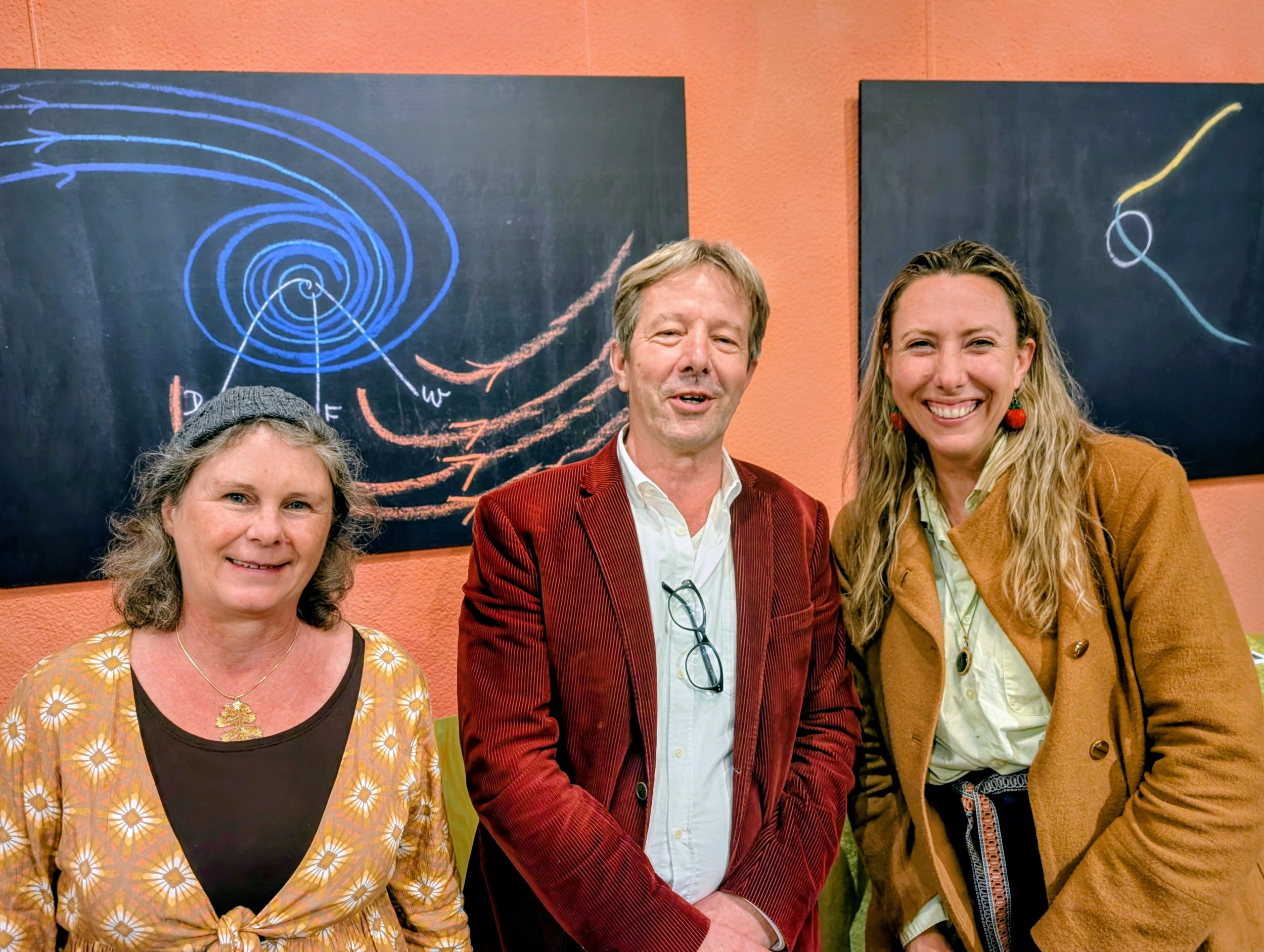
Sophia Montefiore, Ueli Hurter and Emily Samuels-Ballantyne at the Goetheanum, Switzerland, in front of Rudolf Steiner’s chalkboard drawings, an atmosphere of imagination, study, and practice. Agriculture Conference ‘You Never Farm Alone’ 2026.

I attended the Cultural Farms of the Future workshop three days in a row throughout the conference. Its question was simple, courageous, and ambitious: how can farmland become a place where living communities are formed, where healing, education, agriculture and the social arts are integrated as one cultural organism. We spoke of farms as places that can hold learning, care, research, celebration, and good work, and we returned repeatedly to economics: how might we organise farm activity so value circulates rather than extracts, so farms can host people without burning out farmers, and so the social life around the farm becomes an organ of the farm itself.

The same group who ran the Cultural Farms workshop also led a panel titled Our Work with Life: Working with Life in Agriculture, Medicine, and Pedagogy, weaving integrative medicine, education, and biodynamic agriculture into one conversation. Berni Courts (Ruskin Mill Trust) spoke of education through meaningful work. Dr Martin-Günther Sterner brought the human organism into view, linking digestion, rhythm and immunity with social environment. Tobias Hartkemeyer (CSA farm Pente) spoke of co-responsibility and associative forms that make community agriculture real. Ruben Segers and Antoinette Simonart (De Kollebloem, Belgium) offered a living example of a farm as a cultural place where production and pedagogy belong together. The thread running through the conversation was practical reverence: life can be enriched through the farm organism.

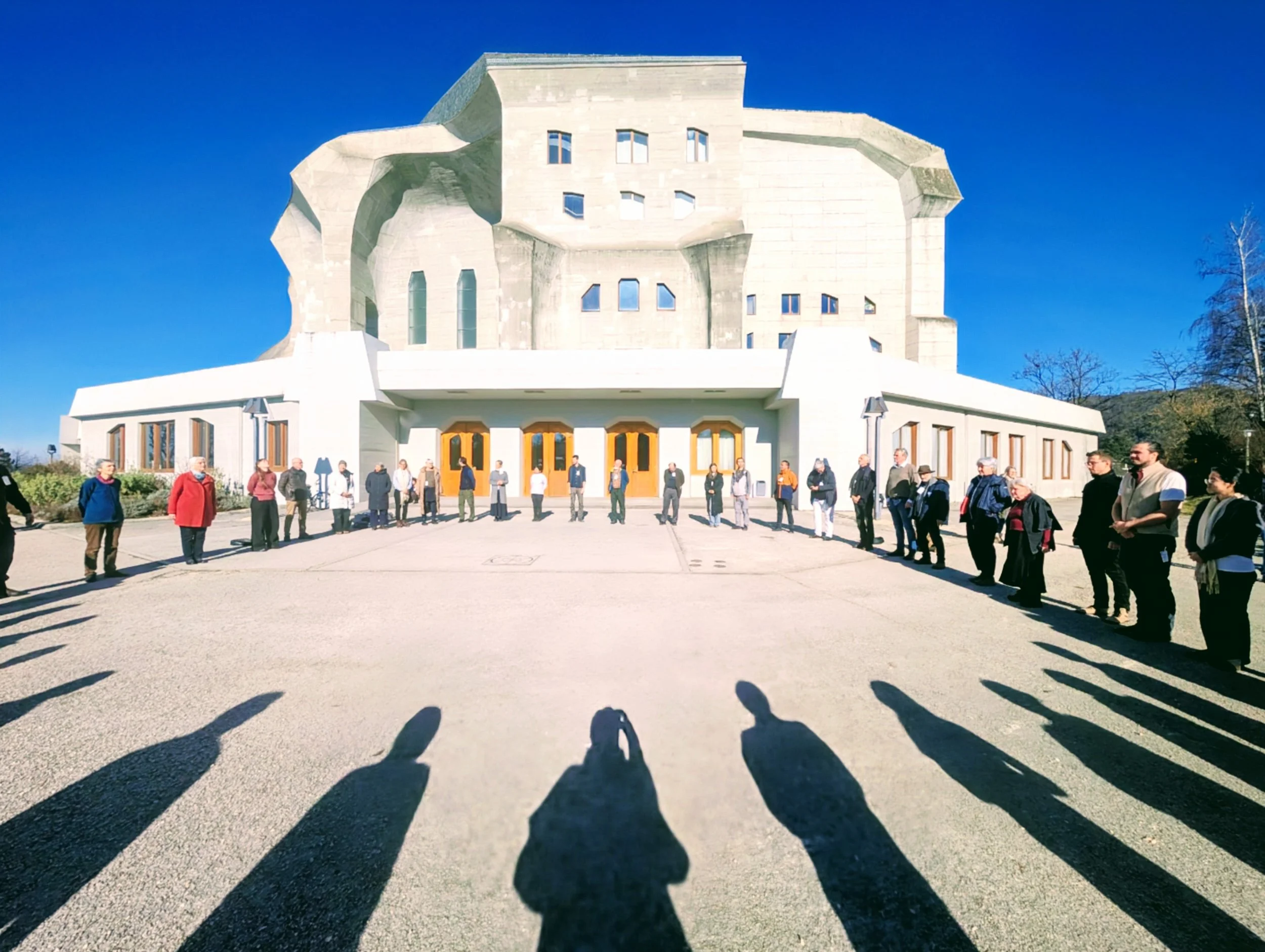
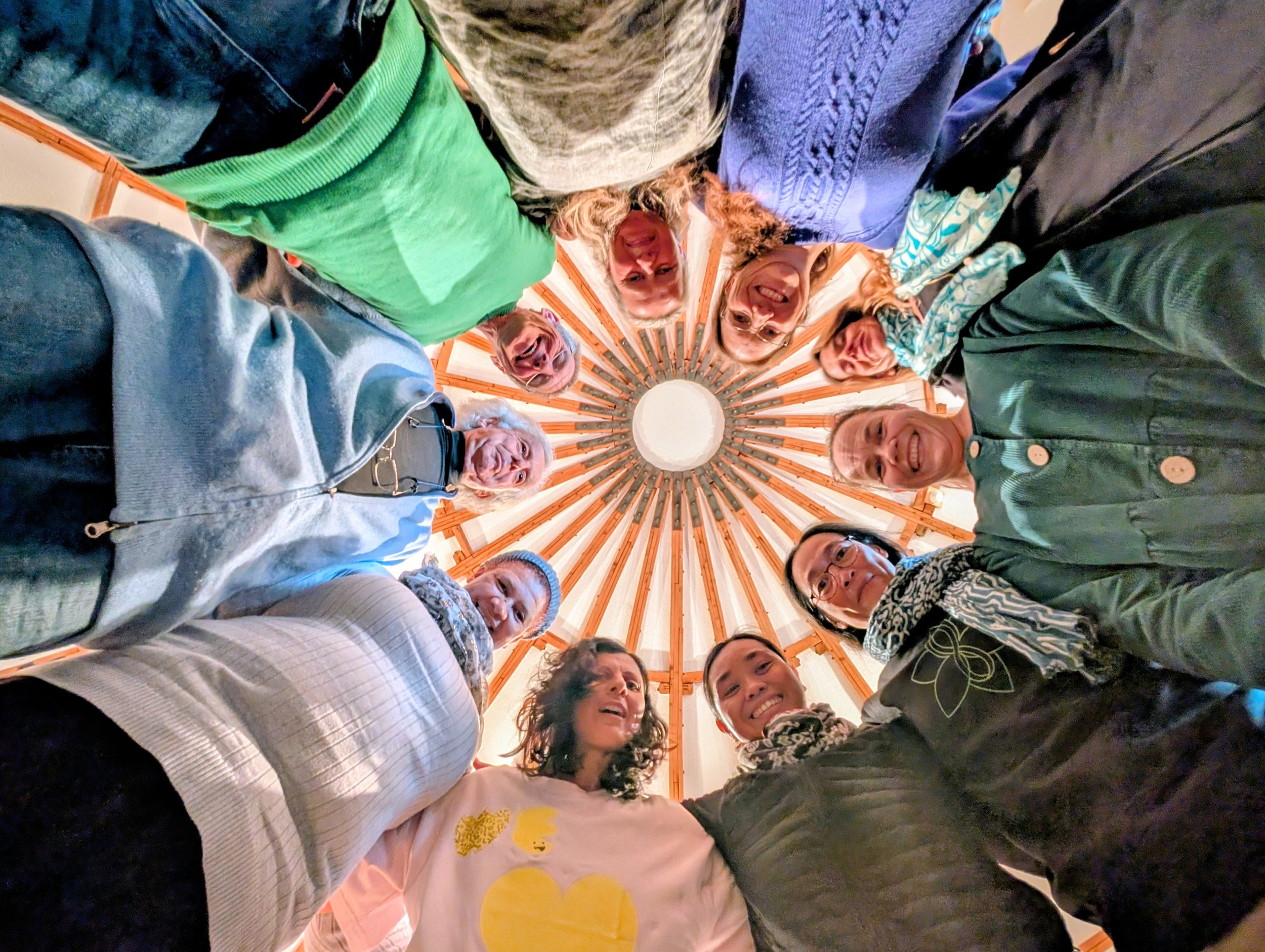
Emily Samuels-Ballantyne in a eurythmy circle as part of the Cultural Farms of the Future workshop at the Goetheanum, during the Agriculture Section conference We Don’t Farm Alone, Switzerland. Photography by Emily Samuels-Ballantyne/Dr Demeter

Ueli Hurter, in his lecture on “Free Will,” named Collaboration from Free Will as a practical social principle: not compliance, not consensus-by-fatigue, but creating the conditions for people to choose the work. Then, when the weather turns (or a moment or situation tightens), cooperation comes as a willing and shared response rather than something forced. He drew on Kepler’s music of the spheres as an imagination for lawful relationship, and the evening concluded with the Turning of Time stanza from Steiner’s Foundation Stone Meditation: a Michaelic request to meet the present with clearer thinking and warmer hearts. In essence, technique alone won’t meet the future of agriculture; what is required is a new warmth and truthfulness between people, and this takes Michaelic courage to discover.

After Ueli’s lecture I found myself in conversation with Eduardo Rincon and turning to a small, almost disarmingly simple gesture inspired by Ueli’s lecture: to make a cup of yarrow tea! I was seeking to give his talk a Keplerian imagination through this simple idea. This Keplerian imagination is a way of perceiving that seeks the lawful relationships at work within both the cosmos and the commonplace, and trusts that these relationships can be consciously participated in, somewhere tangible to rest.

If harmony is experienced as right relationship, then we require simple, repeatable gestures that tune the human being toward listening. Yarrow offers such a gesture. As a plant long associated with boundaries, mediation, and weaving, it works quietly with the organs of the body. Likewise as we know it is quite an integrator in bio-dynamics practices for the soil and the overall farm organism. In the human experience, by steeping, waiting, and drinking, one practises a different tempo, less reaction, more receptivity; less assertion, more attunement.

In the old language of correspondences, yarrow carries a Venus quality: the principle of relationship, balance, and heart-centred communication. Through such a plant, the planetary is not abstract but intimate. The cosmos is not elsewhere; it is participating. And so a simple cup of tea becomes a way of inviting lawful order, warmth, coherence, reciprocity, into the shared field of human conversation and experiences. In this way, plants are not passive background to human development, but living partners in our co-evolution, quietly shaping the conditions through which we refine perception, relationship, and consciousness.

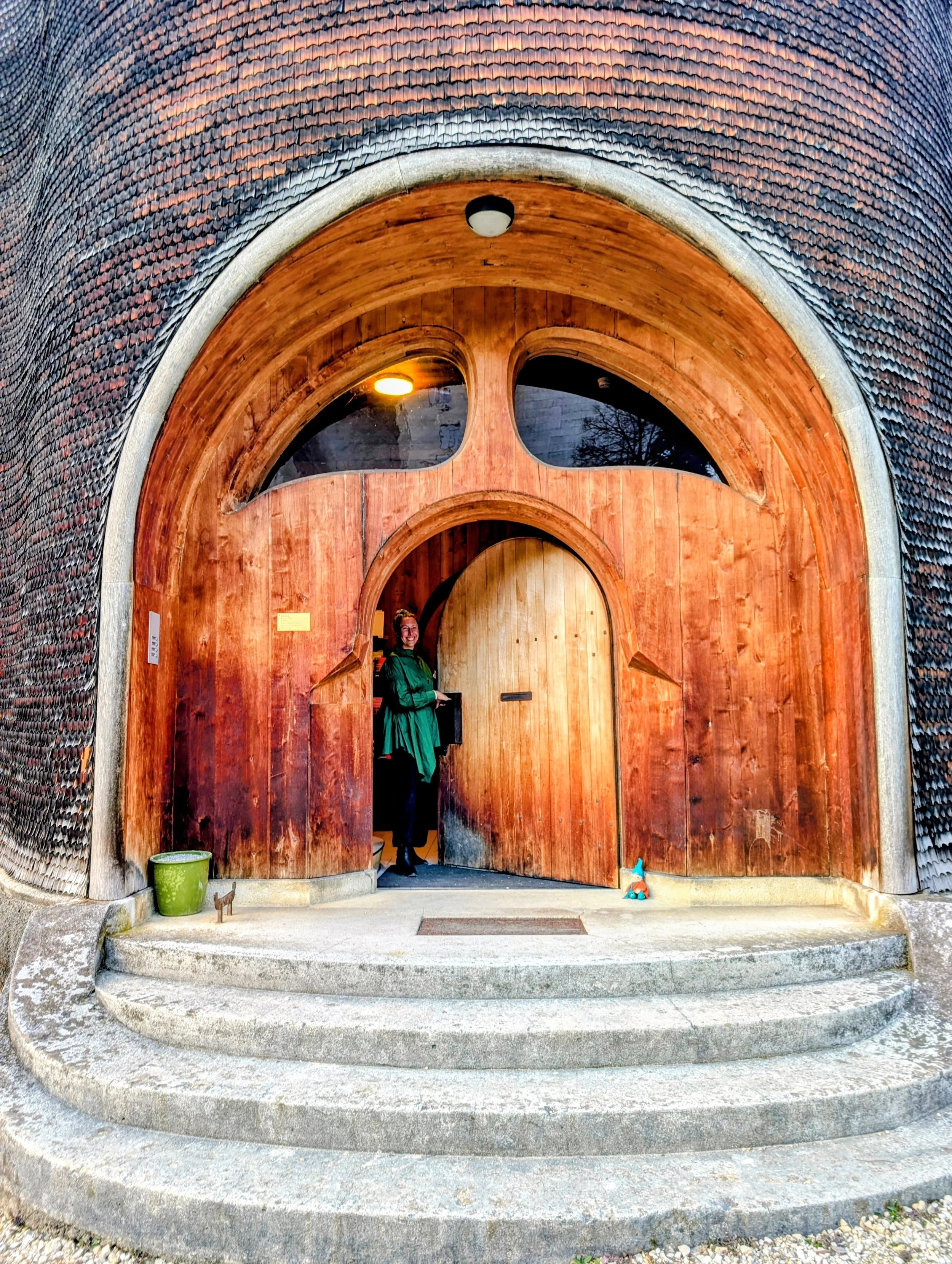
Emily Samuels-Ballantyne at the Agriculture Section front door ‘double dome’. Photography by Evelyn

Insight and reflection questions for readers in Tasmania and beyond:
Where in your region could a cultural farm take root, not as a venue, but as a living place for learning and healing?
What would it mean to design a farm gate as a civic doorway?
Which institutions could become allies, and which habits of control would need to soften into trust?
What would you change if your measure of success included soil, children, elders, microbes, and local stories?
Who are your collaborators from free will, and how will you care for those relationships when pressure rises?

Sevenfold Learning Course Participants at the Agriculture Section building, Photography by Emily Samuels-Ballantyne

Next year’s conference will focus on the biome and nutrition, and I return to our island with renewed impulse: to weave festive agriculture and convivial farming into life, so more people can access biodynamics and culture can be reinvigorated through land connection, one honest relationship at a time. May this impulse become practice in homes, councils, and markets.

With life ‘Con Viv’ and Love,

Dr Demeter

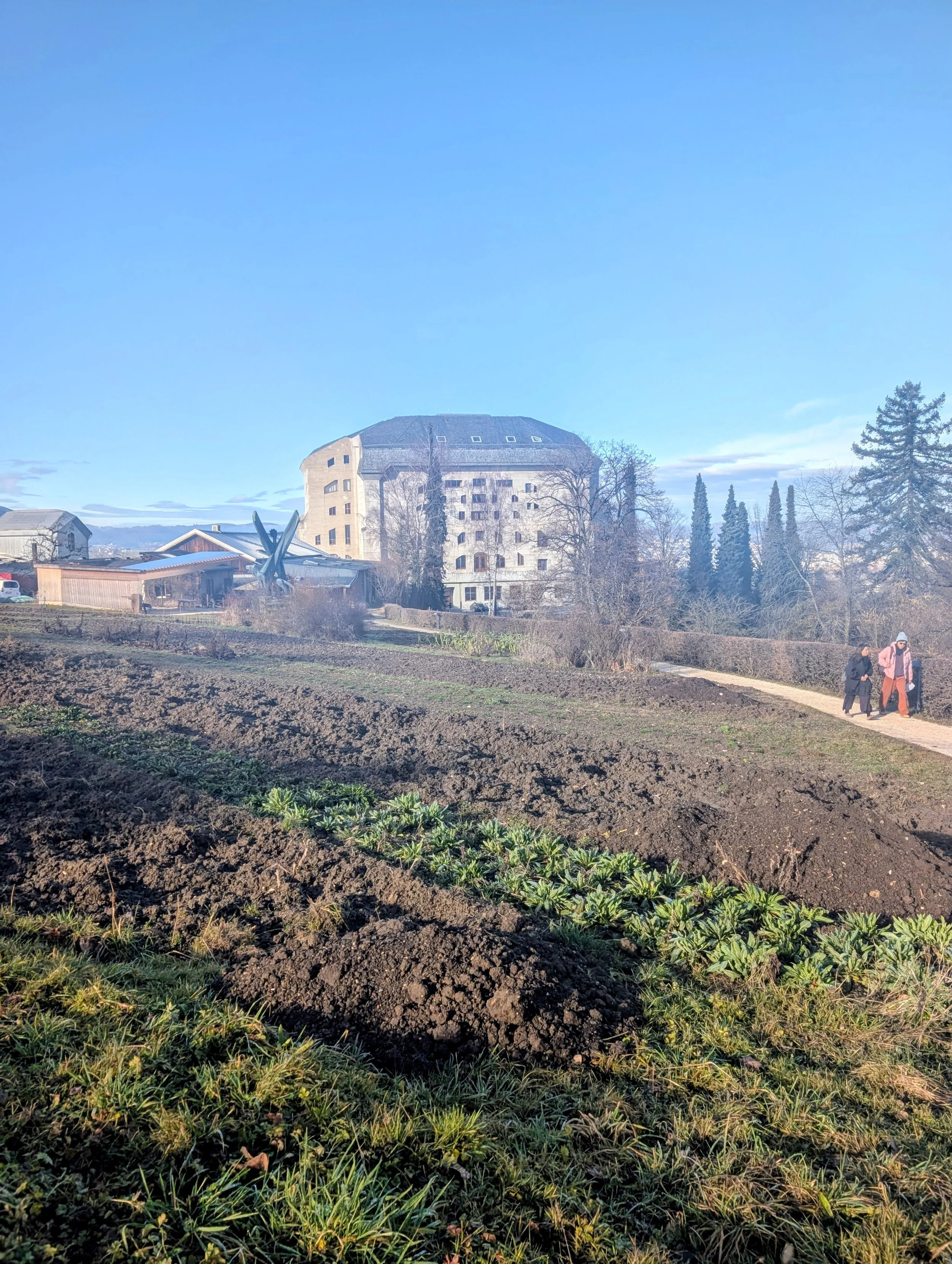
The BD Farm in the foreground, the new preparations storage building and the Goetheanum in the background. Photo: Emily Samuels-Ballantyne

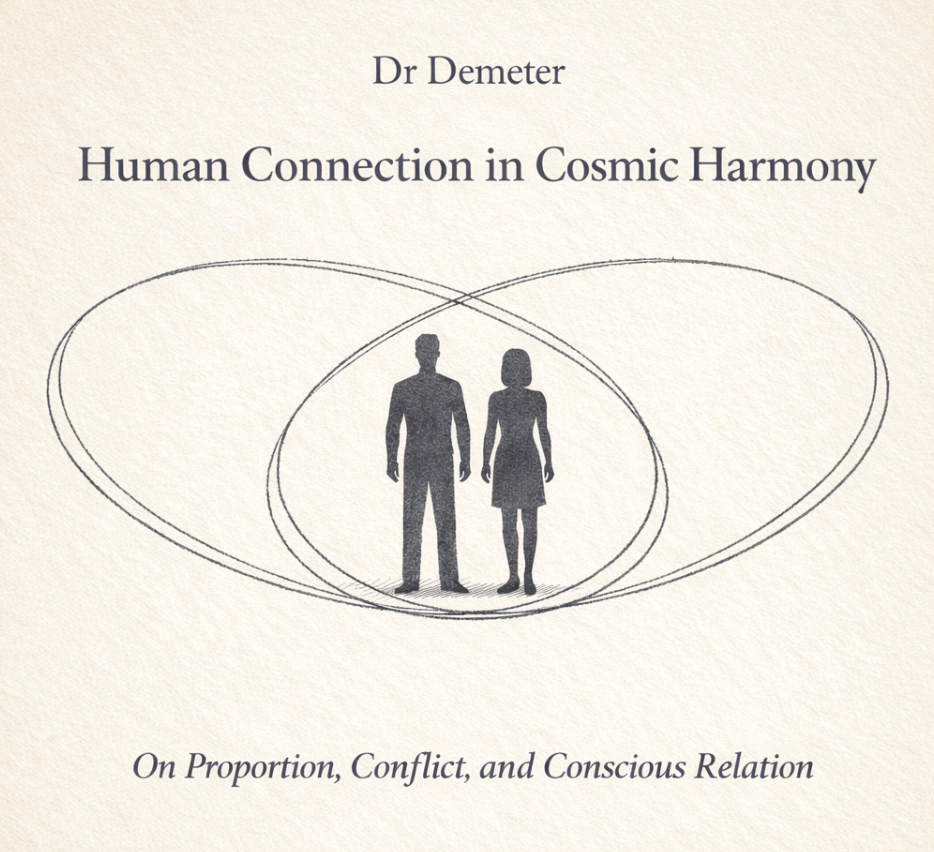
Human Connection in Cosmic Harmony: On Proportion, Conflict, and Conscious Relation

When Johannes Kepler studied the heavens, he did not discover perfection in the sentimental sense; he discovered lawful deviation, planets accelerating and decelerating in precise ratios, forming intervals that sometimes sounded harmonious and sometimes dissonant, yet always belonging to an intelligible order that could be known, measured, and trusted. This is where it is fascinating from a human-relations perspective, his scientific finding is not only about astronomy; it is about anthropology.

Human relationships are not random emotional weather systems. They are patterned exchanges of etheric rhythm and astral intensity, structured by biography, temperament, and moral development. When two people clash, it is rarely because one is evil and the other pure; more often it is because velocities differ, expectations are unspoken, and inner timing has not been brought into conscious relation. What feels like betrayal may in fact be disproportion.

To understand this spiritually is not to become passive. It requires courage. Rudolf Steiner described the Michaelic impulse as clear thinking warmed by heart strength, a sword that cuts through illusion without cutting the other human being. In community life, this means articulating what matters with precision, naming agreements, restoring boundaries where rhythm has collapsed, and refusing the temptation to dramatise difference into destiny.

If we are serious about localising food, regenerating land, and redesigning economic flow, then we must become scientists of relationship, capable of observing tone, timing, projection, and resonance as carefully as we observe soil structure or seed vitality. A community does not fail because conflict appears; it fails when conflict is misread as cosmic meaning rather than developmental tension. We need more community economies and community in life, so our challenge is here before us.

Plants live almost entirely within the etheric field of rhythm and lawful growth, responding to light, season, moisture, and soil without resistance or narrative, revealing immediately through their form when proportion is disturbed; they do not accuse the sun for burning too hot nor resent the rain for falling late, but adjust according to the conditions given, and in this quiet obedience to pattern they demonstrate that right relationship begins with structure, clarity, and consistency, not emotion. Animals, by contrast, move strongly within the astral realm of feeling and instinct, experiencing fear, attachment, territoriality, and affection with immediacy and intensity, yet without the prolonged storytelling that human beings construct around experience; an animal reacts, expresses, and returns to presence, showing us that emotion itself is not the problem, but the way consciousness clings to and amplifies it.

Humans, Plants and Animals Photography by Ness Vandeburgh

Human beings stand between these two kingdoms, carrying both etheric rhythm and astral heat, yet also possessing the self-aware “I” capable of bringing moral proportion into the field; when relationships destabilise, it is often because rhythm has collapsed like neglected soil, or astral reaction has overtaken clarity like a startled herd, and our task is neither to suppress feeling nor rigidly control structure, but to consciously weave them together so that agreements are steady and emotions are honest without becoming tyrannical. Plants teach us lawful pattern, animals teach us authentic feeling, and the human being must learn to hold both within freedom, restoring proportion not through blame, but through conscious relation.

Peace is not the absence of heat; it is heat held within law. Our task is not to eliminate friction but to bring it into proportion, so that what once felt like discord becomes, over time, part of a larger harmony we are mature enough to sustain, and it appears the farm maybe a very good place to learn about these themes?!

Con Viv ‘with life’ & Love

Dr Demeter

The Underworld Is a Supply Chain

Magical Musings by Dr Demeter

I picture Demeter walking through a supermarket at 9pm, under fluorescent lights, past strawberries in winter and bread that tastes like air. Nobody looks up. Nobody asks what it cost. Somewhere, quietly, a field goes infertile and a farmer sells up and a child grows up without knowing what season it is. In the old myth, when Persephone is taken, Demeter stops the grain and the world panics. In ours, Persephone was taken slowly: seed by seed, skill by skill, soil by soil, until we forgot she existed. And still, the body remembers. The earth remembers.

That’s why I became Dr Demeter, as a vow to re-weave the life giving food system: from underworld commodity to living soil, from abstraction to relationship.
— Dr Demeter

My PhD work, ‘Con Viv’, began with a simple unease that grew sharper the more I looked: why are we surrounded by food, yet so many people feel under-nourished, disoriented, and unwell? Why do rural regions thin out while supermarkets “boom”? Why does “efficiency” so often create fragility? The deeper I researched, the clearer it became that modern food has been redesigned as a commodity pipeline. Value moves away from place. Decision-making becomes distant. Costs are hidden in soil loss, water loss, biodiversity loss, and the quiet exhaustion of farmers and families.

But there was another layer I couldn’t ignore, the layer modern policy language struggles to hold. Food is not neutral, it carries vitality. It shapes perception, holds culture and has consequences beyond the measurable.

Biodynamics entered my life as a practical doorway into that deeper reality: the farm as an organism, compost as a living intelligence, timing as a form of listening, preparations as reverent attention rather than superstition. Biodynamics gave Con Viv a depth-organ. It brought me into a grounded living anthroposophy that starts with observation, care, and responsibility, not abstraction. It taught me that fertility isn’t an input; it is relationship made visible over time.

Demeter, in the myth, is the boundary of reciprocity. When relationship is violated, fertility withdraws. Not as punishment, but as truth. Life cannot be endlessly extracted. And if we’re honest, we can see the modern version everywhere: the underworld isn’t below us anymore, it’s in the supply chain. It’s in the way soil is treated as a substrate, seed as intellectual property, and food as a product detached from place and season.

So my work has become one body moving through many layers. Seed libraries keep diversity, memory, and sovereignty alive in the palm of a hand. Magical Farm is where theory meets weather, labour, animals, fences, and the daily reality of rebuilding fertility. Peach n Pear is the everyday convivial layer: local circulation, seasonal trust, food with a face and a place. Community garden gates, swaps, workshops, and shared meals are cultural infrastructure, the mycelium of belonging that makes local food possible. Food policy work is the deep plumbing: changing the rules so regeneration is viable, not heroic.

And now Grow Small, Feed All is the invitation made public: multiply small farms, rebuild local processing, redirect resources toward the people holding fertility, and bring nourishment back into relationship with place. Alongside this, Living Earth College is the educational hearth I’m shaping, a place to learn the literacy of living systems, to practice freedom with responsibility, and to make anthroposophy practical enough to cook with.

I write as Dr Demeter for the highest good: to keep my own vow clear, to serve Con Viv with integrity, and to help restore the conditions for life to keep giving. May we stop pretending abundance is automatic. May we remember it is a relationship. May we build food systems worthy of the earth’s generosity.

With love and life ‘con viv’

Dr Demeter

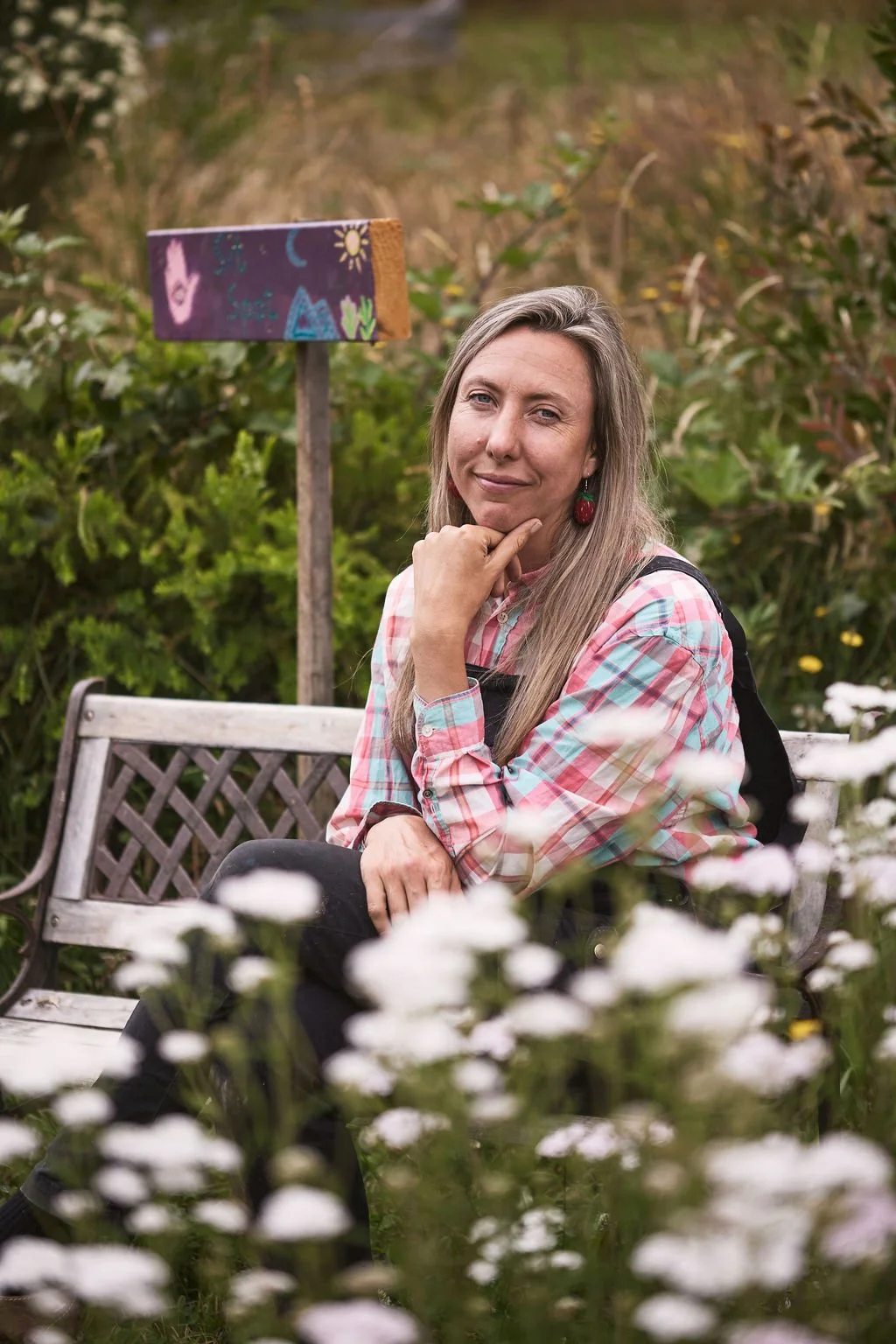
Dr Demeter Photography by Ness Vandeburgh

We Are All Designers: The Case for Life Systems Literacy

Design has long been understood as a professional discipline, practised within studios, universities and consultancies, shaping products, services, policies and environments. The design professions matter deeply. They influence how economies function, how cities are structured, how resources move.

Yet design did not begin with institutions. The first tools were designed, as too was language. Markets and governance systems were designed. The supermarket, the local market, the digital platform, each of these is a designed architecture of economic flow. These structures shape how money circulates, how food travels, how culture gathers, and how power concentrates or distributes.

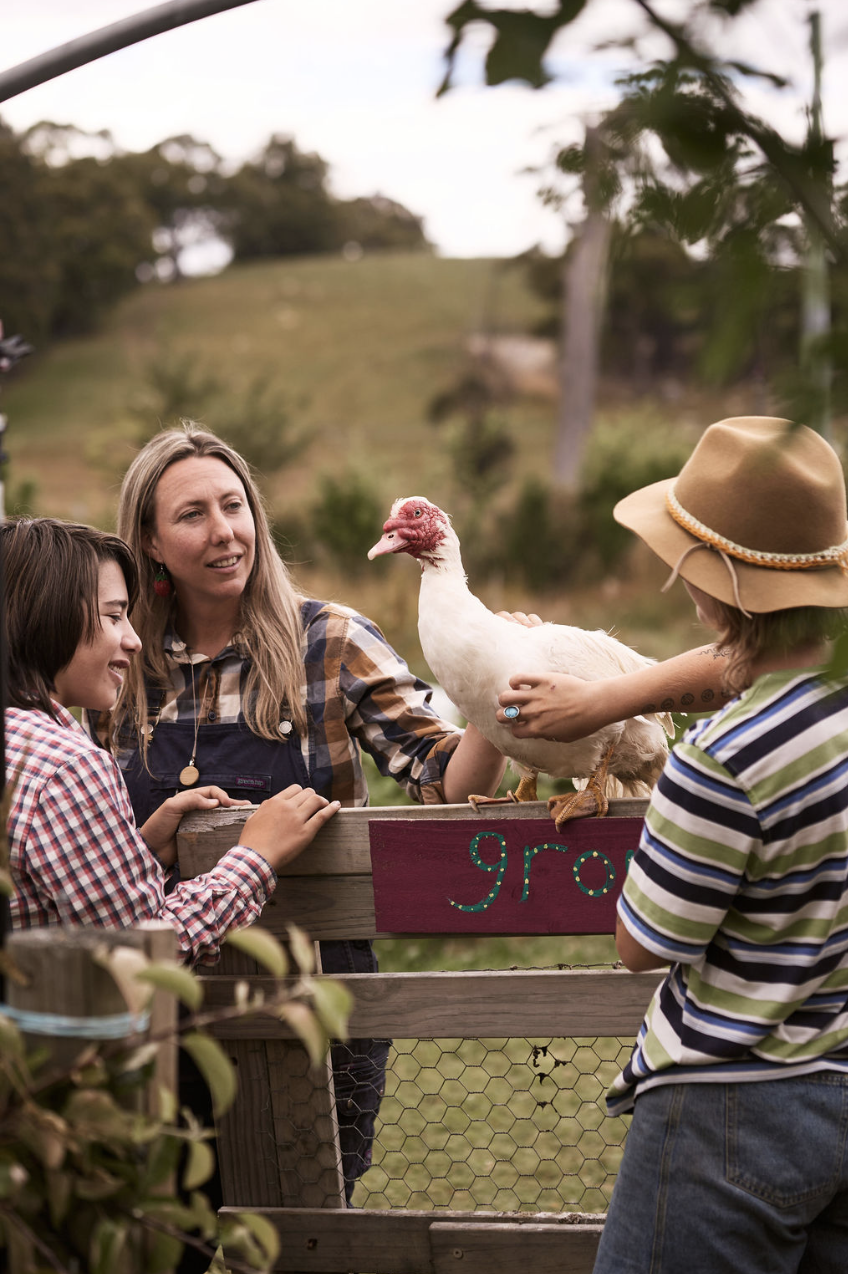
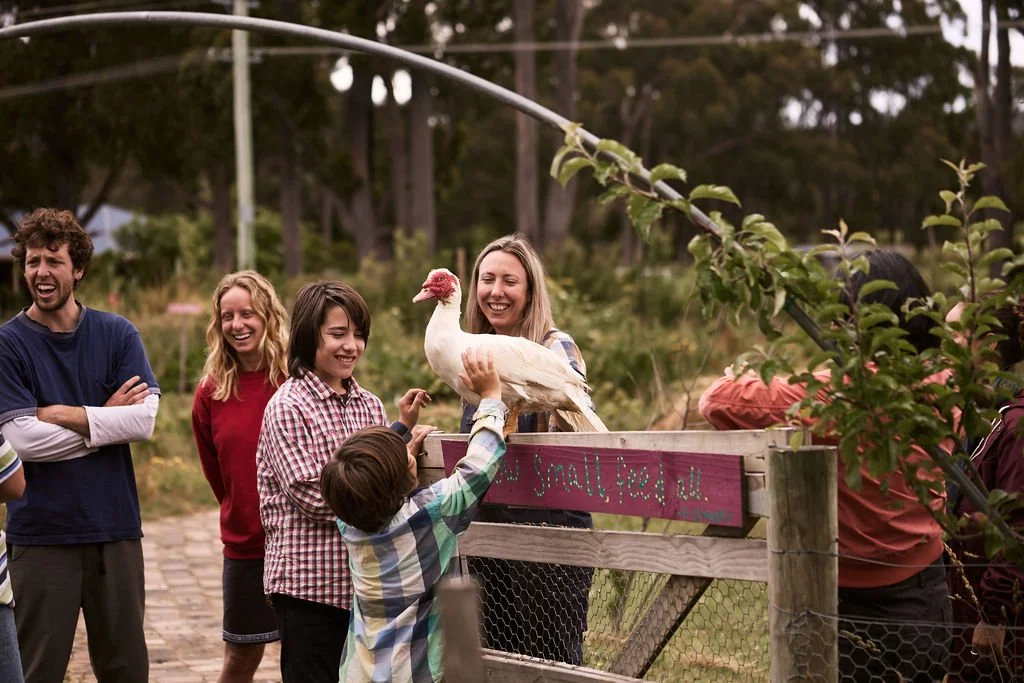
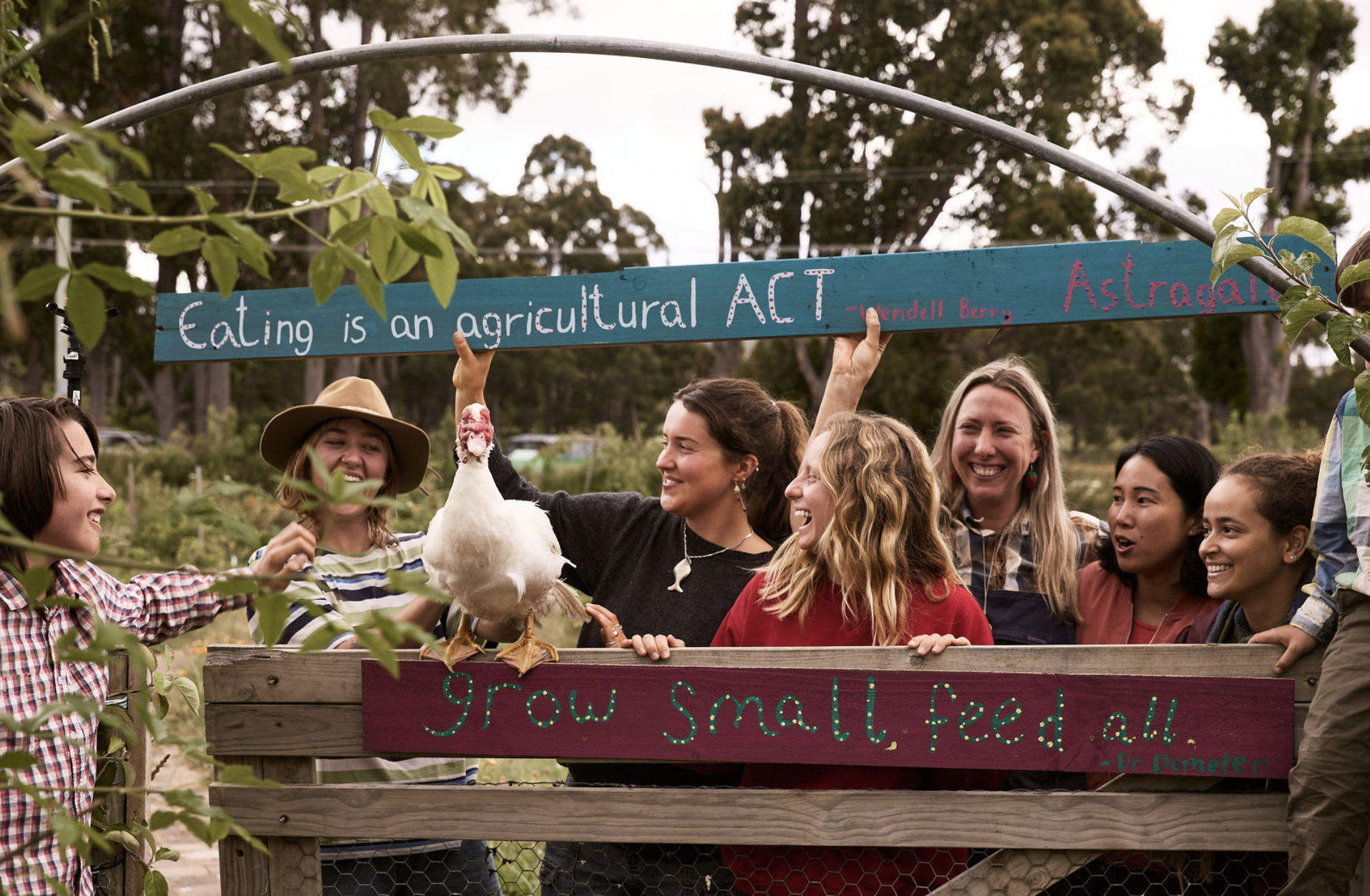
Photography by Ness Vanderburgh: Finn, Perrie, Zach, Abe, Simone the Duck, Emily, Jenny and Noam (behind the apple tree!) from Magical Farm

We are all already designers. The question is whether we understand the living systems within which we are designing.

From an anthroposophic perspective, the human being is not separate from the social and ecological organism but an organ within it. Our daily decisions, what we eat, where we purchase, how we spend, how we organise time, how we participate in civic life are a pattern of our reality. Economic flow reflects or mirrors ecological flow. When value moves through distant, centralised supply chains it is our farmland, landscapes and communities that thin. When it circulates through local markets and small farms, relationships strengthen and resilience thickens.

Food is not simply nutrition it is in fact formative. It shapes the body; the body shapes perception; perception shapes culture and design. A culture that eats together generates cohesion. A region that grows food regeneratively restores soil, biodiversity and water cycles. Healthy land produces healthy food; healthy food supports healthy bodies; healthy bodies enable clearer perception; clearer perception supports wiser design. The loop is ecological, cultural and economic at once.

Localised, biodynamic food systems are therefore not nostalgic gestures, they are perceptual and civic infrastructure. As both farmer and design theorist, I have come to articulate this through Con Viv: convivial living systems design. Con Viv does not reject professional design; it deepens it. It asks designers to consider metabolism alongside materiality, governance alongside geometry, soil alongside system and policy. It recognises that everyday citizens are co-designers of economic and ecological futures through their habits and participation.

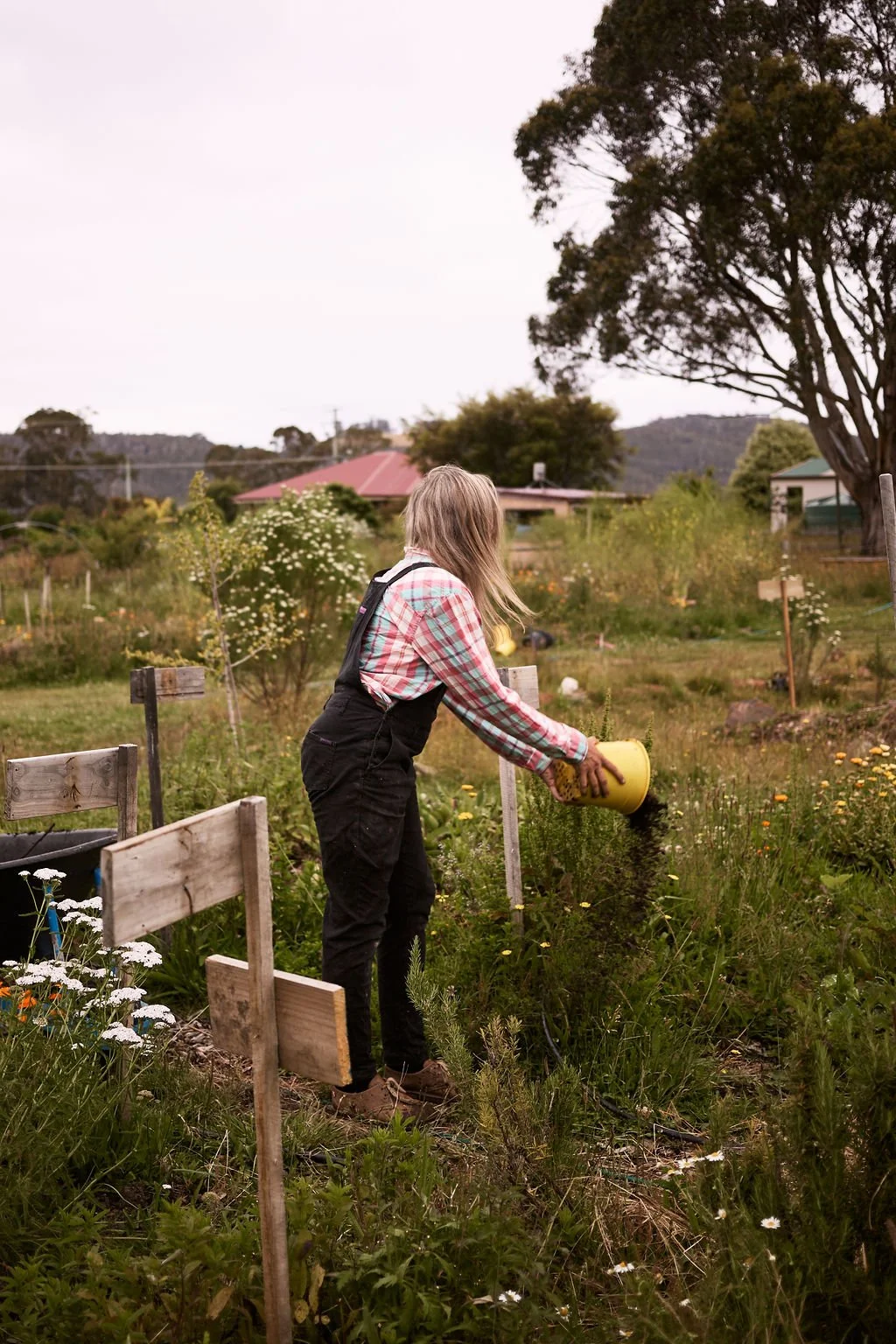
Photography by Ness Vanderburgh at Magical Farm Tasmania

Grow Small, Feed All campaign emerged as a structural application of this thinking, redirecting economic flows toward nourishment, decentralising value, strengthening localised food economies and restoring dignity to producers. It is not a campaign alone; it is a design proposition at regional scale, in Tasmania and possibly for other places too!?

Living Earth College is now emerging from this work as a translocal education platform dedicated to life systems literacy. Its premise is simple: soil processes, cooperative economics, phenomenological observation, real world place-based food projects coming to life as prototypes for sharing, co-design of policy and cultural practice must become foundational within design education, not peripheral.

The professional designer has a critical role to play. So too does the student, the policymaker, the farmer and the household. If life systems literacy were embedded across disciplines and daily life, design would shift from extraction toward participation. We are already shaping the future. As we are all designers, the invitation is to design consciously, in service of living systems.


Dr Demeter

First reflection on the 2026 Goetheanum Agriculture Conference

The 2026 Goetheanum Agriculture Conference has now closed, and I am sitting with a quiet, full heart. I will share photos and deeper reflections in time, and as Dr Demeter I have been in conversation with many extraordinary people here, farmers, researchers, doctors, philosophers, scientists, herbalists, compost makers, and quiet cultural stewards. There are stories coming. For now, this is a small field note from within the experience.

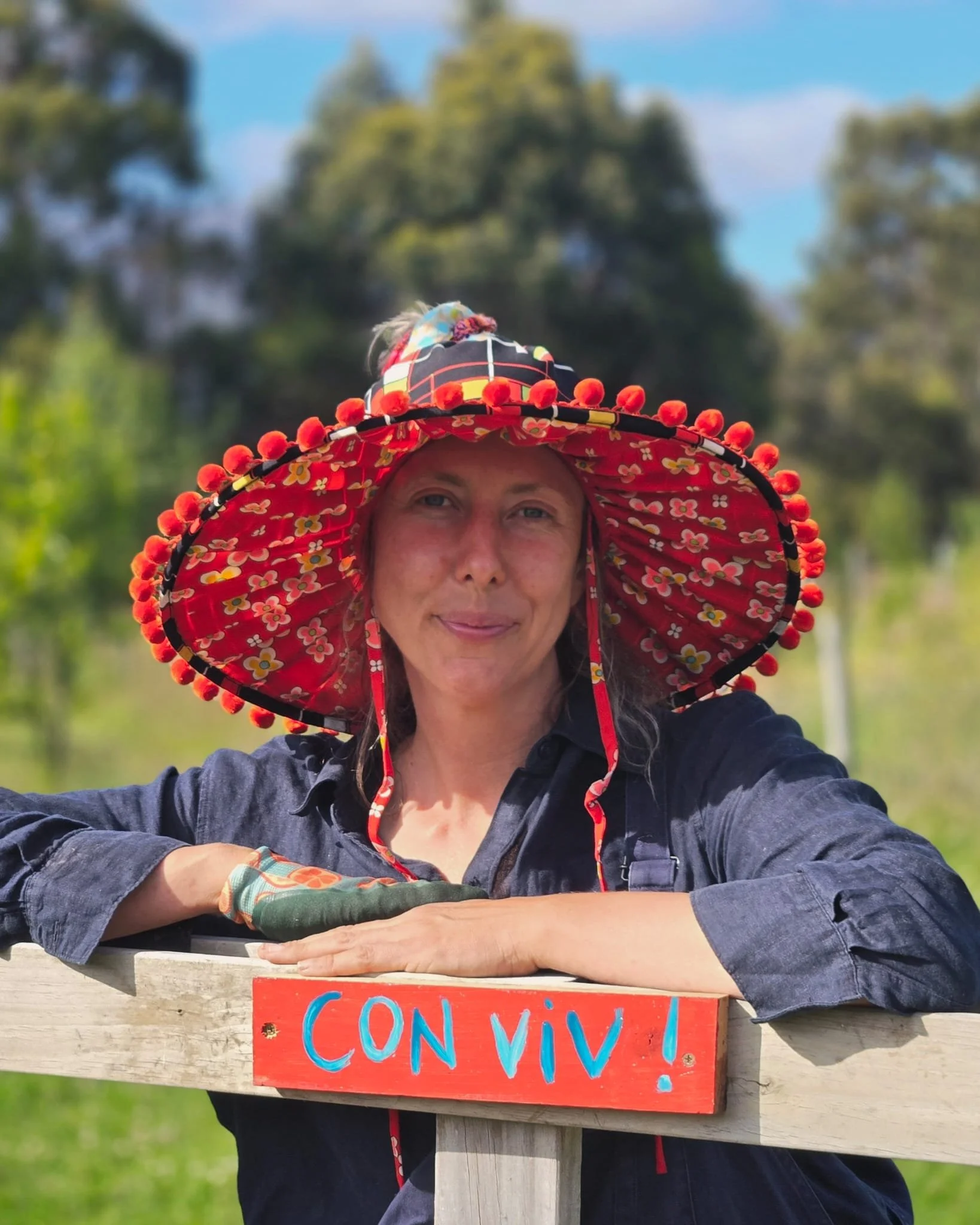
Dr Demeter / Emily Samuels-Ballantyne at Magical Farm Tasmania, just prior for departing for the 2026 Goetheanum Conference in Dornach Switzerland. Photography by Ness Vandeburgh Photography

People from forty-six countries gathered around a shared devotion: care for land, life, and the invisible relationships that make fertility possible. Across languages and climates, I felt a deep Con Viv truth alive, that food systems are not mechanical supply chains, but living cultural ecosystems shaped by soil, story, community, and cosmos.

Compost was spoken about as relationship, not waste management. Herbal preparations were described with reverence…. Yarrow, chamomile, nettle, oak bark, and valerian were held as mediators between Earth and sky. Many people here have simply followed their hearts into this work, often quietly, often without recognition, because the land asked them to.

Again and again, the conference returned to an ancient remembering: agriculture lives inside a cosmic conversation. Rudolf Steiner spoke of earthly life as inseparable from cosmic rhythms, and here that knowing felt practical, embodied, and quietly radical. I was also reminded of Johannes Kepler’s Music of the Spheres, and of Elisabeth Vreede’s work carrying forward the understanding that the heavens are not distant observers, but participants in earthly becoming.

What moved me most was presence. People were not performing knowledge. They were living it.

If there is one thread I carry forward into Con Viv practice, policy imagination, and the Grow Small, Feed All vision, it is this: the unseen world is asking to become visible again through how we farm, design, govern, and relate.

More soon…including voices from the conference, conversations across continents, and the quiet revolution already growing in soils around the world.

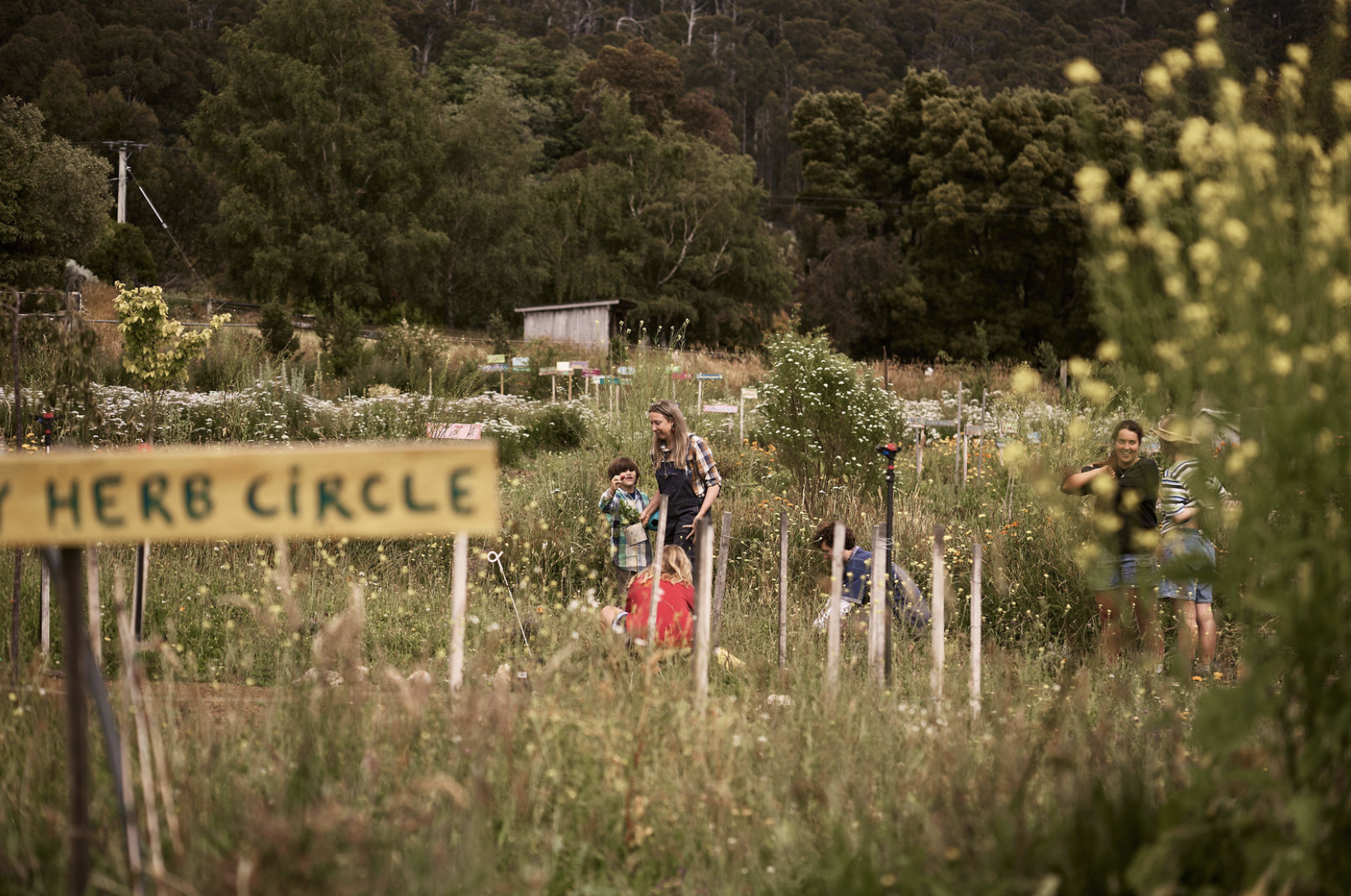
Photography by Ness Vanberburgh at Magical Farm Tasmania

Turning the Wheel from the Ground Up

There is a kind of leadership that faces outward with fire and certainty, yet forgets to turn and listen to the quiet, generative depths from which real authority arises. When power fixes its gaze only on what can be counted, traded, and controlled, it begins to sever itself from the living sources that sustain it. Decisions become fast and impressive, yet increasingly detached from consequence. The wheel keeps turning, and beneath the appearance of progress the subtle infrastructures of life such as soil fertility, trust, culture, and care, are gradually worn away. What disappears first is rarely visible on a balance sheet, yet it is precisely what makes any economy possible. When movement is oriented toward these deeper foundations, motion becomes a force of renewal.

Is this a movement about subtle but profound movement?
— Dr Demeter

Con Viv names this re-orientation. It is a simple way of seeing the living whole and acting from within it. Rather than separating economy, ecology, and culture, Con Viv understands them as one shared field of life. Leadership, in this light, is not command over parts but care for relationships of all kinds.

This is nowhere more visible than in our food systems. Policy after policy treats food as production, land as asset, seed as property, and farmers as operators in a global chain. Life is translated into price signals and logistics; yield stands in for nourishment, efficiency stands in for relationship, and the shared ground of life is enclosed by the language of markets.

Through a Con Viv lens, this is a narrowing of perception. Food is not a unit of output but a living meeting: soil, sun, water, labour, memory, and care arriving together each day on the table. When decisions recognise this interconnectedness, they shape the conditions for life to flourish. The work before us is to recover a clear perception of what food actually is, and to let policy grow from that perception.

Seen with this clarity, a farm is an organism: a living conversation between earth and sky, human intention and ecological process. Con Viv invites governance to become the art of strengthening coherence. Health arises when parts serve the whole and the whole nourishes the parts.

by Ness Vanderburgh Photography

From this vantage, the commodification of life appears as a thinning of reality. It values exchange while overlooking relationship, and ownership while overlooking stewardship. A different way opens when policy cultivates resilient, place-based food webs grounded in living landscapes and communities. This is Con Viv in practice: cultivating the conditions in which life can live well together.

This is also the spirit of Grow Small Feed All: directing support toward many small and medium farms, shortening supply loops, renewing regional processing, and rooting procurement in place. Diversity in landholders becomes diversity in crops, diets, and livelihoods, and risk is shared across a vibrant mosaic of producers. Here, economy is not extracted from place but circulates within it.

By Ness Vandeburgh Photography. Grow Small Feed All Campaign’ by Regen Era Design Studio

For me these ideas are grounded daily at Magical Farm Tasmania, where nothing thrives alone. Compost is community, pollination is partnership, water is memory moving through soil. Con Viv is not an abstract framework here but a daily practice. Policy becomes as practical as saving seed, keeping hedgerows, and opening pathways for young growers. Writing from this place is a laying of an inner foundation stone: thinking rooted in observation, feeling deepened into reverence, and willing expressed as steady, practical care - our 600 million dollar policy redirection has been seeded from these foundations.

From that ground, family, farm, and community form one field of responsibility. Decisions in the paddock echo at the kitchen table, the town meeting, and the policy page. In Con Viv terms, authority grows through relationship and coherence, not scale alone.

Gathering with others under the theme “You Never Farm Alone” gives language to this lived truth: autonomy and interdependence move together. A region stands in its own integrity while participating in a wider living exchange. Reciprocity becomes the organising principle, and isolation gives way to belonging.

Policy shaped from this foundation treats soil fertility as a public good, honours farmers as cultural practitioners, circulates finance locally, and measures success in biodiversity, nutrition, and belonging. These are not alternative indicators but truer ones, aligned with how living systems actually persist.

From the garden this is entirely practical. Con Viv looks like wind breaks planted for future generations, small abattoirs and mills that keep value near the land, farmer-to-farmer learning as a form of cultural renewal, school and hospital procurement that feeds regional growers, seed diversity protected as shared heritage, and regeneration rewarded as essential work.

By Ness Vandeburgh Photography.

When clarity and courage meet the everyday labour of soil and seed, food becomes nourishment, land becomes place, and policy becomes care made visible. Con Viv offers a simple compass for this complexity: strengthen the relationships that make life possible.

The wheel continues to turn, but now in conscious service of life, with movement guided not by extraction but by belonging.

With Love and Con Viv!
Dr Demeter

From Garden to Governance: Practical Wisdom for a Living Food System

To work with the Foundational Stone Meditation given by Rudolf Steiner is to experience thinking, feeling, and willing as living organs rather than abstract faculties. On the farm this is not philosophy but practice: thought becomes observation of soil and season, feeling becomes reverence for the beings who share the fields, and will becomes the steady hands that plant, mend, harvest, and feed.

by Ness Vandeburgh Photography

The meditation speaks of grounding spirit into the depths of the human heart so that action can rise again in freedom. Each morning in the garden I sense this descent and ascent as breath: compost returning matter to darkness, seedlings lifting green toward light. My family life follows the same rhythm. Care moves downward into listening, patience, and nourishment, then upward into guidance, decision, and protection.

Policy, too, must be laid like a stone in this inner foundation. When laws grow only from calculation, they hover above life and soon drift away from consequence. When they are set into the shared ground of place, work, and relationship, they hold. Writing from the farm teaches me that governance begins with attention: to animals who show when pasture is ready, to neighbours who reveal what community needs, to children who ask what kind of future we are making.

The meditation’s threefold gesture invites me to weave inner clarity, outer responsibility, and communal purpose. In human relationships this means meeting others not as roles but as souls in development. In relation to animals it means partnership rather than use, recognising their presence as part of the farm’s consciousness. In community it means shaping agreements that circulate vitality instead of extracting it.

by Ness Vandeburgh Photography

To carry this stone in the heart is to design from below, from roots and relationships, rather than from distant abstraction. Life, work, and policy then arise from the same source: a quiet centre where thinking is warmed by love and strengthened by courage, and where every decision is asked to serve the wholeness that holds us all in living reciprocity together.

Con Viv and With love,

Dr Demeter

Open and Woven: Reweaving Local Life for a Living Future

Dr Emily Samuels Ballantyne / Dr Demeter | Regen Era Design Studio

When Ezio Manzini proposed SLOC, Small, Local, Open and Connected, he was not inventing a new idea so much as naming a quiet pattern of resilience that already lives in healthy human places, villages and neighbourhoods and valleys and islands that are coherent enough to know themselves, yet porous enough to learn, and the brilliance of the frame is that it refuses the false choice between retreat and globalisation, between a closed localism and a corporate world, and instead points toward a living middle way where communities remain human scale and land attuned while staying in relationship with wider worlds.

I have returned to SLOC repeatedly since my collaborations with the Politecnico di Milano from 2010, because it offers a design language that can hold soil and society at once, and because its ethical demand is simple and difficult, to be rooted without becoming rigid, and open without becoming hollow, and this is also the lineage in which I have been shaped by Professor Anna Meroni’s Creative Communities research, which has long insisted that everyday life is not a private afterthought but a design field, a civic art, a shared practice of making ways of living that are more mutual, more grounded, and more capable of care, and that what looks like “small” initiatives are often the seed forms of systemic transition when they are recognised, supported, and allowed to connect.

Small, in the SLOC sense, is not scarcity, it is intimacy and accountability, the scale at which we can recognise each other, repair conflict, and hold shared agreements without outsourcing everything to bureaucracy, and local is not a brand but an ecological relationship, a lived belonging inside the specific conditions that shape life, wind and water and soil and season, economy and culture, so that nourishment, skills and value circulate through the community rather than leaking away, and open is the quality that keeps small and local from hardening into brittle identity, because openness is not vagueness or a lack of boundaries, it is the capacity to receive new knowledge, new practices, new people and new perspectives without panic.

Connected, in Manzini’s deeper sense, is not constant communication, it is real pathways of exchange, learning and reciprocity, the ability for a village, a valley, or an island to be in living conversation with the wider world, sharing what works, borrowing wisely, cross pollinating, and building solidarity across distance, so that local life is strengthened by feedback loops rather than isolated by pride, and so that we participate in a wider fabric without being swallowed by it, and this is where I once rewrote SLOC as SLOW, shifting connected to woven, not to reject Manzini’s intent, but to restore depth to a word flattened by the technological era, because woven speaks to older intelligences of textiles and baskets, mycelium and kinship, the way distinct strands become stronger together, and because the future we need is not merely connected, it is interlaced.

This is not only a design argument, it is a heart opening effort, because the places we love survive not by being perfect, but by being held, by being able to receive and respond, by composting what is no longer life giving, and by taking nourishment from elsewhere without losing the integrity of place, and in that sense the work of “life design” is not separate from spirit, it is spirit made practical, a commitment to build forms of living that can carry the soul rather than erode it.

From Australia, and especially from Tasmania, I can see how strong we are at the markers of small and local, the corner pub, the volunteer fire brigade, the neighbourhood oval, the weekend market, the competence of showing up during fire and flood, and yet we do not always have the thick daily fabric of a village culture where life is integrated through food, ritual, craft, and intergenerational continuity, where people meet each other at the same stalls week after week, where the local market is not an event but a heartbeat, and where a grandmother’s pasta is not a hobby but a lineage, a living transmission of skill, land, time, and care.

Australia is young as a settler culture and many communal traditions are thin, and into that thinness large corporate systems step easily, especially supermarket systems that shape daily habits so quietly we barely notice until we realise that food has become a major disconnection, because many households do not have access to truly local products in any reliable way, growers struggle to compete with centralised distribution, people are busy and tired, gardens are framed as extra work rather than nourishment, and our economic connection to the larger scale intensifies while our relationship with land thins, and this is not a moral critique of individuals, it is a cultural and economic diagnosis, because when food is abstracted the body forgets seasonality, the imagination forgets taste of place, and community forgets the social life that happens when nourishment is exchanged face to face.

This is why, for me, the lineage of Ivan Illich matters alongside Manzini and Meroni, because Illich’s conviviality was never a lifestyle aesthetic, it was a critique of industrial systems that disempower people from shaping their own lives, and it was a call to rebuild tools, institutions, and social arrangements that return agency to communities, and it seeded much of the design discourse that later became legible as Creative Communities, social innovation, and everyday life as a site of cultural production, and the deeper question beneath all of it is simple, do our systems increase the capacity of people to live well together, or do they outsource life to machines and markets until relationship becomes thin.

Tasmania intensifies both the gift and the risk of this pattern, because it is a place where small farms still exist and permaculture lineage is lived, and yet remoteness can harden into defensiveness, and permaculture can be framed as a private alternative rather than a public foundation, and policy can be viewed as either absurdly disconnected from land or inherently corrupted and therefore not worth engaging, and both attitudes leave the same vacuum in which centralised systems and corporate incentives dominate the conditions of everyday life while local practice remains fragile, underfunded, and easily dismissed as charming.

The invitation here is to take SLOC beyond lifestyle and into civic architecture, into what I call Con Viv, a living-systems design approach that centres living-with rather than extracting-from, that treats culture as compost and policy as mycelium, that seeks to design social and economic pathways which behave more like ecosystems than machines, and this is where social permaculture becomes essential, because it reminds us that culture is not merely what we believe, it is what we practise, the invisible structures of decision making, communication, trust and repair, and those structures can be tended, renewed, and redesigned, just like soil.

This is also why I am working on Grow Small Feed All, an attempt to translate this life design intelligence into policy, to build pathways that support micro farms and neighbourhood food networks at scale without destroying their nature, because distributed systems are more resilient than centralised systems, and micro farms, when supported, are not marginal, they are foundational infrastructure for food sovereignty, public health, biodiversity and community cohesion, and finance is central here, because micro banking and revolving funds can become a nutrient cycle for local economies, circulating capital through enterprises that steward land and community, so that the economy behaves more like compost than like a pipeline, enabling emergence rather than extraction.

And yet openness must be held with equity, because gentrification is what happens when the local is commodified and the people who carry local knowledge are priced out, and cosmopolitanism becomes harmful when it is taste without responsibility, mobility without reciprocity, and so the task is not only to be open and woven, but to be open and woven in a way that deepens dignity and shared benefit, because without equity the weave becomes a net that traps rather than a fabric that holds.

Behind all of this, I carry a quiet anthroposophic orientation, not as a label but as an atmosphere, a sense that society is a living organism and that human life requires rhythms, nourishment, and moral imagination, a sense that freedom, equality, and fraternity must be held together if we want a healthy social body, and a sense that the future is not only technical but spiritual in the most grounded sense, it asks whether we can design ways of living that honour life.

So I offer a question for Tasmania, for Australia, and for the broader European design and art community I am returning to now, what would it look like if we treated everyday life as a design field worthy of our best thinking, and if we embraced SLOC and SLOW not only as cultural patterns, but as civic, economic, ecological and spiritual orientations, building villages of villages, plural worlds in relationship, grounded enough to care, porous enough to learn, and committed enough to equity so the future can be born through us as a lived culture of small, local, open, woven life.

I am on my way to Europe with this question in my pocket and soil on my hands, and in the spirit of creative communities and convivial tools and living systems, I offer it not as a conclusion but as an invitation, because the real work begins where design becomes life, where the village becomes a practice, and where the weave becomes strong enough to hold us all.
Con Viv - Movement Into the Year

Con Viv Musing from Dr Demeter

Dr Demeter. / Emily at Magical Farm Tasmania - Con Viv

Today the light touched me different,
as if the farm hummed a note
A soft uprising in my chest,
a warm pulse in the soil,
is this a movement about movement?

Sun on my skin, my body remembering its own rhythm.
This is the doorway.
This is the shift.
This is the year that life is Con Viv, not as story but With

I can feel a special place like a melody approaching,
a song rising from old stone villages,
from mountains that have held stories, longer than language.
A widening path.
A deepening breath.
A call that feels like returning and becoming at the same time.

The year ahead isn’t asking for effort,
Only presence.
Only honesty.
Only the courage to let beauty do its quiet work inside me.

Something is moving now.
Something warm, coherent, alive.
It gathers the past and blesses the future, and opens the centre of me like a prayer that finally found its voice.

Con Viv, the soul-song with can hold with us of living-with,
Loving-with,
Becoming-with.

I am moved by it,

and it is moved by me.

Valerian & Saturn: A Harvest Muse with Brian Keats

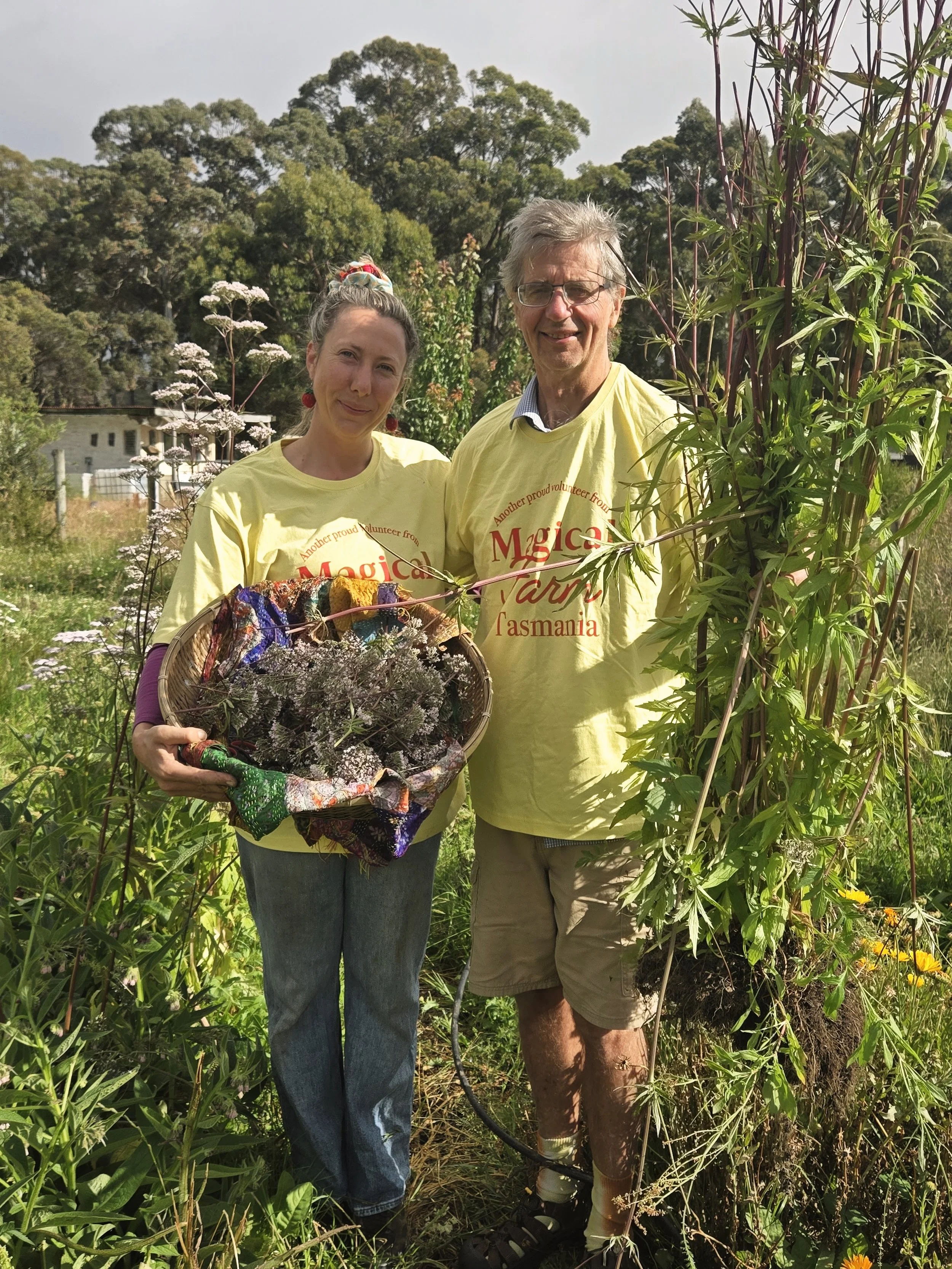
by Dr Demeter / Emily Samuels-Ballantyne, Magical Farm Tasmania

Yesterday I harvested Valerian with Brian Keats, the visionary behind the Astro Calendar and one of the clearest readers of the biodynamic cosmos I have ever met. Working beside him, I was reminded that biodynamics is not just a farming method, it is a way of perceiving the world as an alive, coherent conversation between earth and sky. Con Viv! Brian spoke of Saturn, the planet biodynamics associates with valerian.


Many imagine Saturn as cold, distant, restrictive, the furthest classical planet, ringed and remote. But in the biodynamic understanding, Saturn carries a very different gesture. It brings warmth, concentration, inwardness, and the subtle fire that protects and holds form together. Saturn is the elder planet, the guardian of boundaries, the one who gathers scattered forces and weaves them into coherence.

Brian Keats and Dr Demeter / Emily samuels-ballantyne

Valerian meets Saturn in that gesture.

The plant is a study in inwardness and warmth:
its root plunging into the quiet dark,
its hollow stems carrying sweetness,
its soft mauve flowers lifting delicately into dusk light.
There is a descending and an ascending, a compactness and a fragrance: an alchemy of Earth and cosmos.

Brian reminded me that valerian is not harvested in parts.
You take the whole plant, leaves, stems, blossoms, and the deep-rooted essence that carries its warming, Saturnian signature.
In biodynamics, the wholeness matters. You work with the full gesture of the being, not the fragment. Only then can the planetary forced the far Saturn warmth, speak clearly into the preparation.

As we lifted the whole plant from the soil, I felt a subtle shift in my own body. Something in me quietened, gathered, warmed. Saturn’s gesture is not harsh; it is precise. It asks us to come into form. To know where we stand. To settle into right proportion and inward strength.

Valerian’s scent rose softly from the basket, sweet, nocturnal, strangely reassuring, as though each part of the plant remembered a different layer of sky:
the root recalling winter starlight,
the flower holding summer dusk,
and Saturn binding them in a single, warming breath.

In tending this plant under Brian’s guidance, I felt my own edges come home.
A sense that the compost, the soil, the human nervous system, and the cosmos all share the same need:
warmth that begins in darkness,
form that arises from inwardness,
and alchemy that only unfolds when the whole being is honoured.

This is the quiet gift of valerian.
This is the Saturn rhythm in biodynamics.
This is the teaching I carry back into Magical Farm Tasmania.

Poem: Valerian, Saturn’s Root

Valerian, warm root of the farthest ring,
Saturn’s hush in the garden bed.
You gather time into a single breath
and soften the hard edges of night.
Whole plant, whole star, whole song,
teach my body the warmth
that begins in darkness.

#conviv