Festive Agriculture: A Living Bridge Between Cosmos, Community, and Cultivation

By Dr Demeter | Emily Samuels-Ballantyne

At the Agricultural Section gathering of the Spiritual Science Community of Australia in May 2025, a shared sense of joy and purpose emerged as participants explored a new-old concept: Festive Agriculture with presenters from Bio-dynamics Tasmania Julia Yelton, Kirsten Robinson and myself. Rooted in Biodynamic principles and enriched by global traditions and cosmic wisdom, this term resonated deeply with the conference participants, sparking stories, laughter, memories of intergenerational farming, and visions for a more connected future through sacred agriculture.

In our presentation, we introduced the ABC of Festive Agriculture: Anthroposophy as the spiritual foundation, Biodynamics as the living method, and Community as the heart of celebration and connection. Together, these three elements weave a holistic approach to farming that honours the cosmic, the earthly, and the social as one living whole.

The phrase Festive Agriculture offered something unexpected: accessibility. One participant joked, “I finally have a way to tell my mates what I do “Festive Agriculture” and they’ll get it. That comment echoed throughout the room, highlighting a central theme of our workshop: while Steiner’s Biodynamic agriculture holds profound spiritual and cosmological wisdom, the language around it often remains opaque or misunderstood in wider circles. Festive Agriculture may be one way to gently bridge this gap?

What Is Festive Agriculture?

Festive Agriculture, as presented in our paper, is not a method or a system, but a living relationship with the land. It is the weaving together of cosmic rhythms, seasonal cycles, and community life into an integrated whole. It calls in both ancient and the emergent, in many ways unseen worlds in our materialistic times. Drawing on Biodynamic practices, First Nations sky knowledge, and traditional harvest celebrations around the world.

It is not just about growing food, rather it is about celebrating life, honouring the land, ancestors, and future generations. It invites us into rituals and festivals that acknowledge both the practical and the sacred. In Biodynamic farming, this includes planting by moon phases and observing planetary influences. In other traditions, it might involve singing to seeds, feasting with neighbours, or offering thanks to the spirits of place.

Workshop Reflections: Intergenerational Threads

During the workshop, participants shared stories of how Festive Agriculture awakened memories of intergenerational knowledge-sharing, farm life with grandparents, and rural customs nearly forgotten. Several spoke of the need to rekindle these threads, passing down more than just skills, but also the cultural and spiritual sensibility that once animated farming life.
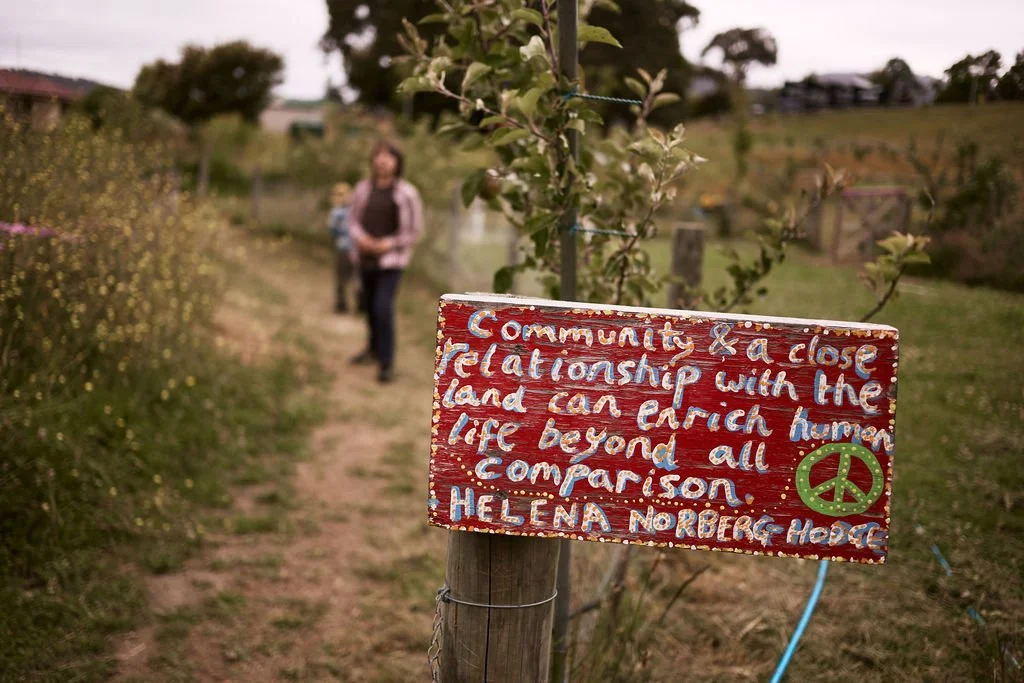
Photography by Ness Vandeburgh Photography

Others reflected on the changing nature of rural life: how industrialisation, individualism, and bureaucratic systems have fractured communal farming traditions. Yet, through seasonal gatherings, Biodynamic convivial farms, and local festivals, there are new opportunities to reconnect. The practice of Festive Agriculture, we agreed, could be a powerful way to reinvigorate land sharing, communal celebration, and learning across generations.

Bridging Biodynamics and Broader Culture

For many in the Biodynamic movement, there is a long-standing wish to make this work more visible and accessible without diluting its depth. We heard from participants who feel torn. On one hand they are deeply committed to the spiritual foundations of Biodynamics, yet unsure how to speak about it outside their own communities. Festive Agriculture may offer a gentle entry point, a way to name the joy, the relationships, and the cosmic consciousness embedded in these practices?

This is not about rebranding Biodynamics, but about opening new pathways for engagement, especially with younger generations, artists, educators, and those interested in food, culture, and ecology. If we can frame farming as both practical and festive, grounded and celebratory, it becomes a more inviting field of belonging.

The Role of Festivals and Ritual in Land Care

In our paper, we explored agricultural festivals from Japan to the Andes, from Indigenous Australian calendars to the European solstice rituals practiced on Biodynamic farms. Despite vast differences, these traditions share key themes: cosmic alignment, sacred reciprocity, seasonal awareness, and community celebration.Festive Agriculture takes inspiration from these examples. It honours planting and harvesting not just as labour, but as opportunities for joy, storytelling, feasting, and song. In doing so, it rekindles the human side of land care, not just as a responsibility, but as a form of belonging and shared purpose.

Events like the Cygnet Crop Swap, Bio-Dynamics Tasmania field days or the seasonal festivals and workshops at Magical Farm Tasmania demonstrate that even in our modern world, agricultural festivals still hold a place. They offer space to exchange food and knowledge, and to remember that food is not a commodity, it’s a relationship.

A Call to Celebration

In closing, Festive Agriculture is both an ancient memory and a future possibility. It offers a way to bring Steiner’s vision of the farm as a living organism into dialogue with wider cultural movements for ecological renewal, food sovereignty, and spiritual reconnection. What we plant in the soil matters, but so does what we plant in culture. Festivals, gatherings, stories, and rituals are vital nutrients for our communities and for the earth. By celebrating the cosmic, seasonal, and communal dimensions of farming, we may grow not only food, but a deeper joy, a stronger culture, and a future rooted in reverence.

As one participant said, “This has opened a doorway. I can feel the future pulling us toward something beautiful.” That something may well be Festive Agriculture, not a trend, but a return to something we never truly lost.


Con Viv ‘with life’ & Love,

Dr Demeter
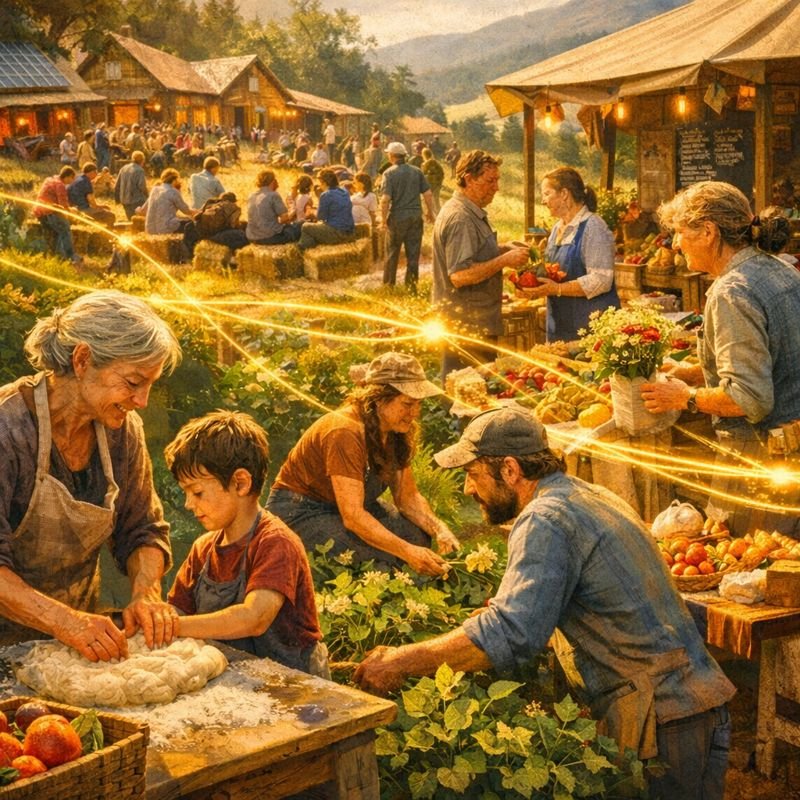
Open and Woven: Reweaving Local Life for a Living Future

Dr Emily Samuels Ballantyne / Dr Demeter | Regen Era Design Studio

When Ezio Manzini proposed SLOC, Small, Local, Open and Connected, he was not inventing a new idea so much as naming a quiet pattern of resilience that already lives in healthy human places, villages and neighbourhoods and valleys and islands that are coherent enough to know themselves, yet porous enough to learn, and the brilliance of the frame is that it refuses the false choice between retreat and globalisation, between a closed localism and a corporate world, and instead points toward a living middle way where communities remain human scale and land attuned while staying in relationship with wider worlds.

I have returned to SLOC repeatedly since my collaborations with the Politecnico di Milano from 2010, because it offers a design language that can hold soil and society at once, and because its ethical demand is simple and difficult, to be rooted without becoming rigid, and open without becoming hollow, and this is also the lineage in which I have been shaped by Professor Anna Meroni’s Creative Communities research, which has long insisted that everyday life is not a private afterthought but a design field, a civic art, a shared practice of making ways of living that are more mutual, more grounded, and more capable of care, and that what looks like “small” initiatives are often the seed forms of systemic transition when they are recognised, supported, and allowed to connect.

Small, in the SLOC sense, is not scarcity, it is intimacy and accountability, the scale at which we can recognise each other, repair conflict, and hold shared agreements without outsourcing everything to bureaucracy, and local is not a brand but an ecological relationship, a lived belonging inside the specific conditions that shape life, wind and water and soil and season, economy and culture, so that nourishment, skills and value circulate through the community rather than leaking away, and open is the quality that keeps small and local from hardening into brittle identity, because openness is not vagueness or a lack of boundaries, it is the capacity to receive new knowledge, new practices, new people and new perspectives without panic.

Connected, in Manzini’s deeper sense, is not constant communication, it is real pathways of exchange, learning and reciprocity, the ability for a village, a valley, or an island to be in living conversation with the wider world, sharing what works, borrowing wisely, cross pollinating, and building solidarity across distance, so that local life is strengthened by feedback loops rather than isolated by pride, and so that we participate in a wider fabric without being swallowed by it, and this is where I once rewrote SLOC as SLOW, shifting connected to woven, not to reject Manzini’s intent, but to restore depth to a word flattened by the technological era, because woven speaks to older intelligences of textiles and baskets, mycelium and kinship, the way distinct strands become stronger together, and because the future we need is not merely connected, it is interlaced.

This is not only a design argument, it is a heart opening effort, because the places we love survive not by being perfect, but by being held, by being able to receive and respond, by composting what is no longer life giving, and by taking nourishment from elsewhere without losing the integrity of place, and in that sense the work of “life design” is not separate from spirit, it is spirit made practical, a commitment to build forms of living that can carry the soul rather than erode it.

From Australia, and especially from Tasmania, I can see how strong we are at the markers of small and local, the corner pub, the volunteer fire brigade, the neighbourhood oval, the weekend market, the competence of showing up during fire and flood, and yet we do not always have the thick daily fabric of a village culture where life is integrated through food, ritual, craft, and intergenerational continuity, where people meet each other at the same stalls week after week, where the local market is not an event but a heartbeat, and where a grandmother’s pasta is not a hobby but a lineage, a living transmission of skill, land, time, and care.

Australia is young as a settler culture and many communal traditions are thin, and into that thinness large corporate systems step easily, especially supermarket systems that shape daily habits so quietly we barely notice until we realise that food has become a major disconnection, because many households do not have access to truly local products in any reliable way, growers struggle to compete with centralised distribution, people are busy and tired, gardens are framed as extra work rather than nourishment, and our economic connection to the larger scale intensifies while our relationship with land thins, and this is not a moral critique of individuals, it is a cultural and economic diagnosis, because when food is abstracted the body forgets seasonality, the imagination forgets taste of place, and community forgets the social life that happens when nourishment is exchanged face to face.

This is why, for me, the lineage of Ivan Illich matters alongside Manzini and Meroni, because Illich’s conviviality was never a lifestyle aesthetic, it was a critique of industrial systems that disempower people from shaping their own lives, and it was a call to rebuild tools, institutions, and social arrangements that return agency to communities, and it seeded much of the design discourse that later became legible as Creative Communities, social innovation, and everyday life as a site of cultural production, and the deeper question beneath all of it is simple, do our systems increase the capacity of people to live well together, or do they outsource life to machines and markets until relationship becomes thin.

Tasmania intensifies both the gift and the risk of this pattern, because it is a place where small farms still exist and permaculture lineage is lived, and yet remoteness can harden into defensiveness, and permaculture can be framed as a private alternative rather than a public foundation, and policy can be viewed as either absurdly disconnected from land or inherently corrupted and therefore not worth engaging, and both attitudes leave the same vacuum in which centralised systems and corporate incentives dominate the conditions of everyday life while local practice remains fragile, underfunded, and easily dismissed as charming.

The invitation here is to take SLOC beyond lifestyle and into civic architecture, into what I call Con Viv, a living-systems design approach that centres living-with rather than extracting-from, that treats culture as compost and policy as mycelium, that seeks to design social and economic pathways which behave more like ecosystems than machines, and this is where social permaculture becomes essential, because it reminds us that culture is not merely what we believe, it is what we practise, the invisible structures of decision making, communication, trust and repair, and those structures can be tended, renewed, and redesigned, just like soil.

This is also why I am working on Grow Small Feed All, an attempt to translate this life design intelligence into policy, to build pathways that support micro farms and neighbourhood food networks at scale without destroying their nature, because distributed systems are more resilient than centralised systems, and micro farms, when supported, are not marginal, they are foundational infrastructure for food sovereignty, public health, biodiversity and community cohesion, and finance is central here, because micro banking and revolving funds can become a nutrient cycle for local economies, circulating capital through enterprises that steward land and community, so that the economy behaves more like compost than like a pipeline, enabling emergence rather than extraction.

And yet openness must be held with equity, because gentrification is what happens when the local is commodified and the people who carry local knowledge are priced out, and cosmopolitanism becomes harmful when it is taste without responsibility, mobility without reciprocity, and so the task is not only to be open and woven, but to be open and woven in a way that deepens dignity and shared benefit, because without equity the weave becomes a net that traps rather than a fabric that holds.

Behind all of this, I carry a quiet anthroposophic orientation, not as a label but as an atmosphere, a sense that society is a living organism and that human life requires rhythms, nourishment, and moral imagination, a sense that freedom, equality, and fraternity must be held together if we want a healthy social body, and a sense that the future is not only technical but spiritual in the most grounded sense, it asks whether we can design ways of living that honour life.

So I offer a question for Tasmania, for Australia, and for the broader European design and art community I am returning to now, what would it look like if we treated everyday life as a design field worthy of our best thinking, and if we embraced SLOC and SLOW not only as cultural patterns, but as civic, economic, ecological and spiritual orientations, building villages of villages, plural worlds in relationship, grounded enough to care, porous enough to learn, and committed enough to equity so the future can be born through us as a lived culture of small, local, open, woven life.

I am on my way to Europe with this question in my pocket and soil on my hands, and in the spirit of creative communities and convivial tools and living systems, I offer it not as a conclusion but as an invitation, because the real work begins where design becomes life, where the village becomes a practice, and where the weave becomes strong enough to hold us all.