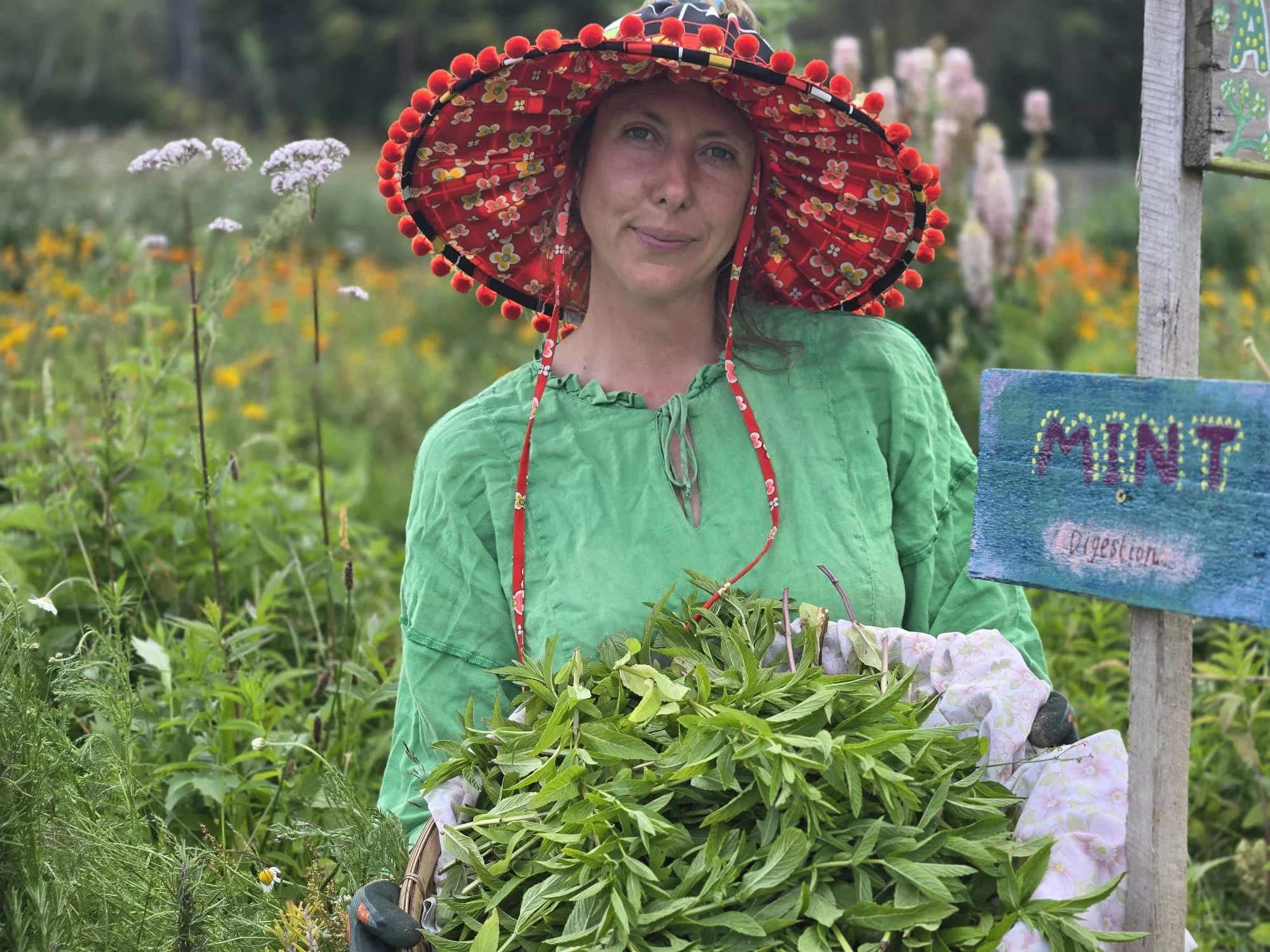
Mint rises from damp soil cooling the gut
reminding the body how moisture moves
sweetness returns, digestion softens, nerves listen
all roots teach patience slowly beneath moonlit ground.
With love & Con viv,
Dr Demeter
Your Custom Text Here
Mint rises from damp soil cooling the gut
reminding the body how moisture moves
sweetness returns, digestion softens, nerves listen
all roots teach patience slowly beneath moonlit ground.
With love & Con viv,
Dr Demeter
The garden holds its breath and listens.
Above, the wanderers shine their slow bright paths.
Below, the rooted ones practice quiet miracles.
Seed becomes promise, stars share stories,
Plants bring nourishment and planets bring belonging.
For a moment, everything remembers it is one.
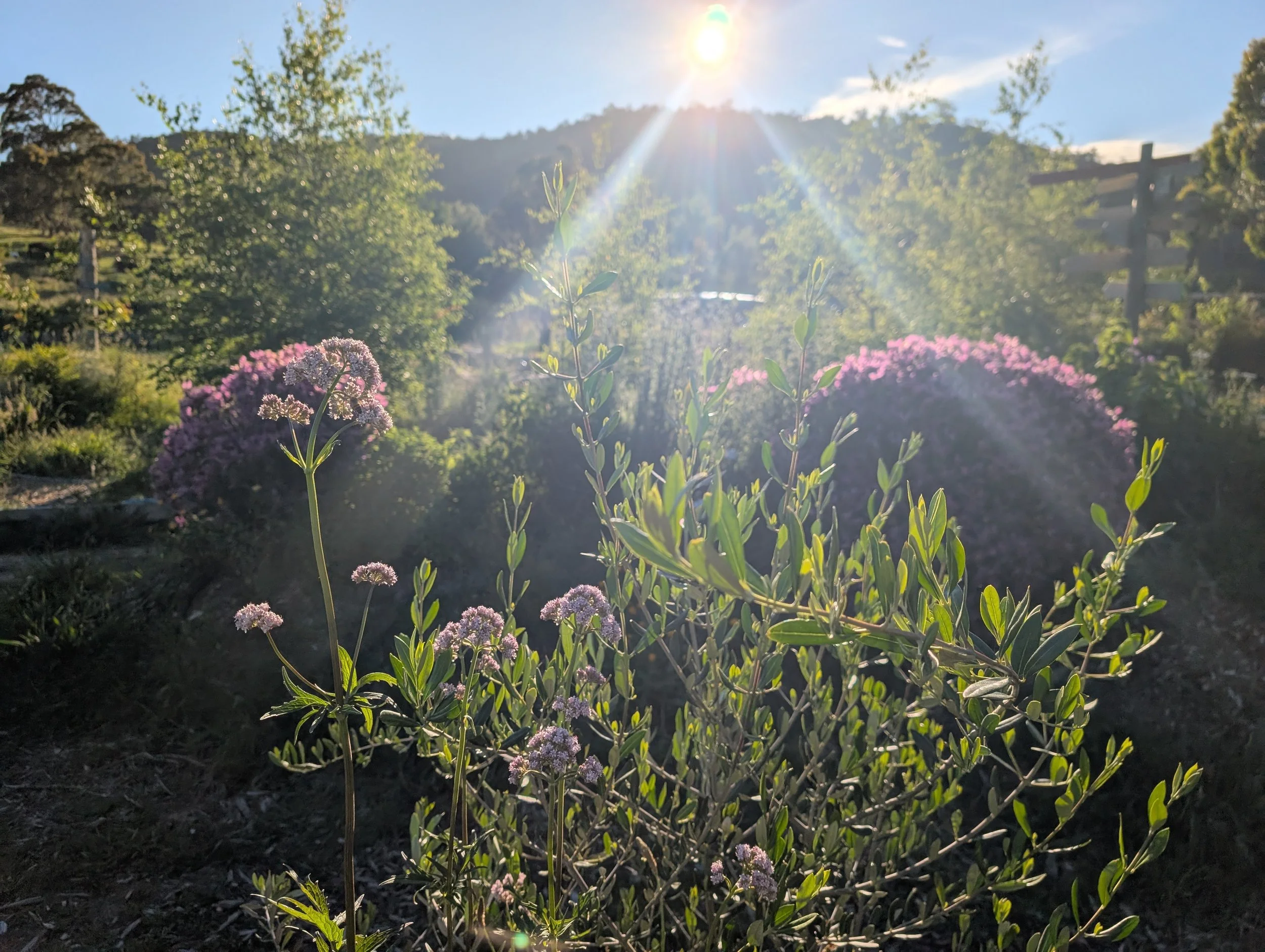
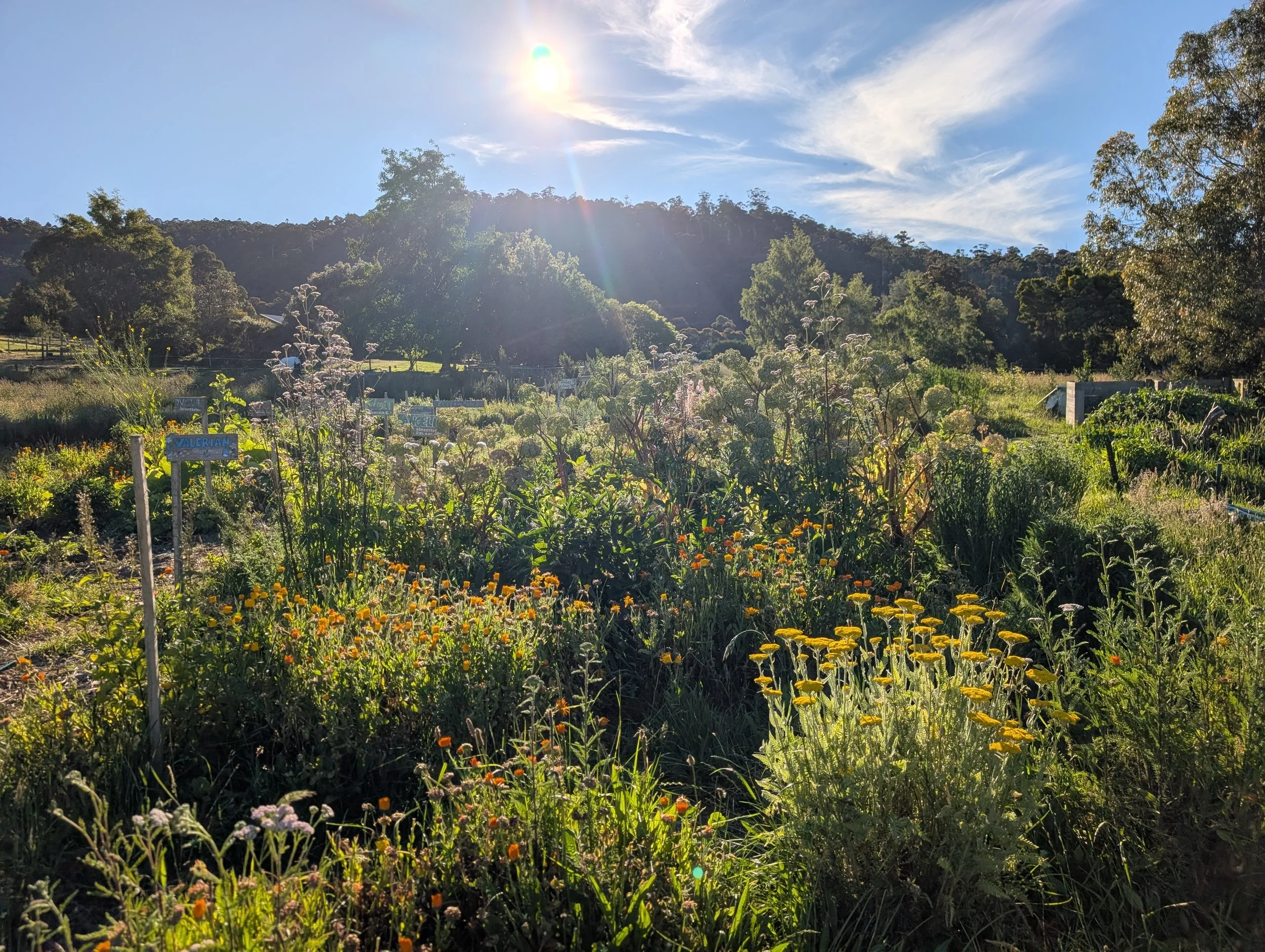
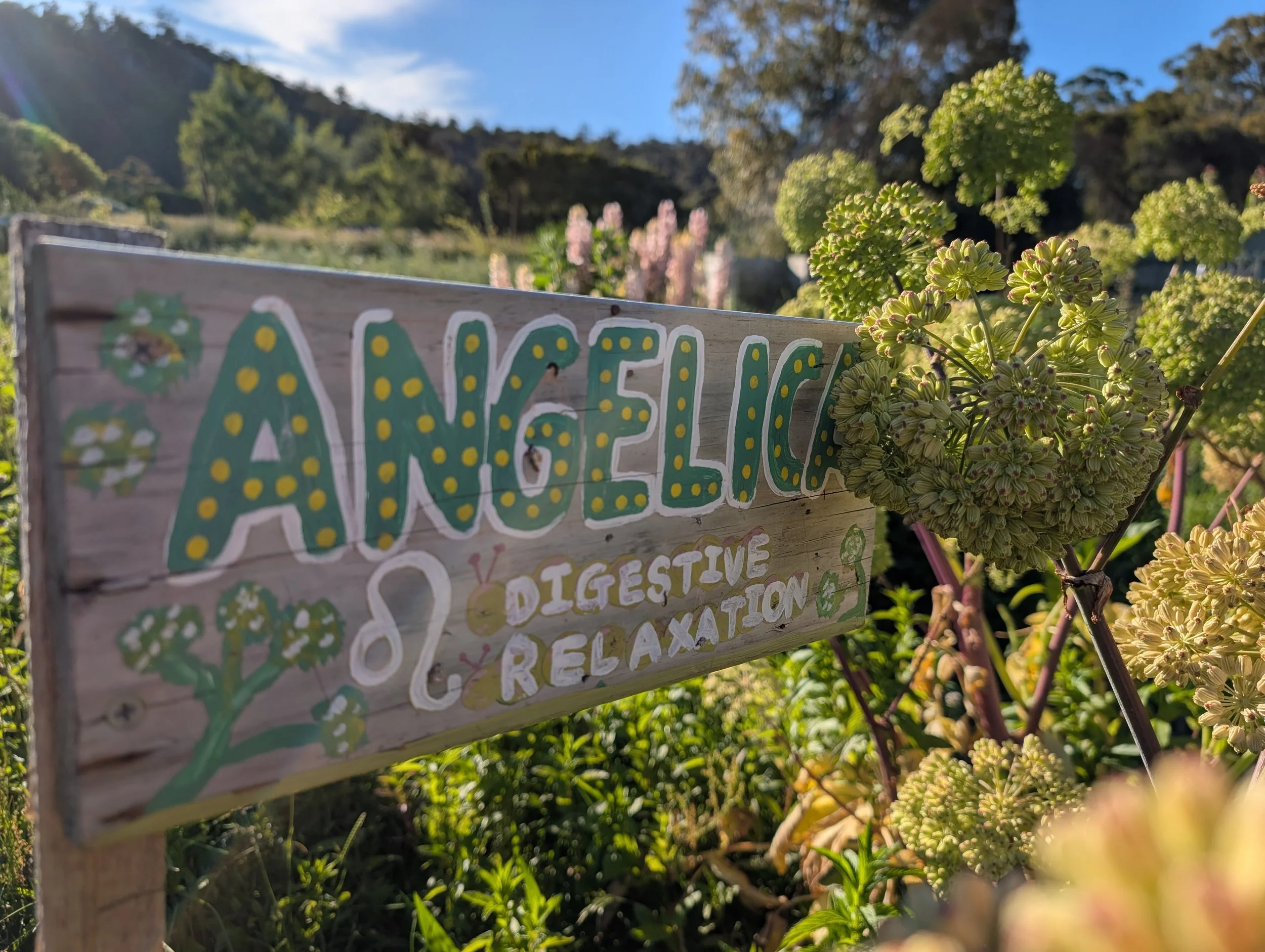
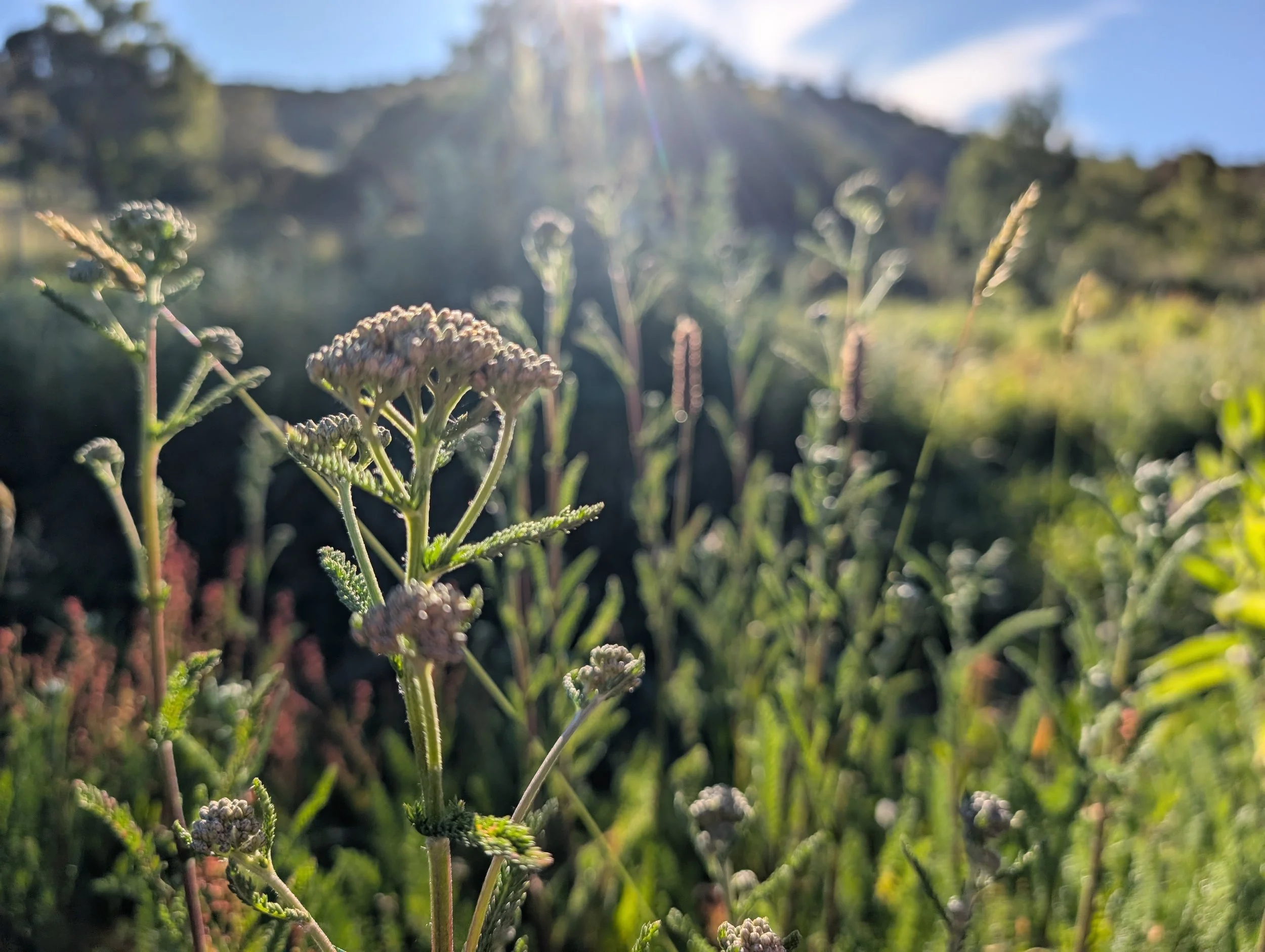
Summer Solstice Eve at Magical Farm had a beautiful glow. The plants seem almost translucent at the edges, and the whole garden feels like it is participating in something larger than “weather.” A regenenerative farmer once old me ‘5 years’ and it will begin to sing. I felt that the other night and I also felt the magic of life: the plants and planets….
“For me, this season carries a simple invitation to bring the wide view home, in a deeper kind of leadership, where vision becomes something you can live, where the future is built through relationship rather than rhetoric, where the everyday is treated as sacred because it is where nourishment is made real.”
Plants and planets closeness on the tongue feels like a clue, because they carry two gestures that hold a life. A planet is a wanderer, a moving light that travels across the dark, and a plant is something placed, set into earth, rooted and sprouting, spreading its quiet intelligence into soil. Wanderer and rooted one, motion and belonging, horizon and home, and suddenly an interconnected view of life becomes easy to understand because it becomes easy to feel.
Plants are not as still as we imagine, because they travel through seed and pollen, through cuttings carried in a friend’s hands, through compost and wind, through the soft multiplication of life that never needs applause. And planets, for all their wandering, move with patterns that shape our sense of time, offering rhythm and return, reminding us that life is not random but cyclical, ripening, resting, beginning again.
Solstice is one of those special thresholds where everything turns. Where the light reaches its height and then, almost imperceptibly, begins to tilt toward the other half of the year, and that turning lands in the body as much as it lands in the sky. It lands in the kitchen and the conversations we are willing to have, in the way we choose to show up, in the way we decide what matters.
When I say an interconnected view of life, I mean the plain, beautiful chain that is happening all the time. Sun becomes leaf, leaf becomes soil, soil becomes nourishment, nourishment becomes mood, mood becomes choice, choice becomes culture, and culture becomes the way we treat land and each other. On Solstice Eve that chain feels almost touchable, as if the world is briefly showing its inner architecture, and it becomes obvious that renewal doesn’t arrive as an argument, it arrives as a living network of small acts and steady care, a mycelium way, many local threads becoming one shared strength.
So these images and videography are not just a record of a beautiful night, they are a reminder of how life actually works, luminous, ordinary, woven. The wanderers above, the rooted ones below, and us learning, again and again, how to belong to both, how to carry a horizon while tending the ground, how to come home without losing our vision, how to live as if everything is connected because it is.
With love and Con Viv, Dr Demeter x
I’m holding this piece inside a wider field than opinion. Across the Great Southern Land, there is a shared grief that does not need to be named but to be felt. When something breaks in public life, the shock moves through us in waves. This may be a moment to let that shock deepen our questions, and to return to the slow intelligence that knows how to hold life.
Earlier this year in The Island Almanac, I wrote about the Art of Peace, then about Why Outrage is not Enough for Progress. What I want to reflect on now is how we recover a praxis (an idea into practice) of relationship: a lived, everyday practice of reweaving the social fabric, human by human, until belonging becomes more normal than polarity.
Many people are enmeshed with modern conditions that can under-hold us: urban speed, industrial economic models, dislocated community, hyper-mobility, the commodification of attention, and the quiet thinning of local civic life. In that atmosphere, nervous systems become more reactive, meaning-making becomes brittle, and complexity starts to feel like danger. The pull toward binaries, good and evil, for and against, my people and your people, often arrives as a search for certainty when the ground feels unstable. Not only that, algorithms reinforce these hardened attitudes.
Through Manfred Max-Neef’s lens, conditions for hardened attitudes in our social life are a symptom of unmet human needs: protection, affection, participation, and identity. When these needs are not reliably met, we reach for substitutes that imitate safety or belonging for a moment, while narrowing the relationships that could meet those needs more deeply. The invitation is to cultivate synergistic satisfiers: forms of community life that meet multiple needs at once, so complexity becomes holdable again and the social fabric can begin to knit. Think shared gardens, local markets, cooperative projects, and convivial gatherings that return people to one another in simple, repeated ways.
Anthroposophy offers me language for diagnosing these times without collapsing into blame. It begins with the human being as more than a political identity or an economic unit: a being of spirit, soul, and will, whose health depends on balance between thinking, feeling, and doing. When culture over-trains the head and under-nourishes heart and hands, thinking can harden into ideology, feeling can spill into volatility, and the will can lose direction. Outrage can then become both a moral signal and a discharge, and without a deeper container it can scorch relationship, the very medium required for transformation.
This is why I keep returning to an older seed-story in my own life. When I was eleven, I attended a peace conference in Japan with children from fifty-six countries. Since then, I have continued supporting the Asian-Pacific Children’s Convention in Fukuoka as a peace ambassador and chaperone for Australian children. At the heart of that gathering is what they call omoiyari 思いやり: a secular ethic of considerate attention, a discipline of recognising another’s reality and responding with care as a daily practice. It is sometimes described as “sending one’s thoughts to others.” I have come to understand it as the willingness to let another person matter enough that your actions adjust around their presence.
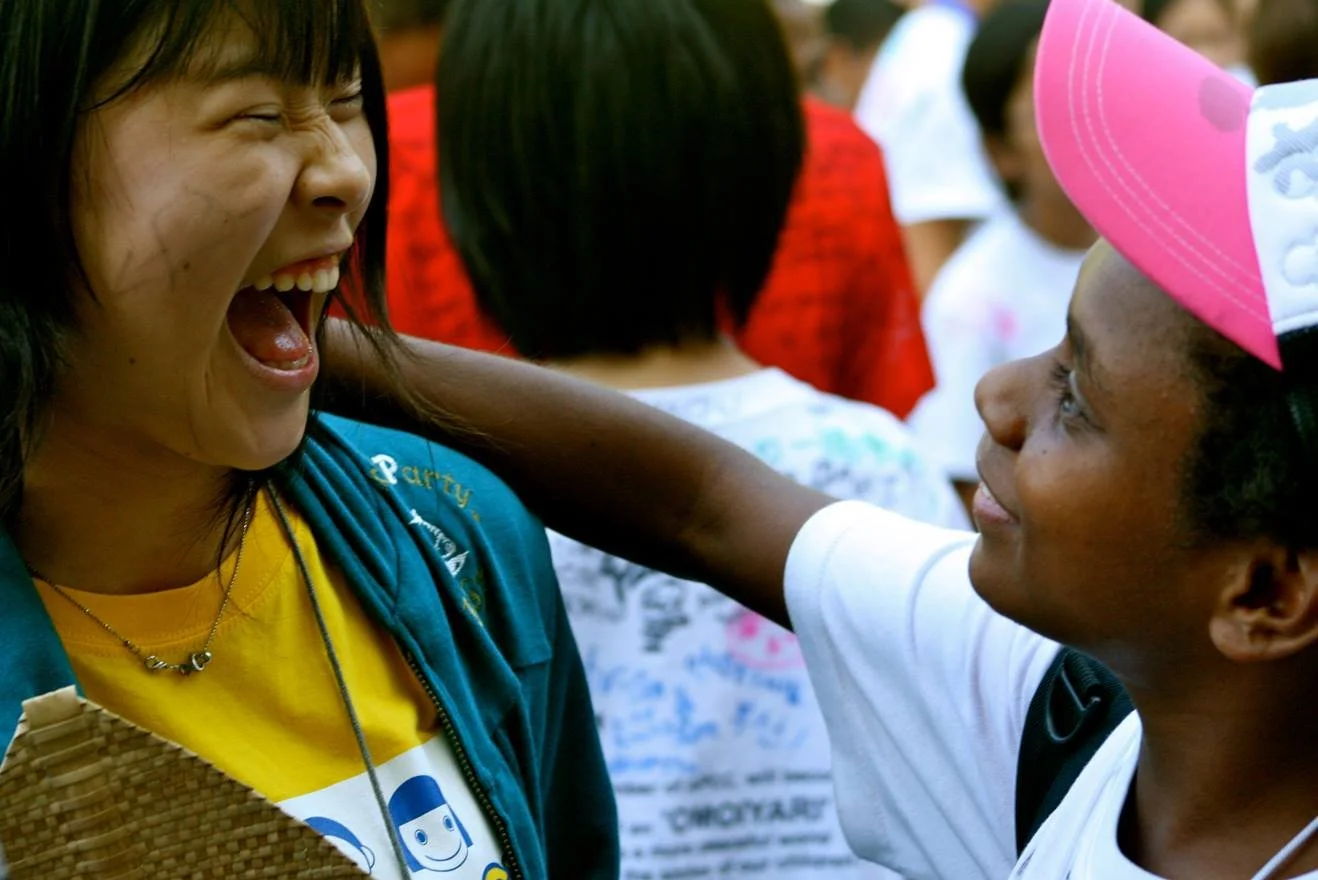
Photography by Emily Samuels-Ballantyne, at 2011 Asian Pacific Children’s Convention in Japan
Omoiyari is practical. You notice what might help someone feel safer, lighter, more included, and you respond, often before they need to ask. You make space in conversation. You slow your pace to match someone else. You bring what will help without announcing it. You choose words that protect dignity. This is small-scale, human-scale peacebuilding.
So what does it mean to practise omoiyari in Australia, especially when grief is close and the cultural atmosphere is hot with agitation? When the collective nervous system tightens and begins scanning for certainty, the work becomes a different kind of strength: to stay with the ache without turning it into a weapon, and to build social forms that can hold the human being.
Here, Steiner’s threefold social understanding offers a useful map for cultural repair. In the threefold picture, society is healthiest when three realms can breathe in their own way: a cultural and spiritual life free enough for living thinking, education, art, and meaning-making; a rights life that treats people as equal in dignity; and an economic life that becomes associative, cooperative provisioning of needs rather than extraction as the default. When these realms collapse into one logic, community thins, people become functions, and a function cannot feed a soul.
This is also where I want to acknowledge First Nations knowledge systems with care and humility. On this continent there are deep traditions grounded in Country, kinship, reciprocity, responsibility, and continuity. Without appropriating, we can still be guided by the ethical direction: relationship is the substance of life, and place is a teacher. When we listen respectfully to what First Nations people say about community life and gentle ways of living, we are called away from abstraction and back into pattern, where repair becomes a living act carried through relationship.
From this ground, I want to offer a nurturing kind of clarity for the forward vision: softness as life-making strength, the capacity to create conditions where something good can grow. This is clarity that illuminates rather than humiliates. It is authority expressed as stewardship, through conditions that help life thrive. In anthroposophical terms, it is the heart remembering it can sense what is true, and the will learning again how to serve life instead of moving from fear.
What might this look like in practice for Australians right now? It can look like rebuilding the village layer of society as deliberate culture-making. Small, repeated gatherings that thicken trust. Shared meals. Working bees. Repair cafes. Community gardens. Parent circles. Walking groups. Spaces where people can be present with difference without being reduced to their opinion. Alongside this, it can look like a civic skill we practise: returning to breath when outrage rises, so the nervous system stays inside the body and care remains capable of relationship. It can look like investing in cultural life that nourishes, including education, arts, local storytelling, and ritual. It can look like strengthening rights life so dignity is protected in practice, not only in principle. It can look like building more cooperative economic forms, including local food systems, co-ops, local energy, and care networks, so meeting needs becomes a practice of cooperation rather than a theatre of fear.
I have witnessed both the absence and the presence of omoiyari in Australia. I have seen politics harden and pressure erode compassion. I have also seen people show up quietly for one another, and neighbours carry each other through difficult seasons. Tasmania has been one lens for me, because on an island you can feel the social atmosphere quickly, yet this is not only a Tasmanian story. It is an Australian one.
This is the heart of what I want to offer as a continuation of my earlier essays: peace is a practice, outrage is a signal, grief is a threshold. The way through is slower and more human. It is the work of reweaving, rebuilding the social fabric until the binary spell loosens, until belonging becomes more normal than contempt, and until we remember that the opposite of polarisation is relationship strong enough to hold difference.
Omoiyari is not a foreign ideal. It is an attention-practice we can speak in our own language: care, neighbourliness, mateship made real, village culture built deliberately through the choices we repeat. The invitation now is simple and practical: to become cultivators of life, creating conditions where what is most human in us can grow again.
With love and Con Viv,
Emily / Dr Demeter
Emily Samuels-Ballantyne, PhD / Dr Demeter is a Tasmanian-based regenerative designer, biodynamic herb farmer, educator, and policy-oriented researcher. Her work brings together living systems design, conviviality, and place-based governance to help communities build conditions for care, belonging, and ecological repair. She leads Magical Farm Tasmania, a small farm and learning site, and Regen Era Design Studio, a design studio supporting community scale food systems, regenerative enterprise, and public sector reform. She is also developing Con Viv, a long-form body of work and practical framework for relationship-centred agriculture and cultural renewal.
Emily’s peace activism began early. At eleven, she attended an international peace conference in Japan with children from fifty-six countries. Since then, she has continued supporting the Asian-Pacific Children’s Convention in Fukuoka as a peace ambassador and chaperone for Australian children. Her public writing and community work focus on restoring the social fabric through everyday practices of attention, cooperation, and locally rooted cultural life.
By Dr Demeter (Emily Samuels-Ballantyne)
At Magical Farm Tasmania, our work is as much about cultivating conviviality and community as it is about cultivating soil and soul. The farm is a living philosophy, a regenerative lifestyle experiment where community, ecology, and imagination intertwine.
Each Thursday, our landcare group gathers to restore and tend the land. Volunteers learn about regenerative farming, herbal wisdom, and biodynamic rhythms, farming in sync with the cosmos. We explore the sevenfold patterns that shape life: seven days of the week, seven chakras, seven inner planets, and seven biodynamic plants that correspond with them.
From this ecosystem grew YoFence, a practice that unites the sword and the soul, fencing and yoga. Inspired by Eastern Body, Western Mind, YoFence invites courage, conviction, and connection. The sword represents clarity and boundaries; yoga, holistic union. Together they form a living metaphor for what our world needs in 2026: a way to move beyond binaries and commodification toward authentic connection, to people, place, and planet.
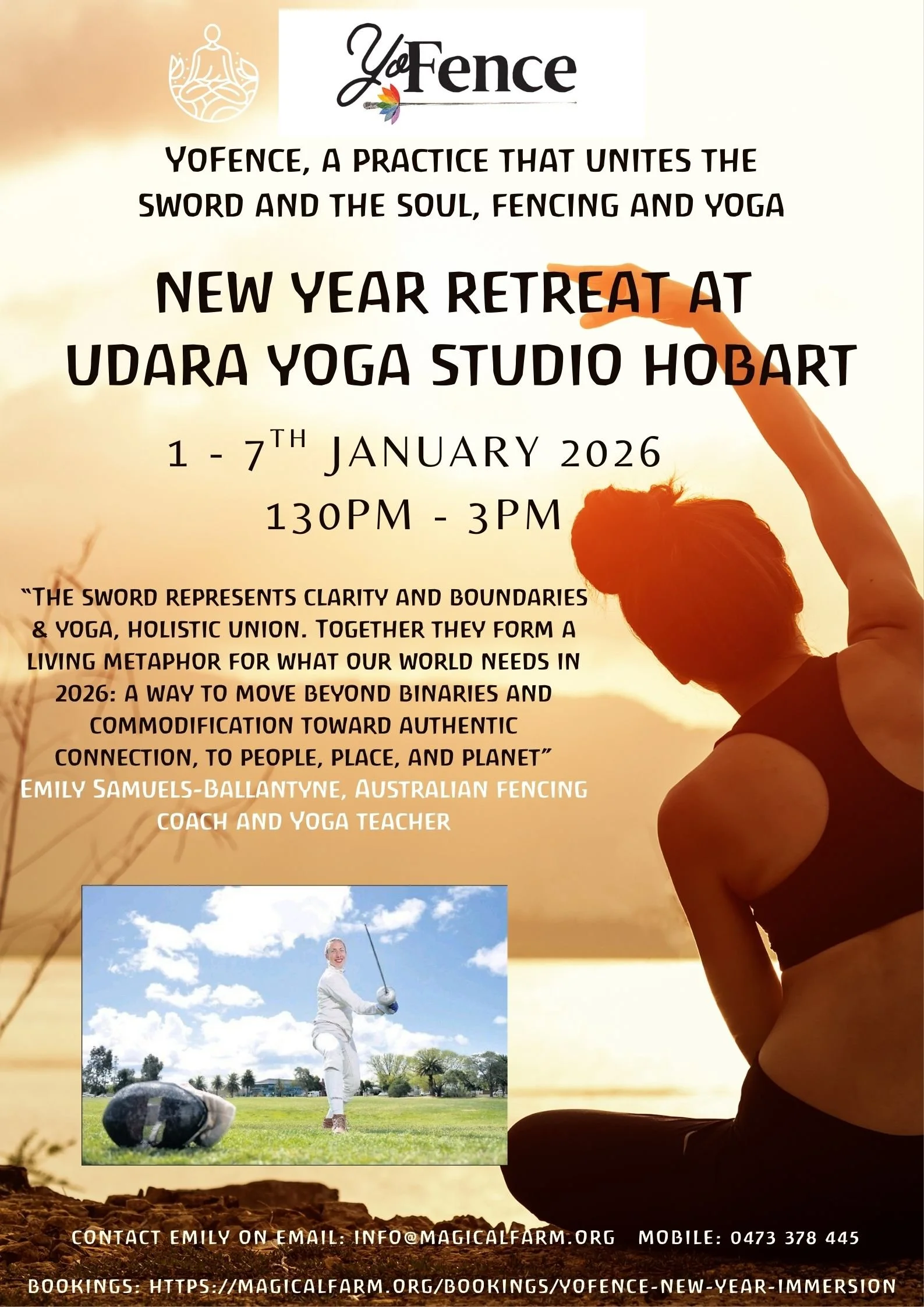
In early 2026, I’ll be offering a seven-day YoFence immersion (January 1 – 7 at Urdara, Hobart), a transformative beginning to the year. Participants will explore embodied regeneration through movement, mindfulness, and nature-based ritual. It will be fun, creative, and deeply grounding.
For those who can’t join the full retreat, you’re warmly invited to participate in our Thursday Landcare days, meet our community, and experience how we are farming the future in festivity, food, and friendship.
This work also flows into the Regen Era Design Studio, our policy and design initiative rooted in the soil. We imagine new ways of shaping governance and the food system so they align with the living principles of nature itself.
YoFence has become my way of transmuting grief of a broken world into creative leadership. Like mycelium, this vision spreads quietly underground, connecting hearts, ideas, and places into one living web. To join the January 2026 immersion or volunteer with the landcare group, visit: www.magicalfarm.org/bookings
I’m delighted to share that I’ll be joining Udara Yoga and Pilates Studio in Hobart for a new Sunday offering that feels very close to my heart. Beginning this month, I’ll be guiding a 4.15pm Yin Yoga class each Sunday, a gentle space to unwind, soften, and return to yourself. And, as we welcome the new year, I’ll also be offering a week-long YoFence immersion from 1–7 January, hosted at Udara as part of Magical Farm’s growing suite of regenerative practices.
These two offerings sit together like inhalation and exhalation: one soft, slow and restorative; the other quietly activating, helping you stand in your centre with clarity and embodied strength.
The Sunday class will be a tender threshold for the week, weaving my knowledge of yoga, astrology and life systems. Yin Yoga has always spoken to me as a practice of deep listening: long, supported poses that invite the body to melt, the breath to settle, and the nervous system to drop down into a quieter rhythm. It’s a practice that doesn’t demand anything of you. Instead it offers space to feel the softness and subtle intelligence of your inner world.
As someone whose work sits at the meeting point of yoga, living-systems philosophy, community ecology and emotional regeneration, these sessions will gently weave awareness of the body’s energetic landscape: the chakras, the fascia, the emotional field, into simple, grounded shapes. My classes encompass sequences of small invitations to notice where you feel rooted, where you feel held, and where you might need more space or support.
If you’d like to join us, please reach out directly to Udara Studio to book your spot.
In early January, I’ll offer a YoFence New Year immersion, at Udara Studio, in their hot room! YoFence is a practice I’ve been quietly developing for many years. YoFence weaves together the breath, grounding and awareness of yoga with the precision, discipline and focus of my first life as an international-level fencing athlete. It is not about fighting. It is about boundaries, presence, and learning to inhabit your own energy with both softness and strength.
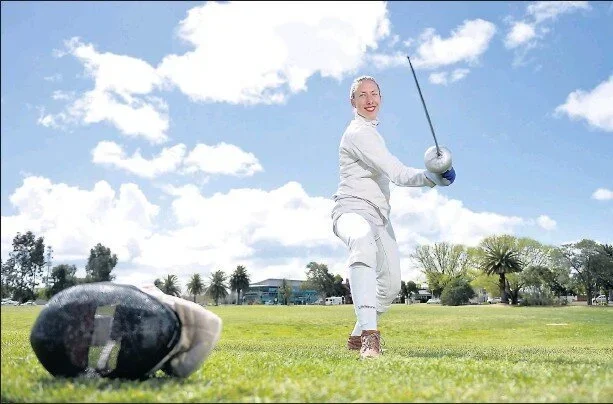
Over the week, we’ll explore posture, simple fencing-inspired drills, stillness, breathwork and reflection. It’s a powerful way to begin the year: clearing out old patterns, strengthening your inner ground, and reconnecting to the part of you that knows how to stand tall without hardening, and soften without collapsing.
Bookings for the YoFence retreat can be made through the Magical Farm booking page.
This collaboration with Udara feels like a natural expression of everything emerging through Magical Farm, Con Viv, and my own inner path. We live in a time where rest has become rare, boundaries blur easily, and many of us walk carrying more than we realise. These two offerings Yin and YoFence speak to both sides of the equation: the need to soften, and the need to stand clearly within ourselves.
My hope is that these sessions become a small but steady rhythm in our community, a way for people to re-enter their bodies, restore their nervous systems, and feel a sense of village again. Whether you’re brand new to yoga, returning after a long pause, or simply seeking a gentle space that honours the depth of your inner world, you’re welcome here.
I’d be honoured to practice with you.
Emily / Dr Demeter
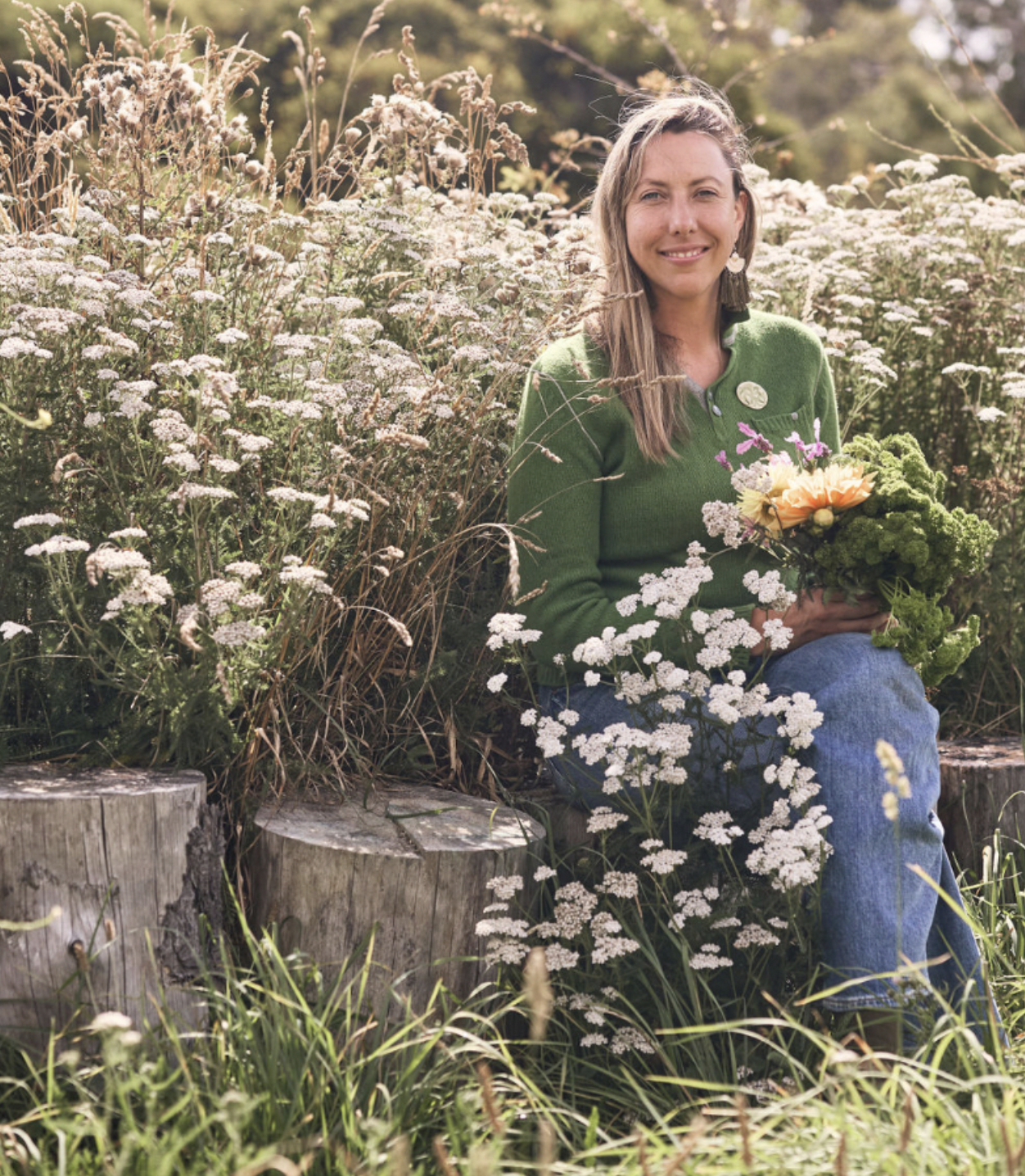
Photography by Ness Vandebourgh, Tasmania
There are moments when the rhythm of this Island shifts and the deeper story reveals itself. The blizzard that moved through our valley this week carried more than weather. It brought a message woven through several events at once: a neighbour passing quietly next door, a letter from local government questioning the very portfolio of conviviality and cultural renewal I have dedicated my life to, and a fleeting morning dream in which I imagined taking my boys to Italy, a place my blood remembers, where village life is still a living architecture, not a nostalgic wish.
When I woke, the dream lingered, but so did the conviction that leaving is not the answer. The work is here. The future of my boys, their light, their soulful way of being, is here. And the cultural healing this island requires is not something to be witnessed from afar. It is something to be created with courage and heart, right here in the soil and soul of Tasmania.
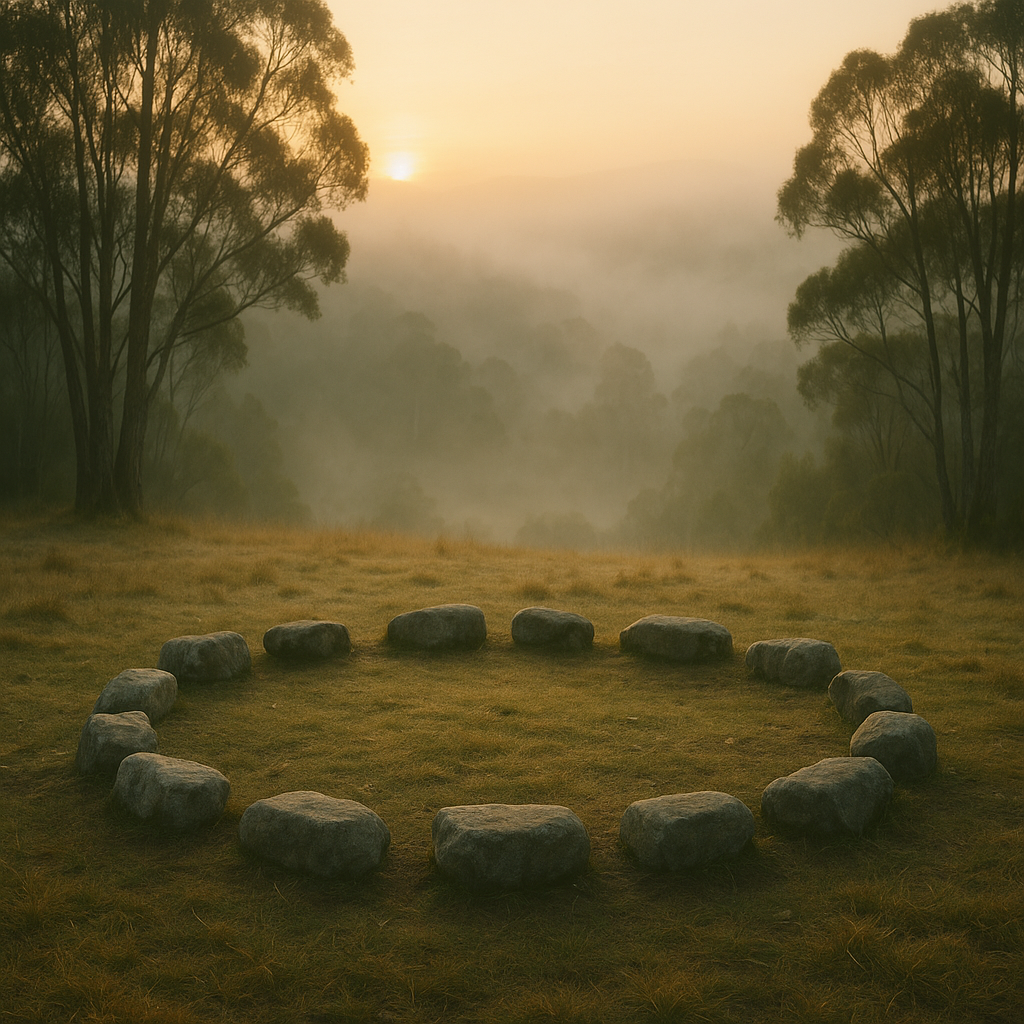
I live in a valley that is exquisitely beautiful. The sun rises with a hush that feels ancient; the mist kisses the land and the rivulet; the trees hold the memory of older worlds. But beneath this beauty lies a pattern that is more difficult to speak about, though it shapes nearly everything: a quiet watching instead of warm engagement, a reflex toward gossip instead of conversation, a discomfort with difference that sits beneath the surface like a low, persistent hum.
This pattern is not malicious, but it is consequential. It is a kind of rural panopticism not created by technology, but by habit, fear, and inherited cultural norms. People see but do not speak, judge but do not ask. In the absence of real connection, stories fill the gaps, and the stories almost always bend toward suspicion rather than generosity.
I felt this acutely when building our cob house, when shaping Magical Farm into a place of creativity and regeneration. Instead of curiosity there was scrutiny. Instead of dialogue, rumours. Instead of relationality, distance. Rather than being about any one person, these responses reveal a deeper cultural discomfort with anything that operates outside the established rural template.
Magical Farm, in many ways, functions as a prototype of new relational possibilities: a living, experimental lab exploring creativity, regeneration, shared responsibility and convivial social design. I have seen similar dynamics emerge in other community-based initiatives, such as the Huon Valley Food Hub, where innovative relational models were met with uncertainty or resistance simply because they departed from familiar council norms. These projects are not threats; they are invitations. Yet in a culture that has not yet rebuilt its village, even invitations can be misunderstood.
This struggle becomes even clearer when I think about the heritage my boys carry through Mum and Dad. Our family line holds Mediterranean warmth, a tradition of reflective minds and imaginative hearts, Celtic fierceness and a creative instinct that never fits neatly within the boundaries of anglo-settler emotional restraint. My children are spirited, perceptive, full of imagination and movement! The kind of children who flourish in a village culture, not in a culture of quiet judgment. They need to be seen, not managed; supported, not scrutinised.
The Missing Village
This absence of village life is not unique to our valley; it reflects a broader pattern on the island. The Roseto study, which Malcolm Gladwell later popularised in Outliers demonstrated something profound about human health and community life. In the 1960s, researchers discovered that the people of Roseto, a small Italian-American town in Pennsylvania, had remarkably low rates of heart disease and chronic illness. What startled the medical world was that these outcomes had nothing to do with diet, wealth, genetics, or geography. The Rosetans smoked, drank wine, cooked in lard, and worked physically demanding jobs, yet they were thriving. Researchers were astonished to discover that the people of Roseto were thriving not because of diet or wealth, but because of the density of their relational life: daily visits, multigenerational households, rituals, shared responsibility and unpretentious hospitality.
Tasmania mirrors the Roseto story in reverse. We have beauty but not belonging. Geographically close but emotionally distant. Small in population yet fractured in connection. An island where people endure hardship quietly because speaking openly feels too vulnerable and where gossip travels faster than truth.
Compounding this is the pervasive presence of gossip, a force that many brush off lightly but which erodes the very conditions required for community. Gossip behaves like a subtle weather system. It moves through kitchens and driveways, shaping reputations before conversations ever occur. It reduces real people into caricatures and provides the illusion of connection without the reality of it. Gossip is not community; it is the shadow of community.
It thrives where emotional literacy is thin, and Tasmania’s settler-colonial inheritance has long carried the residue of communities built not on relational foundations but on survival, authority and silence. Convicts torn from homeland, guards enforcing order, settlers navigating isolation without elders or ritual, these histories shaped a culture where vulnerability feels unsafe and difference feels disruptive.
In such climates gossip becomes a stand-in for real communication. People lean away instead of leaning in. They create narratives rather than ask questions. They preserve distance rather than build bridges. And over time, this quiet avoidance erodes the informal relational systems that hold the village together.
From a Con Viv lens, this is where our social architecture collapses. The relational layer is too weak to support difference or metabolise conflict. The everyday rituals, shared stories, and intergenerational exchanges that sustain a village have eroded leaving communities reactive instead of resilient.
Yet the antidote is not abstract. It exists in the relational wisdom of the First Peoples of this island, whose communities flourished for over 80,000 years. Aboriginal relational culture was and remains grounded in reciprocity, kinship, shared responsibility, ceremony, storytelling and collective intelligence. Children were raised by many hands. Conflict was navigated through dialogue and ritual. Knowledge flowed intergenerationally in ways that created stability, belonging and coherence.
Viewed through the Con Viv framework, Aboriginal community life embodied all seven relational elements: ritual, routine, relationship, conversation, new knowledge, skill-building and storytelling. These elements formed a cultural immune system, a village muscle, strong enough to prevent gossip from becoming corrosive, because tensions were addressed before they hardened into fracture.
Tasmania’s healing lies in honouring this older, wiser architecture of community. Rebuilding the village is not nostalgia; it is a return to relational practice.
The letter from council this week, asking that I formally acknowledge their involvement in my Con Viv portfolio, despite the fact that I personally seeded the work, stayed up until three in the morning writing the application, and then had to beg directors to submit it because my role was no longer funded, revealed far more than administrative misunderstanding. It revealed a pattern in colonial institutions: the impulse to claim or contain community-led innovation while erasing the labour and cultural depth that birthed it.
Yet even this awkward moment holds possibility. The fact that institutions feel compelled to engage with ideas outside their familiar frames suggests the membrane is softening. They are noticing relational philosophy, ecological imagination and community-led design, even if they cannot yet articulate why. This is where renewal begins: in the tremor before understanding.
If institutions can move from claiming to collaborating, from surveillance to reciprocity, from extraction to relationship, then something new becomes possible on this island.
Stay or go? For me the answer is clear. Tasmania does not need abandonment. It needs renewal: gentle, honest, courageous and heart-led. Cultural renewal begins with conversation, not gossip. With curiosity rather than fear. With celebrating difference rather than containing it. With restoring the village not as nostalgia, but as necessity.
I write this for my children, for those whose creativity has been misunderstood, for families carrying lineages that sit outside the anglo-normative frame, for Aboriginal communities whose wisdom is essential, and for every person who has ever felt watched when what they needed was to be welcomed.
Tasmania has the potential to become a living Roseto, a place where emotional warmth, relational courage and cross-cultural intelligence form the backbone of shared life on this heart shaped Island. What we lack is not beauty. What we lack is connection. And connection is something we can reweave, valley by valley, neighbour by neighbour, if we are willing to begin.
Con Viv & With Love,
Emily / Dr Demeter

Tarkind 2025 with beautiful artworks and inspiring citizen science expressions. Photography By Danielle Gilbert
Allens Rivulet, Tasmania October 27, 2025

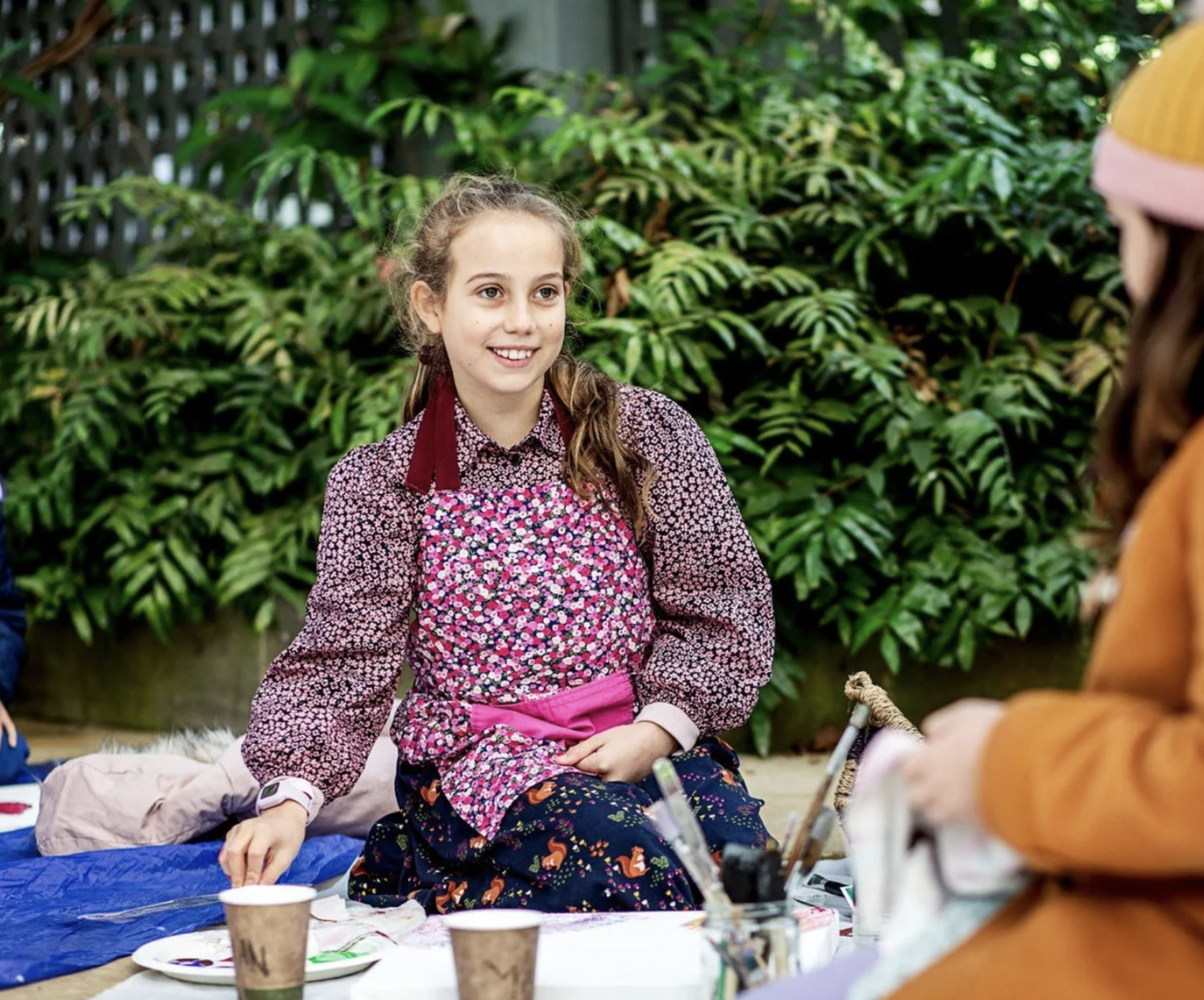
Daisy at her second Tarkind Art and Citizen Science Event. Photography by Emily Samuels-Ballantyne
Twenty-two participants, mums and their children gathered at Magical Farm Tasmania in Allens Rivulet this weekend for a Tarkind event celebrating the connection between heart, art, and science. Supported by Landcare Tasmania, the gathering was part of the internationally renowned Great Southern BioBlitz, a citizen science initiative uniting communities across the Southern Hemisphere in biodiversity discovery.
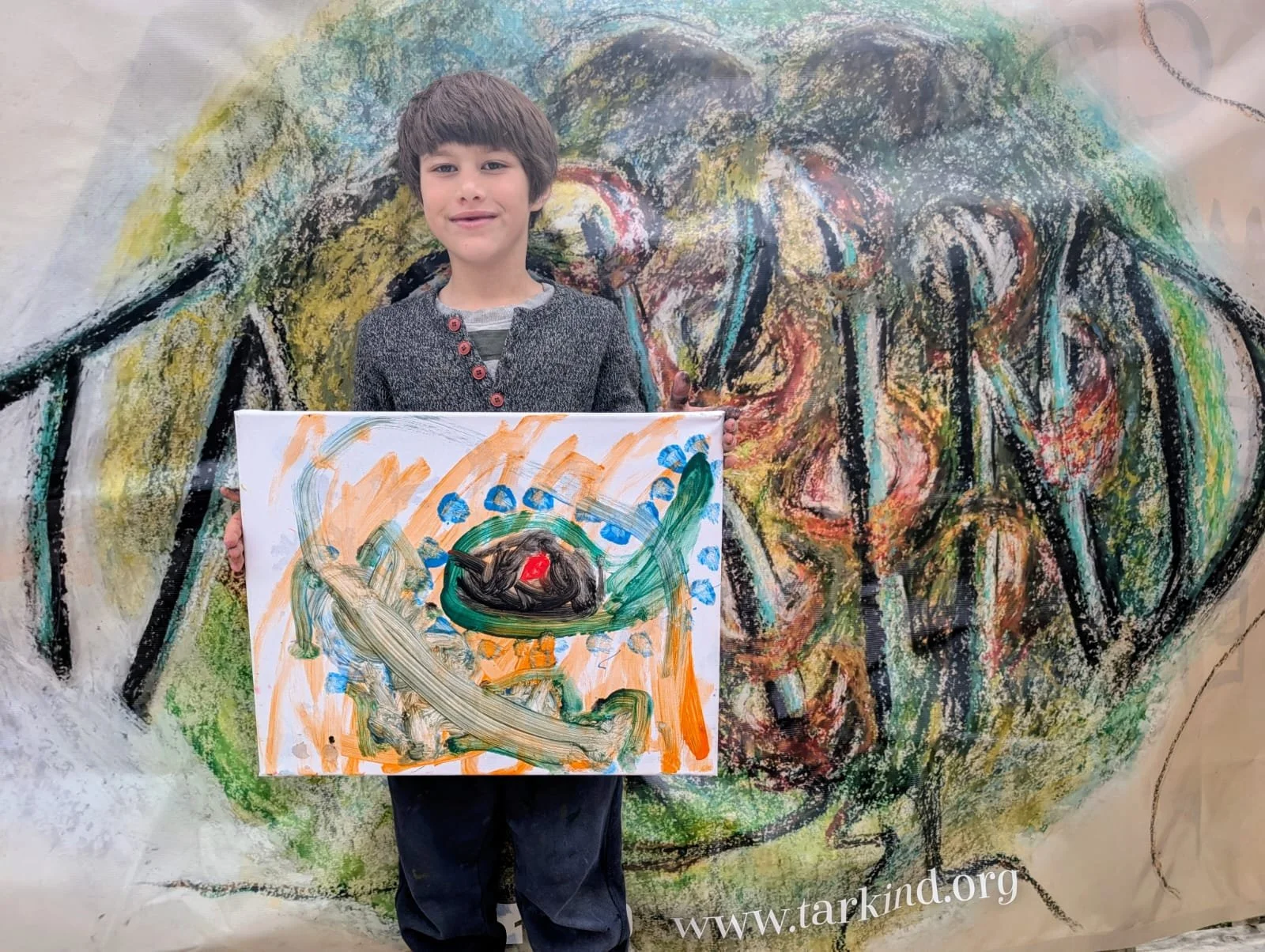
Abe participating in his fourth Tarkind Art and Citizen Science Event. Photography by Emily Samuels-Ballantyne
The day began with a circle of sharing, where participants told stories about connecting to Country and the living systems around them. After an inspiring walk through the bushland, families collected and recorded over 25 unique species in just one hour, contributing valuable data to global biodiversity mapping efforts.

Raphael’s fourth Tarkind event.
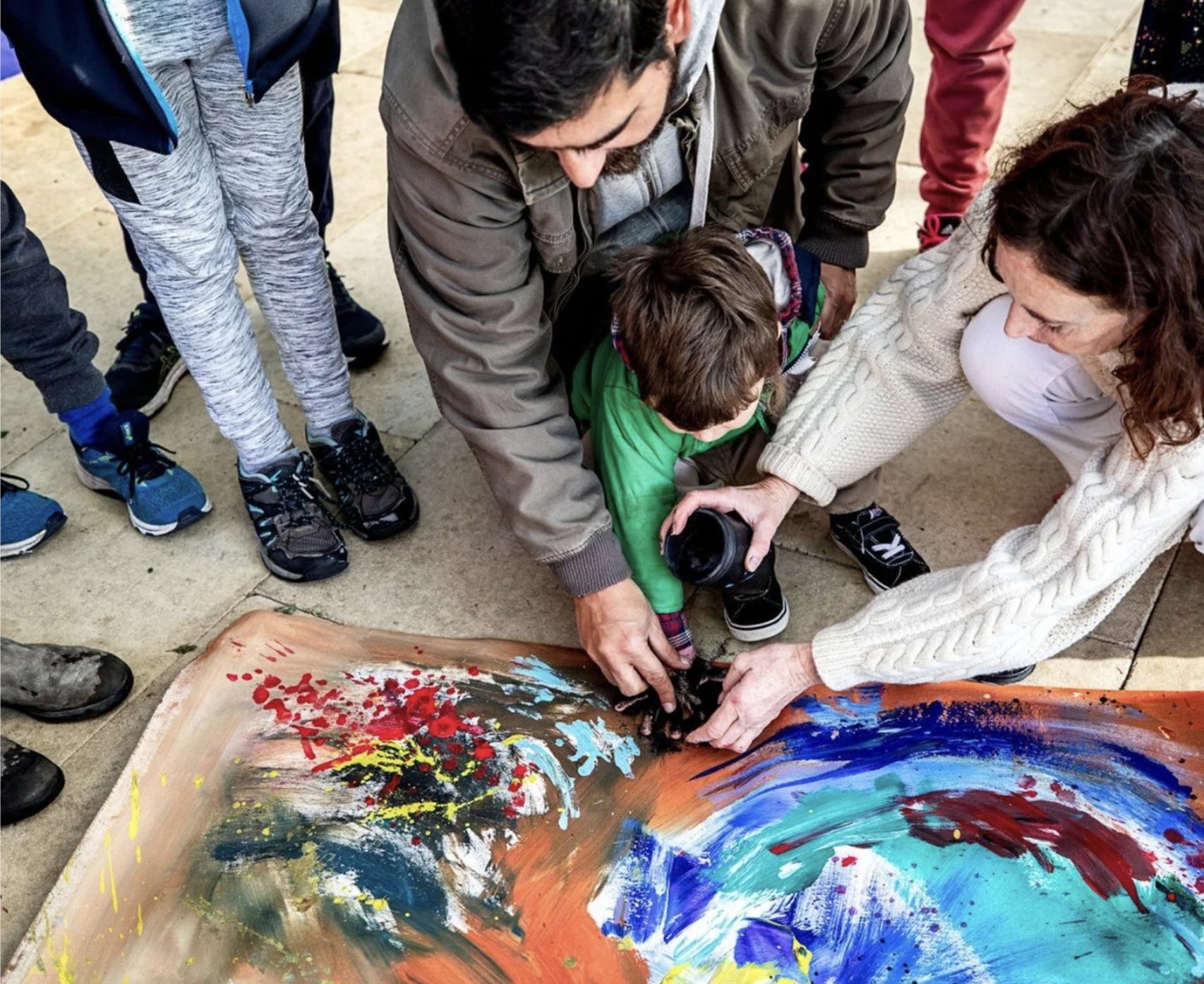
The event flowed naturally into a creative painting session, with children and adults expressing their encounters through art inspired by mosses, fungi, and forest textures. The artworks reflected the beauty and complexity of the Tasmanian landscape, bringing science and creativity together in a living dialogue.
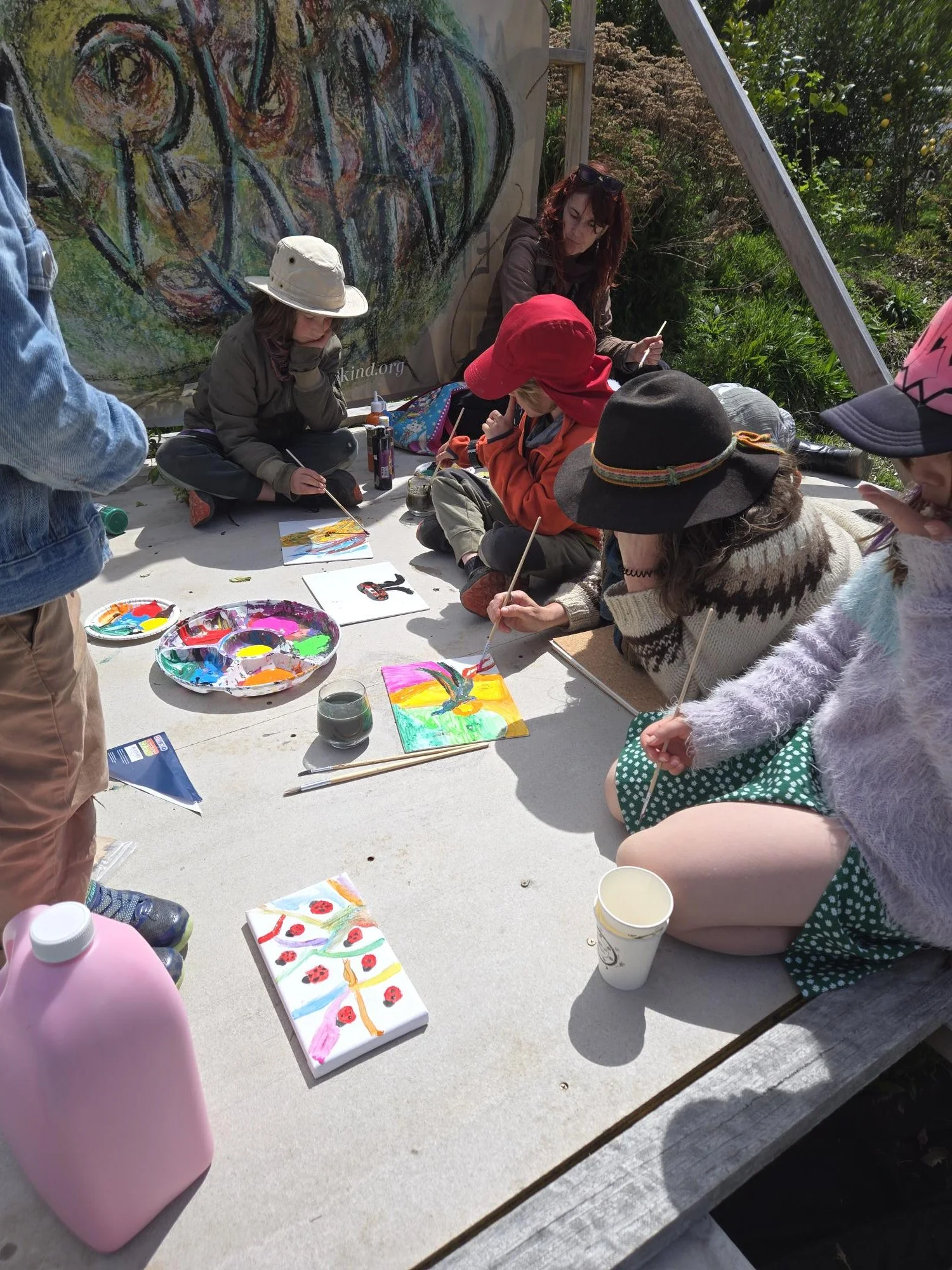
Everyone painting together. Photography by Emily Samuels-Ballantyne
“It was deeply inspiring to see families connecting heart, art, and science,” said Dr Emily Samuels-Ballantyne, creative director of Magical Farm Tasmania and the Tarkind Project. “There’s such beautiful aesthetics in these moments, when we connect to nature and express that connection through art, we begin to see and feel life as one integrated system.”
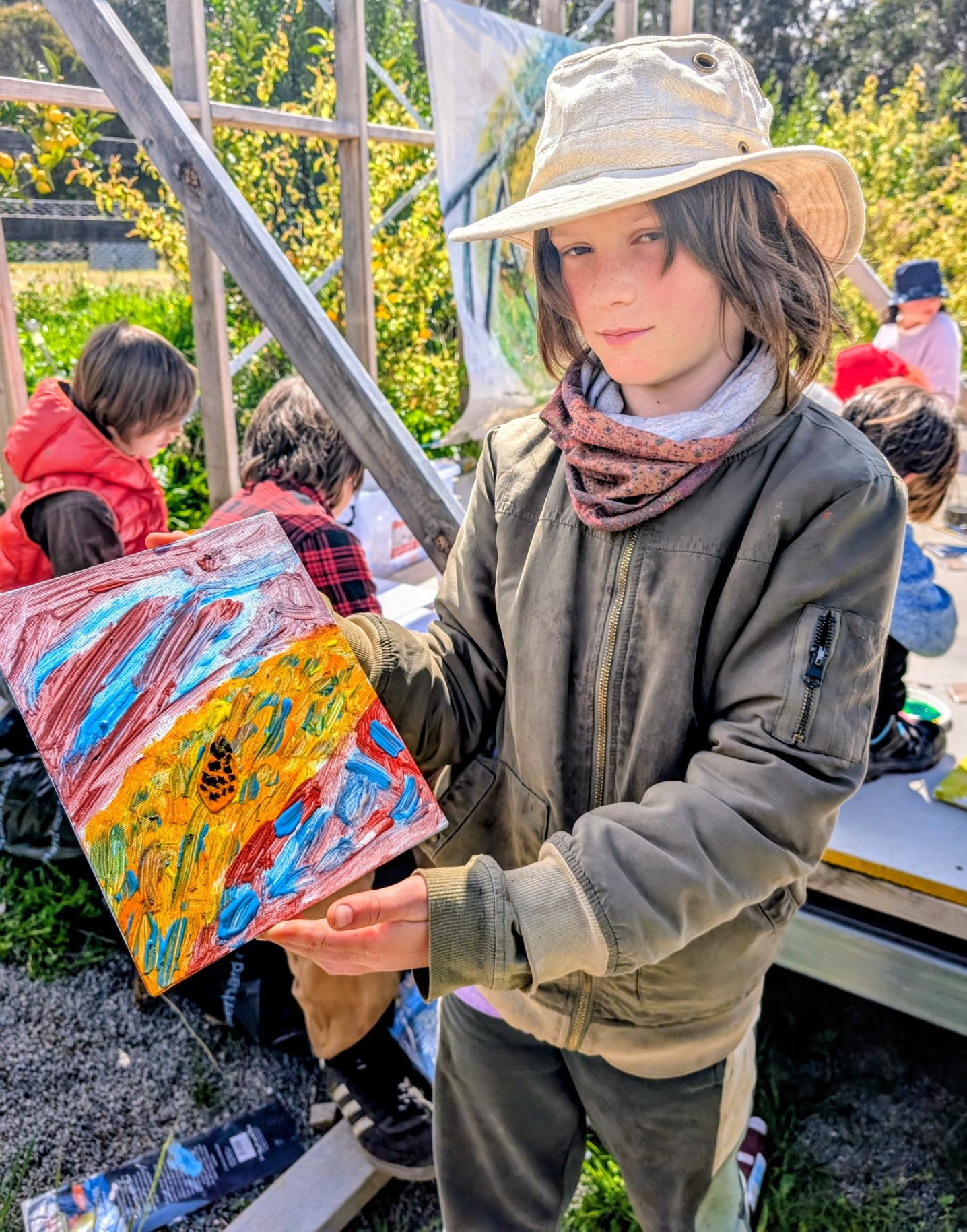
Beautiful art by the children. Photography by Emily Samuels-Ballantyne
As the afternoon closed, participants reflected on how simple acts: walking, noticing, painting, and sharing foster a deeper relationship with the natural world and with one another.

Circle to begin the day. Photography by Seb Samuels
Tarkind’s community-based approach to environmental education continues to grow, blending ecological science, art, and storytelling. Plans are already underway for the 5th Tarkind event next year.
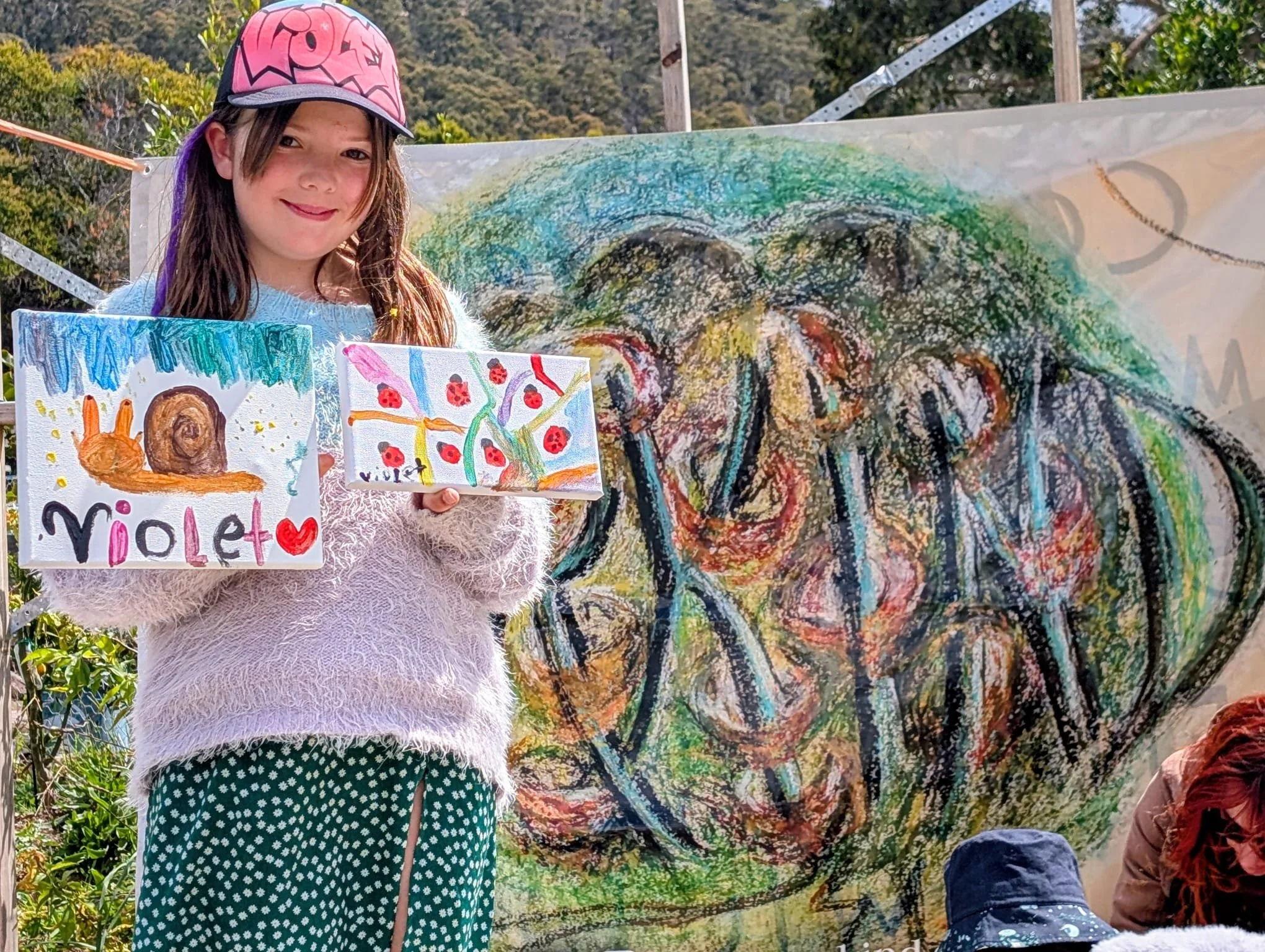
Violet participating for her fourth Tarkind event. Photography by Emily Samuels-Ballantyne

Sacral and heart charka healing by Emily Samuels-Ballantyne

Citizen Science explorations as Part of the Great Southern Bio-Blitz, Prior to our Community Art Event

Exploring nature in Allens Rivulet. Photography by Emily Samuels-Ballantyne

Uploading our findings onto iNatralist Citizen Science App for the Great Southern BioBlitz. Photography by Emily Samuels-Ballantyne
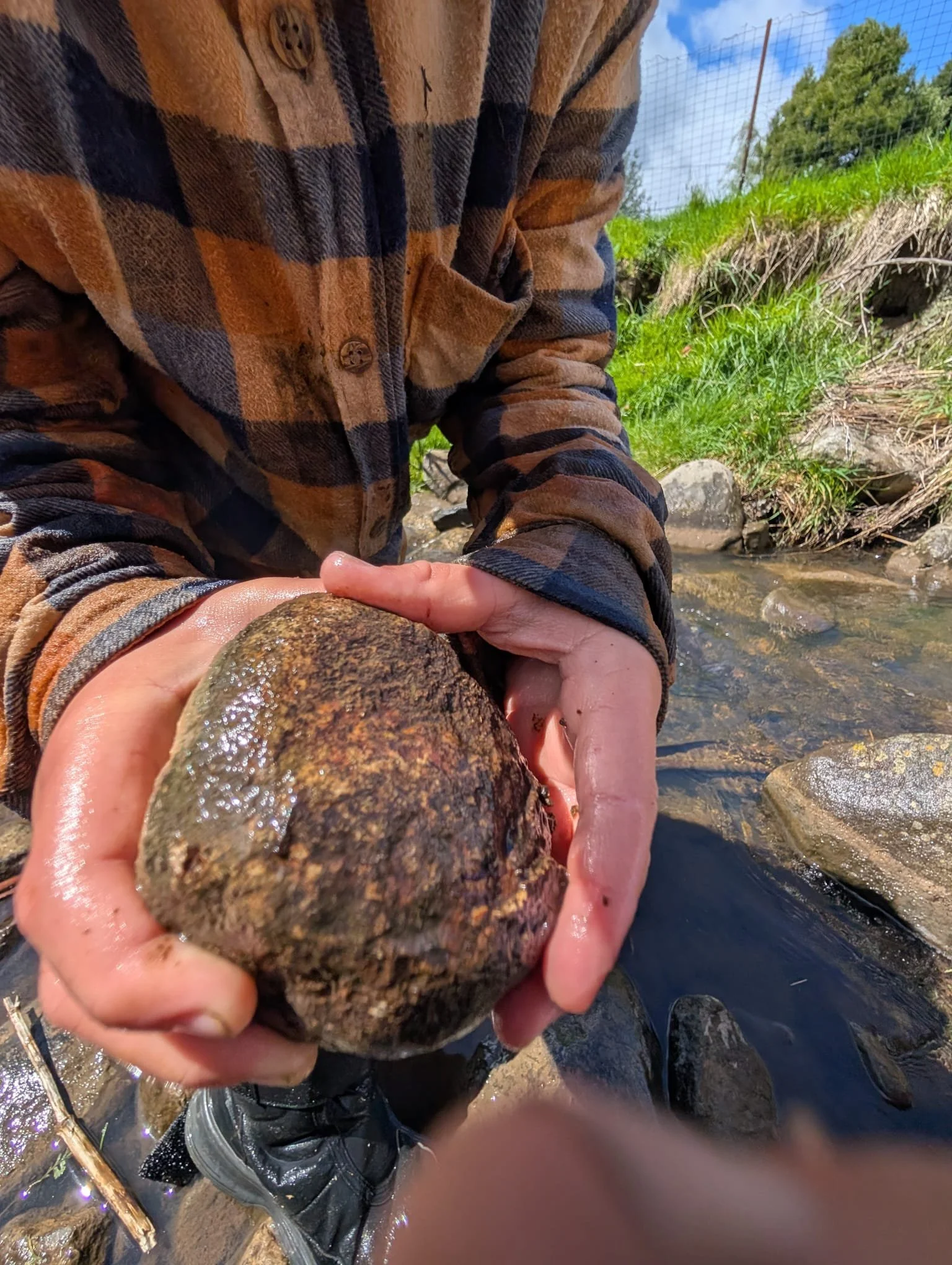
Citizen Science Explorations by Tarkind Collective, as Part of the Great Southern BioBlitz. Photography by Emily Samuels-Ballantyne

Citizen Science Explorations by Tarkind Collective, as Part of the Great Southern BioBlitz. Photography by Emily Samuels-Ballantyne
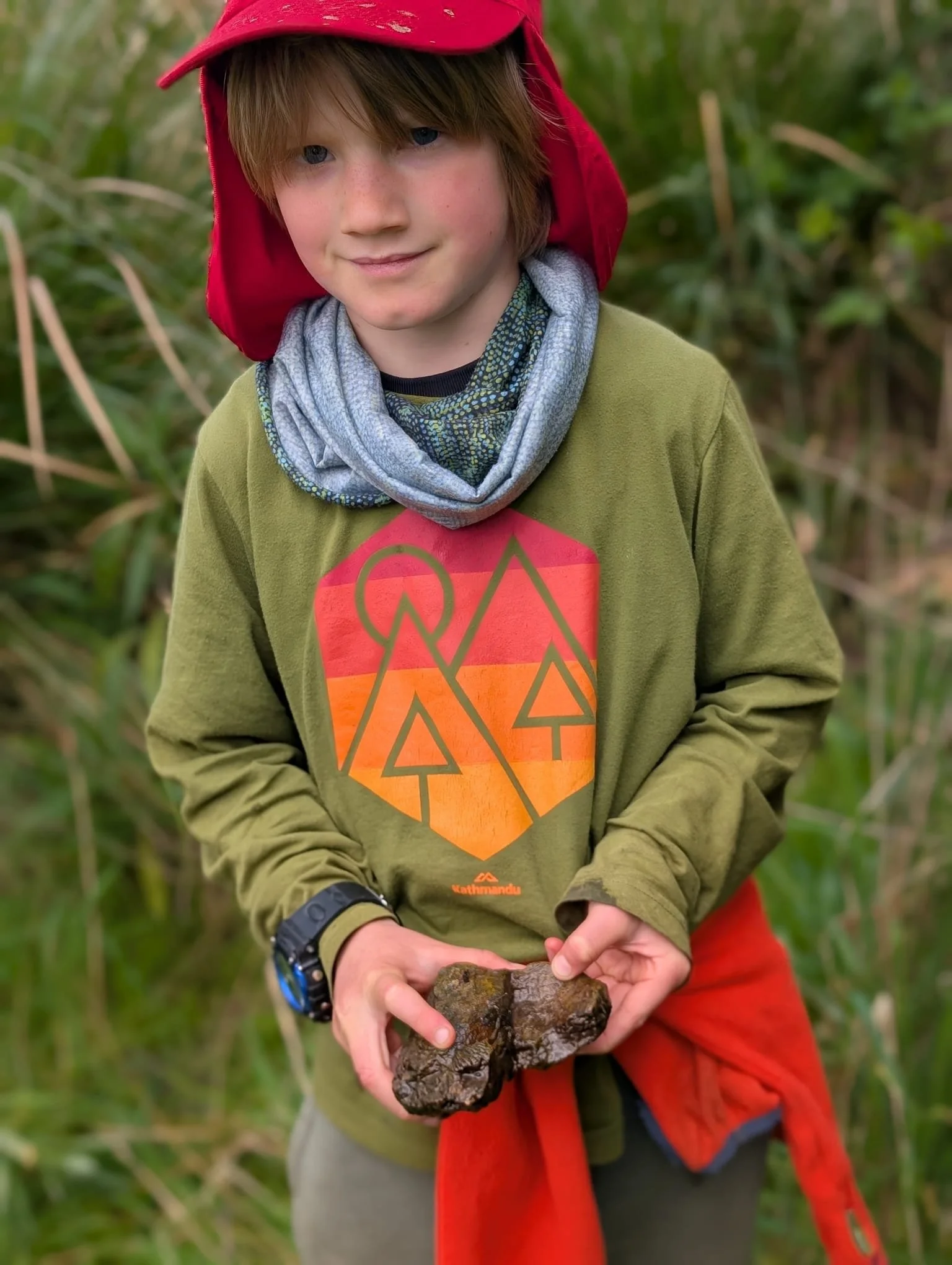
Citizen Science Explorations by Tarkind Collective, as Part of the Great Southern BioBlitz. Photography by Emily Samuels-Ballantyne

Citizen Science Explorations by Tarkind Collective, as Part of the Great Southern BioBlitz. Photography by Emily Samuels-Ballantyne
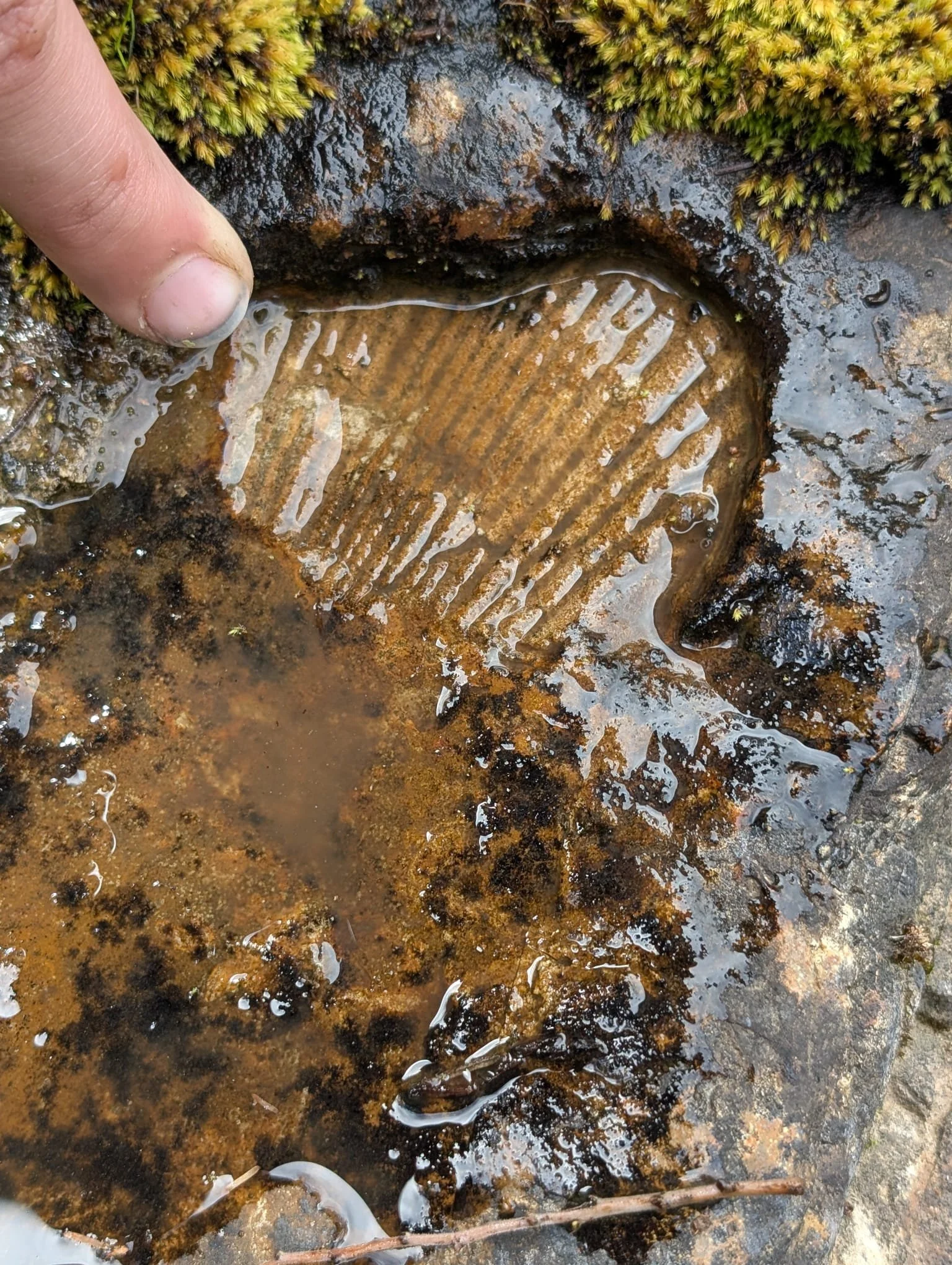
Citizen Science Explorations by Tarkind Collective, as Part of the Great Southern BioBlitz. Photography by Emily Samuels-Ballantyne

Citizen Science Explorations by Tarkind Collective, as Part of the Great Southern BioBlitz. Photography by Emily Samuels-Ballantyne
Learn more at:www.tarkind.org
(Companion to “Healing the Shadow of Stolen Land” - Peace in the Outer World Essay)
By Dr Demeter (Emily Samuels-Ballantyne, Magical Farm Tasmania)
For years, I have tended to the outer world, in the soil, the garden, the policy room and public spaces. I knew, theoretically, the importance of the inner world, but never gave myself the time to go deep, not in a true, embodied sense. But now I understand: the way I treat my own body is the way I treat the Earth.

Echinecia - a symbol of balance, peace, patience, moderation, inner calm, perspective, tranquility, harmonious relationships in Magical Farm. Photography by Ness Vandebourgh Photography
Biodynamic practice has been both a signal and a breaking point, revealing the limits of the old way, the burnout of doing without being. It has cracked me open to feel grief, to meet the shadow, and to descend into the inner world where regeneration truly begins. When I move through yoga or Pilates, I’m not striving to improve; I’m learning to inhabit. My body is my first ecosystem, a landscape of weather, soil, and song.
This is what I call beauty without an agenda, the act of moving, creating, or resting not for an outcome but for aliveness itself. It is the essence of Con Viv, to live with life, to participate once more in its living conversation.
Carl Jung taught that healing requires the courage to meet the shadow, the parts of ourselves we deny or overextend. I have often lived in the shadow of the giver: pouring out vision and care until depletion whispered its quiet warning. Jung reminds me that what we do not integrate within will return to us through the outer world.
Rudolf Steiner would see this as an imbalance between the etheric and astral bodies: too much outward giving, not enough inward renewal. He speaks of the need for ‘rhythm’: day and night, work and rest, giving and receiving. Regeneration depends on that sacred breathing of life.
Tyson Yunkaporta would describe this as a “pattern distortion” a break in reciprocity between self and Country. When we move without listening, we step out of pattern. His custodial law asks us to live in right relation, to act as participants in the story of place rather than its authors.
And Joanna Macy offers a way back: her Work That Reconnects transforms burnout and despair into action through gratitude, grief, perception, and practice. She teaches that our pain for the world is proof of our belonging and that thread that reweaves us into community.
Many of us who care deeply for the world have forgotten to include ourselves in the circle of care. We overwork the soul as we have overworked the soil - the industrial and modern pattern is entrenched and the redesign requires us to break that pattern. The medicine and pattern we need in life is greater care and gentleness and part of this revolution is simply just to rest. Beauty without an agenda is how the overextended spirit learns to breathe again. It reminds me that the feminine act of receiving is not passivity, it is participation in the flow of creation.
Our bodies are not private possessions; they are commons - microcosms of the planet itself. When one person slows down, the field shifts - as we are all part of an interconnected life system. When one person moves with grace, the world feels it, ah, how I need to remind myself of this again and again. In the language of our four teachers, this is the crossroads where the inner and outer worlds meet:
Jung’s integration of the shadow.
Steiner’s spiritual ecology.
Yunkaporta’s relational custodianship.
Macy’s collective awakening.
Together, they teach that the Earth feels through us, that every act of awareness in the body is a small awakening in the world.
In my birth chart, Chiron, the Wounded Healer, rests in Taurus in the third house, the realm of communication and connection. It teaches healing through the ‘Beauty Way’: through embodied language and sensory wisdom. Yet as I write, transiting Chiron moves through Aries, lighting up my second house of self-worth and resources. Together, these transits open a deep dialogue between value and voice, how I speak, what I create, and what I believe myself worthy to receive.
For much of my teenage and adult life, I sought peace through words, by explaining, convincing, or teaching. The ‘education’ system took me out of my body and told me it was my mind that needed to navigate. But my heart and Chiron keeps guiding me back to something simpler: that the most profound communication is not spoken, but lived. I am now remembering myself as a child, in my garden, in nature, in my imagination and quite the introvert. This is my happy place.
Taurus teaches that words are most powerful when they are rooted in the body, when the throat, heart, and hands speak together. Every breath, every gesture, every act of care becomes a form of language the world understands. This is the healing of my Chiron wound: learning that true communication is not persuasion, it is presence. And Aries’ fire now reminds me that self-worth is not a concept, it is a practice of being here, fully alive, in one’s own embodied authority.
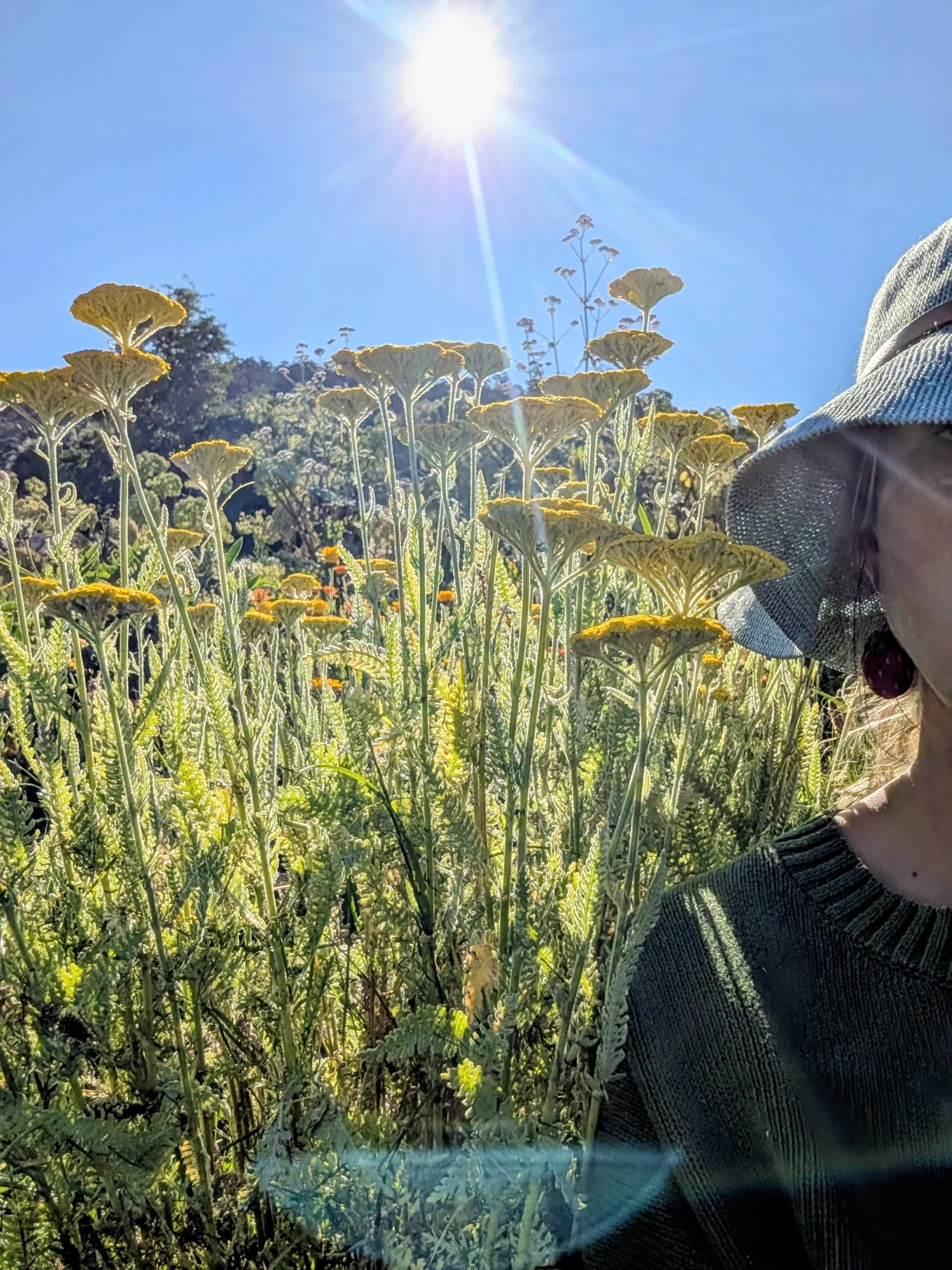
At my front doorstep and throughout the farm, Yarrow grows freely, one of the first plants to greet visitors, one of the last to fade. She is both delicate and indestructible, soft and strong and a child of Venus and Chiron, and thus a true teacher of the Beauty Way.
Yarrow reminds me what embodied communication looks like in nature. She doesn’t speak, she radiates. In summer, I watch beetles and bees land upon her umbels; she receives them with grace and gives nourishment in return. I love watching this and feel so fulfilled that I have given so much life to the land and all of these beautiful living creatures.
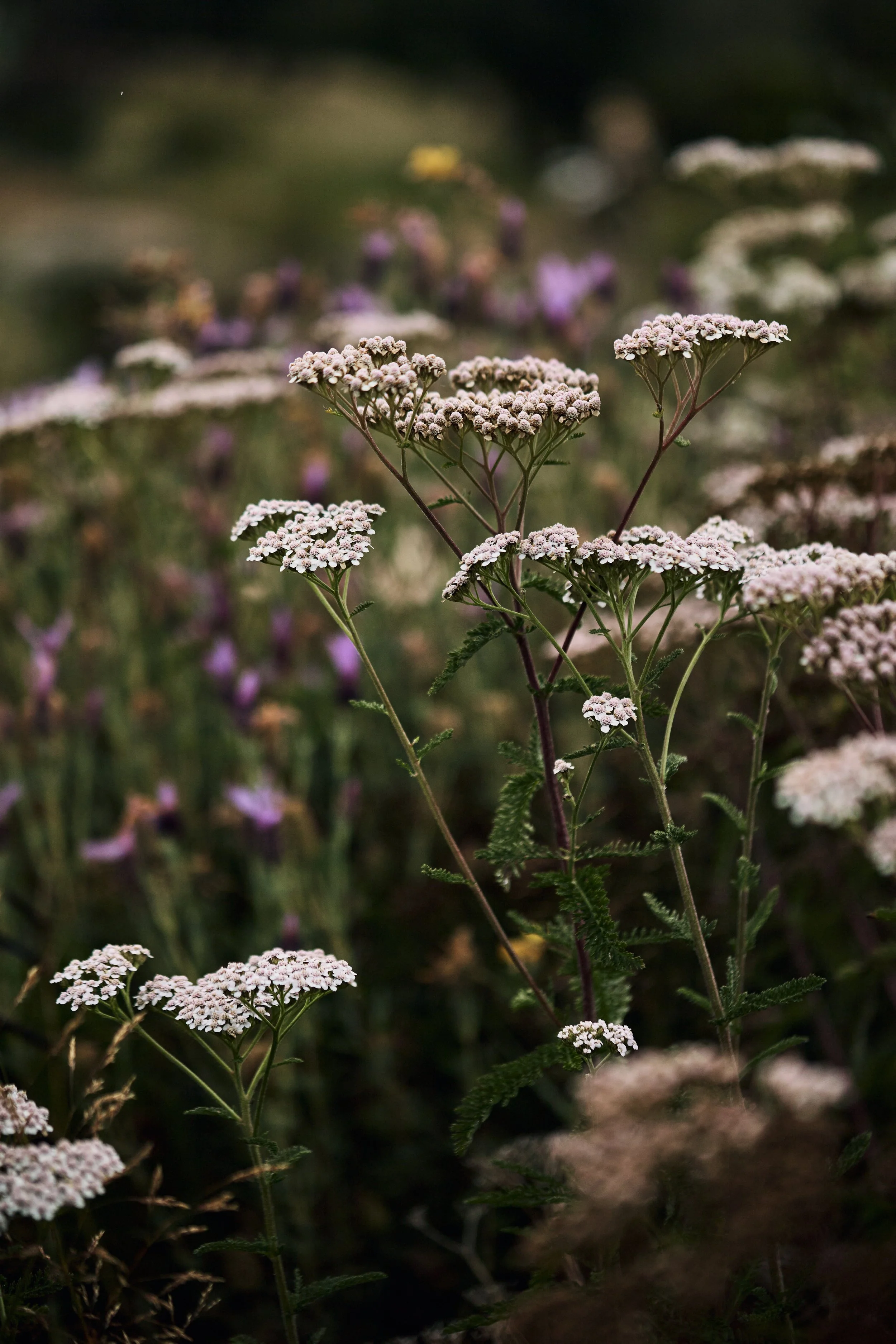
Yarrow on Magical Farm Symbol of integration, new beginnings, creative sparks, finding new passion, starting something, potential, talent … Photography by Ness Vandebourgh Photography
Yarrow, rooted in poor soil, thrives not through lack but through inner sufficiency and her ability to integrate what is around her and alchemise it into nourishment. Oh Yarrow, you beauty. She embodies the principle that Steiner called “etheric intelligence”: the plant’s capacity to mediate between Earth and cosmos and matter and meaning. Through Yarrow, I learn that true healing is about integration, being okay with complexity and ‘letting it be’. Like her, I am learning to root deeply, receive openly, and give back simply by being fully alive. Yarrow is my daily reminder that beauty without an agenda is enough.
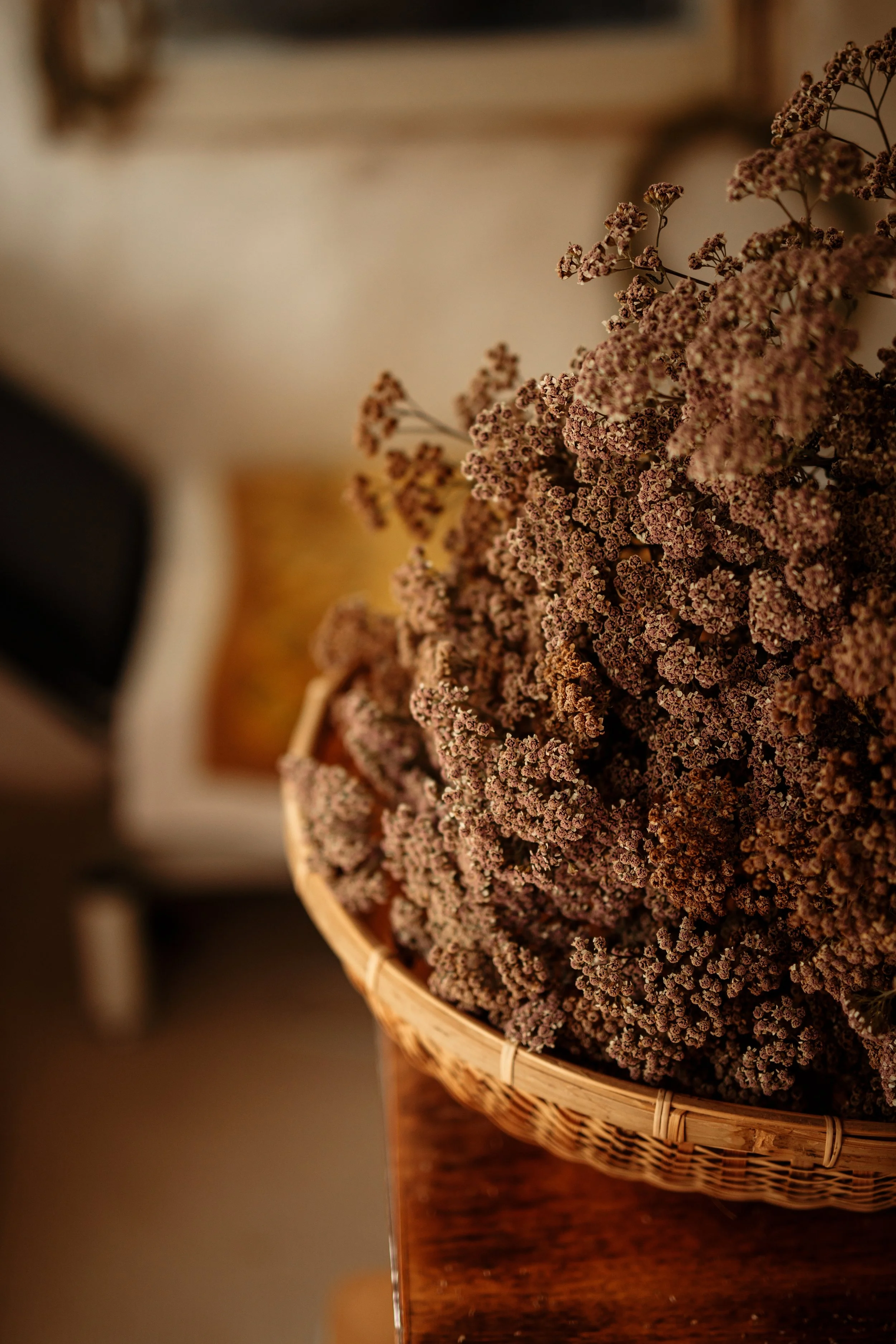
Yarrow at Magical Farm’s Herb Drying Cob House by Ness Vandebourgh Photography
At Magical Farm Tasmania, we practice this integration every week. Our Thursday Landcare gatherings begin in stillness, noticing our breath, our bodies, and the land’s quiet pulse before we touch the soil. In my body practice that I share in community which is called YoFence, the fusion of sword and yoga, we embody balance: the sword for boundary, the breath for belonging. Strength and softness meet as a new kind of dialogue, one where courage and compassion co-exist.
In January 2026, our YoFence Immersion at Urdara will offer seven days of this embodied communication: seven days of courage, conviction, and connection lived through the body as a prayer for the planet.
Jung teaches: integrate.
Steiner whispers: balance.
Yunkaporta reminds: relate.
Macy calls: reconnect.
And Yarrow, growing at my door, simply “is”. Together they form a mandala of inner peace that radiates outward. When we come home to our own embodiment, we are no longer separate from the world we wish to heal.
Beauty without an agenda is the quiet revolution of our time. To move, rest, or create for no reason other than the joy of being alive is to align with the regenerative intelligence of Earth herself. When I inhabit my body as sacred ground, the land recognises me and in that recognition: soft, wordless, whole, peace begins again.
“When I speak through my body, the Earth understands.”
By Dr Demeter (Emily Samuels-Ballantyne)
The phrase “No peace on stolen land” echoes across our world, painted on banners, whispered in prayer circles, shouted at rallies. It speaks an uncompromising truth: peace cannot be built on a foundation of denial. Every field, city, and coastline that carries the memory of dispossession holds an unhealed psychic and spiritual wound.
But beneath this cry is also a question: Can peace be restored, and if so, how? To explore this question through a healing lens, we must descend into the deeper currents of psyche, spirit, and story. I will weave in here four teachers: Carl Jung, Rudolf Steiner, Tyson Yunkaporta, and Joanna Macy, and each of them offer a path not of forgetting, but of remembering. By remembering I mean, remembering what we are part of, and what we are responsible for.
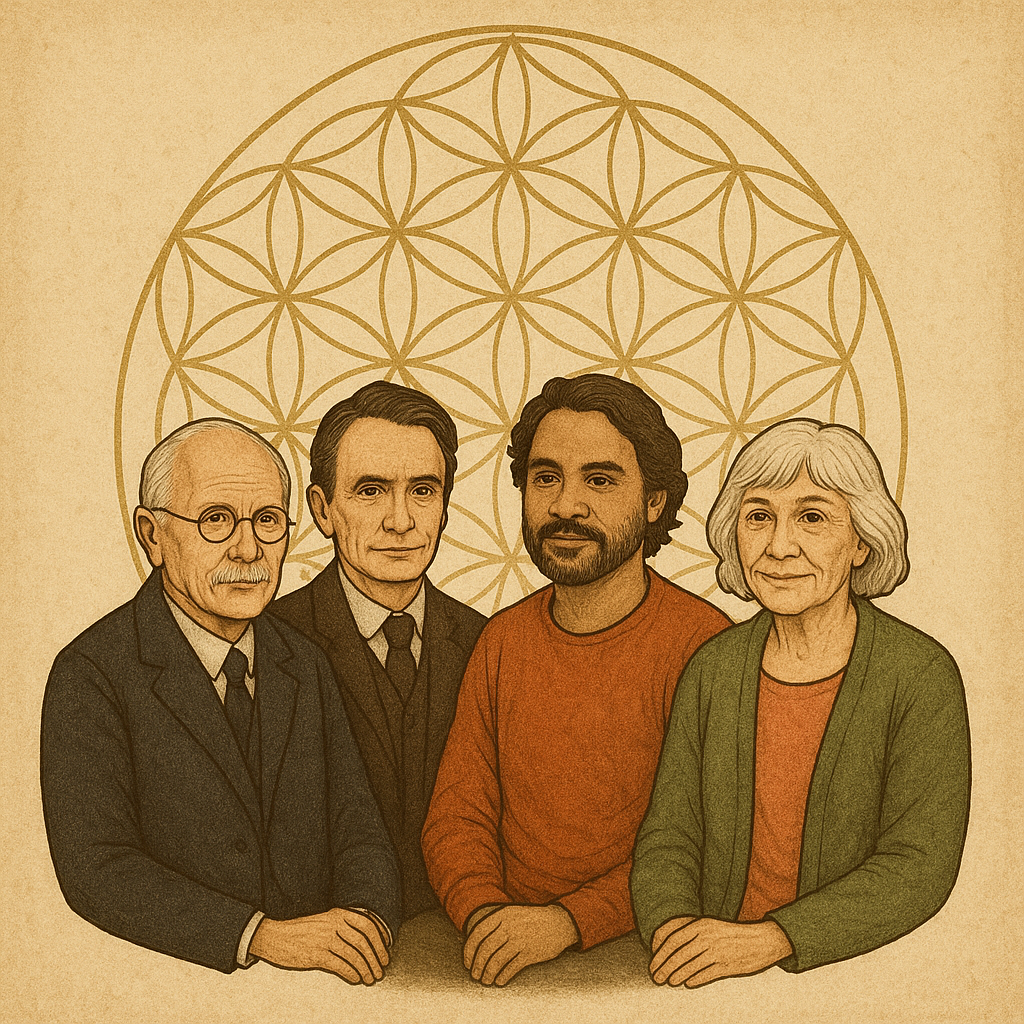
Carl Jung, Rudolf Steiner, Tyson Yunkaporta, and Joanna Macy by Regen Era Design Studio
Firstly, lets explore Jung through his lens of The Shadow of Civilisation thesis. Carl Jung reminds us that what we refuse to face becomes the shadow that governs us. The colonial enterprise was not only a material conquest; it was a projection of the Western psyche’s own disowned parts: the feminine, the Indigenous, the Earth herself. We see and feel this fracture everywhere today.
“No peace on stolen land” therefore mirrors a deeper unrest within consciousness. Jung would call for an individuation at a cultural scale…a process in which societies, not just individuals, make the unconscious conscious. There is a great responsibility of traditional and social media platforms to embrace these principles. Research shows much media these days is binary and performative. Healing the shadow means acknowledging complicity, integrating grief, and transforming guilt into responsibility and it asks that we replace domination with dialogue, not only with one another, but with the land itself.
Secondly I weave in Steiner and his insight called “The Spiritual Law of Balance”. For Rudolf Steiner, the Earth is not an object but a living being, so to take from Gaia without spiritual reciprocity creates karmic imbalance, which equates to a kind of moral drought. He urged humanity to develop a “threefold social order”: cultural freedom, political equality, and economic fraternity.
Applied to our context, this means:
Cultural repair through reverence and education of the spirit.
Political repair through self-determination and honest dialogue.
Economic repair through transforming ownership into stewardship.
To Steiner, peace is not the absence of conflict; it is the “presence of balance”, between matter and spirit, between taking and giving, between human will and cosmic rhythm.
Thirdly, I weave in Yunkaporta, and his tapestry offering of Custodial Mind and Pattern Thinking.
First Nations philosopher Tyson Yunkaporta takes the conversation further by dissolving the illusion of ownership itself. In his worldview, land is not a thing to be stolen or possessed: it is a web of relationships. What colonisation breaks is not just geography, but the pattern which is the living, intricate, reciprocal law that keeps Country alive.
Healing, then, is the restoration of right relationship “custodial mind”. We are in essence custodians of land, layer, upon, layer upon layer. It is not about guilt or transaction, but participation in the story of place. Yunkaporta teaches that peace is not achieved through comfort, but through correct relation, through ceremony, conversation, and care. When humans remember themselves as one thread in a living system, the land begins to remember them in return.
Fourth in the foundational woven offering I bring today, is Macy and her concept of “The Work That Reconnects”. She is an Eco-philosopher who now brings us the missing piece: the praxis of collective transformation. By praxis I mean idea/theory in practice! She names our time as the “The Great Turning”, a transition from an industrial growth society to a life-sustaining civilisation.
Macy invites us to feel the world’s suffering as our own, not as despair but as a doorway. Her “Work That Reconnects” moves through four stages:
1. Coming from Gratitude and anchoring in what still lives.
2. Honouring Our Pain for the World: facing grief and rage together (this is also a community engagement methodology P2P if you were interested to read more on it).
3. Seeing with New Eyes: by recognising interbeing and systemic wholeness.
4. Going Forth: by acting from compassion and courage.
Through Macy’s lens, “No peace on stolen land” becomes not an accusation, but an initiation, a call to transmute sorrow into sacred action.
At Magical Farm Tasmania, we live these teachings as daily practice. Each Thursday (Jupiter Day), our Landcare Group gathers to tend the earth, learn herbal wisdom, and farm in rhythm with the cosmos. Through biodynamic agriculture, we explore the sevenfold patterns of life, the seven planets, chakras, and days of the week, as mirrors of wholeness. Here, peace is not an abstract hope but an embodied rhythm: composting grief into growth, listening to soil microbes as teachers.
Through the lenses of Jung, Steiner, Yunkaporta, and Macy, peace emerges as a “living verb”, a process of becoming whole again.
Psychic repair (Jung) integrates the shadow.
Spiritual repair (Steiner) restores balance.
Custodial repair (Yunkaporta) renews relationship.
Collective repair (Macy) transforms grief into generative action.
Together, they form a mandala of healing, a compass for those who seek not just to protest the past, but to re-pattern the future.
To heal the statement “No peace on stolen land” is not to soften its truth, but to evolve its meaning. Peace cannot be declared, it must be CULITVATED.
When we acknowledge the shadow, honour our pain, reconnect with the living Earth, and act from love, peace becomes a praxis, a daily tending of relationship between people, place, and planet.
At Magical Farm, we hold this as both philosophy and practice: Healing the land is healing the self and restoring the pattern is restoring peace.
Join us at Magical Farm Tasmania to volunteer, participate in our YoFence Immersion, www.magicalfarm.org or explore regenerative living through the Regen Era Design Studio. www.regeneradesign.org
“Together, we can re-imagine peace, not as a treaty signed upon the Earth, but as a seed sown within here”
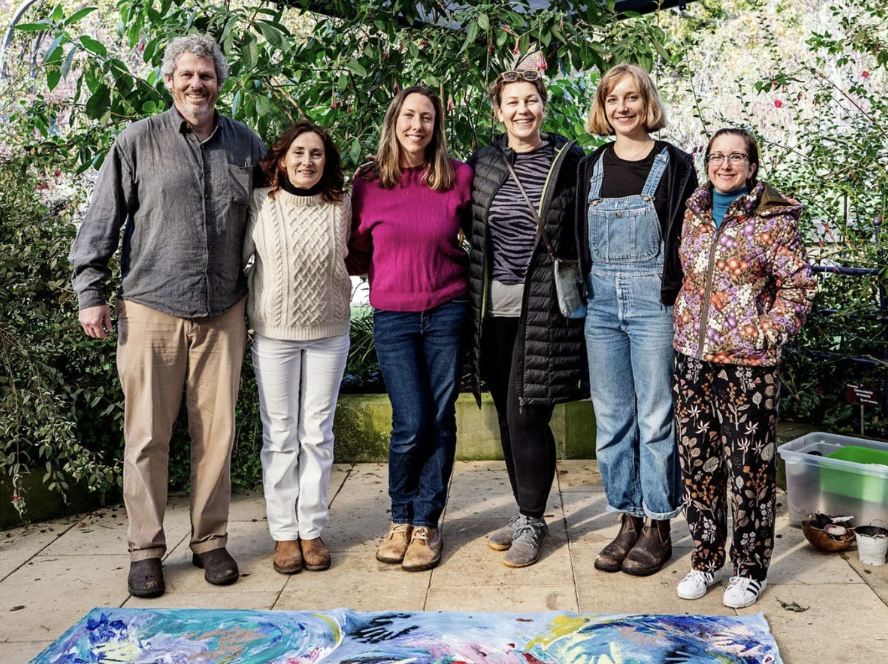
We began Tarkind in 2022 as a small collective, myself and my son Zach, invertebrate biologist Dr Keith Martin-Smith, and palawa woman Gemma O’Rourke, to weave science, story, and art into everyday care for place. We are excited to announce our 2025 Tarkind community art and citizen science day! Firstly I want to share why we want to educate about living systems.
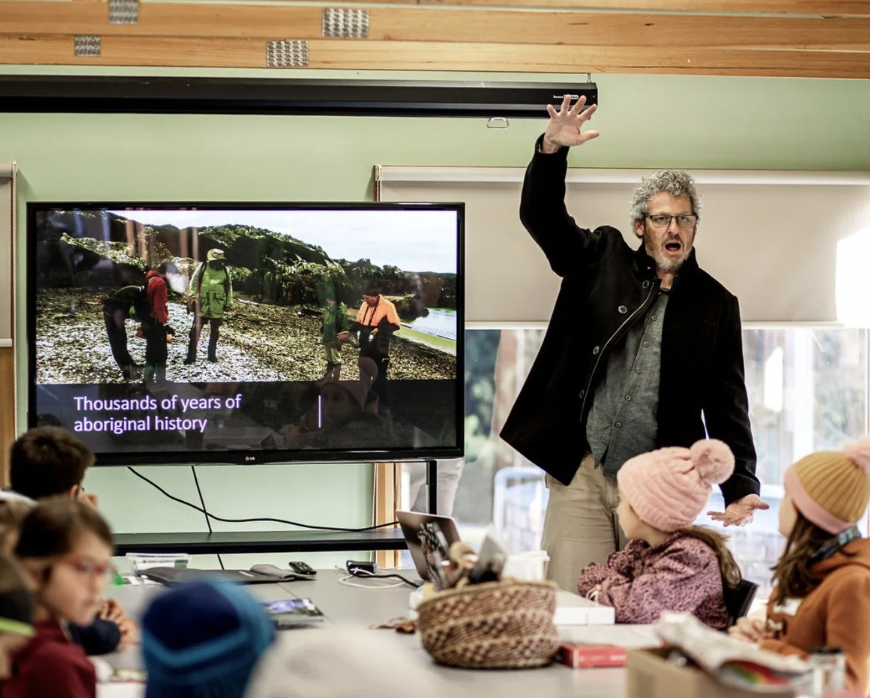
In Tarkind we work from a simple conviction: life works in relationships. Fritjof Capra calls this the systems view of life: living beings, communities, and ecologies are networks of relationships whose health depends on patterns, flows, feedback, diversity, and rhythm, rather than on single parts. For Capra, this isn’t only biology or ecology; it’s also ethics and meaning. When you see the web, a quiet spiritual intuition follows: we belong to something larger. That belonging is not a doctrine; it’s a practice of attention, of noticing consequences, caring for cycles, and letting our actions be accountable to the whole.
Daniel Christian Wahl extends this into culture. His question is: what kinds of cultures help places to heal? He invites us to design for regeneration, work that leaves people and places more capable than before. That means place-sourced learning, bioregional thinking, circular use of materials, and stories that grow responsibility rather than extraction. In his frame, art, education, and landcare are not extras; they are cultural technologies that renew our capacity to live well together.
Walk, notice, name. We use iNaturalist and field journaling to see the web, Capra’s patterns are therefore made tangible.
Paint what we felt and found. The art is how the insight lands in the body and the community; it keeps the story alive.
Plant and repair. Regeneration is Wahl’s litmus test: did our time together leave the place more resilient?
This is also the heart of my Con Viv work, head, heart, and hand in one movement, supported by David Orr’s reminder that all education is environmental education, and Satish Kumar’s call to hold soil, soul, and society in balance.
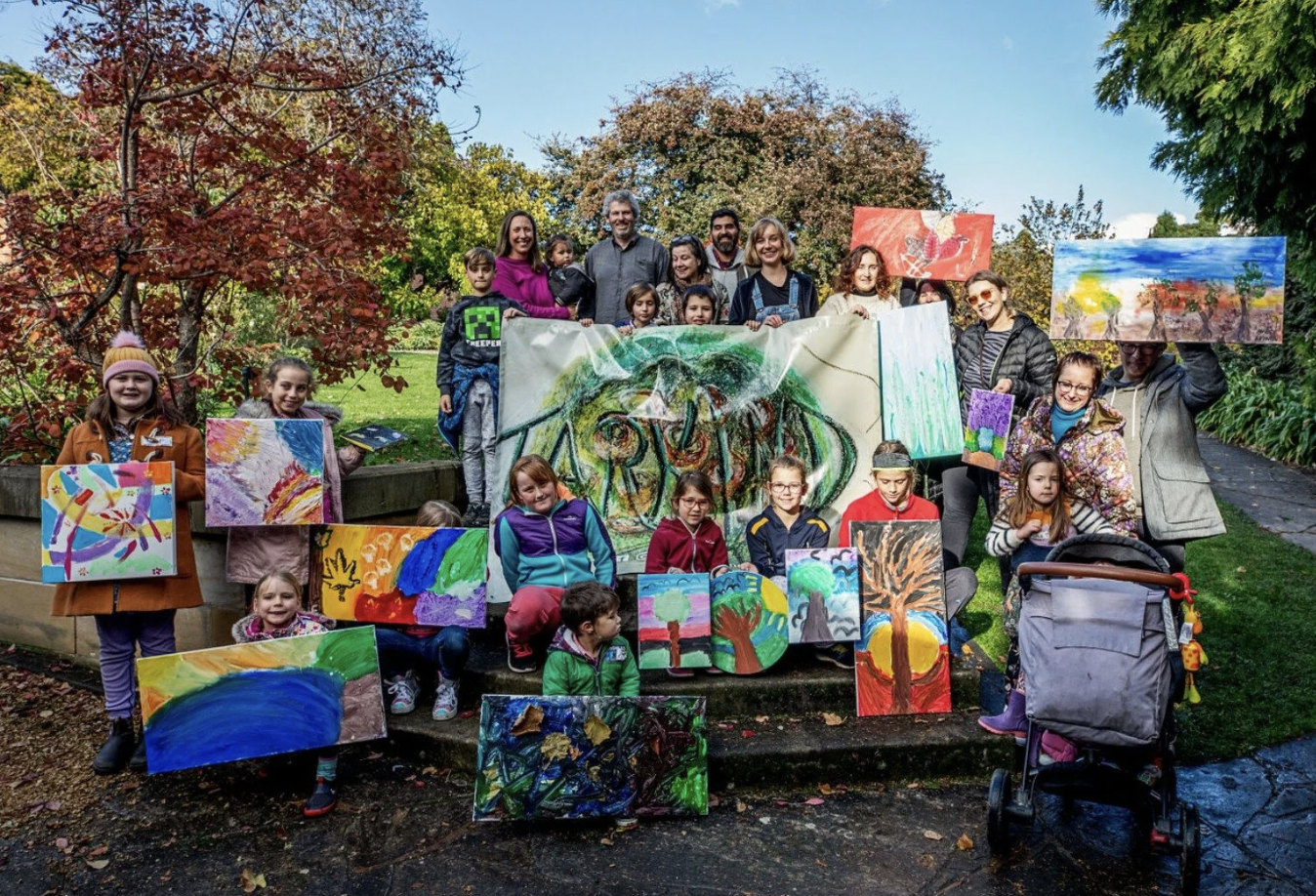
Photography by Ness Vandeburgh Photography
Why it matters: a living-systems worldview builds tolerance (difference is an asset), love (care becomes structure: roles, rhythms, and repair), and a gentle spiritual stance (reverence for the whole we share). If more of our schools, councils, and neighbourhoods worked this way, conflict wouldn’t vanish, but it would have somewhere useful to go, into listening, making, planting, and the slow renewal of culture.
Citizen science is everyday people helping do real science. We notice, record, and share observations, photos, sounds, simple measurements, and those data feed into research, conservation planning, and education. It’s hands-on learning that turns curiosity into evidence: you don’t need a lab coat, just attention, respect for place, and a phone or notebook. For kids and adults alike, it builds ecological literacy, confidence, and a sense of belonging to the living world.
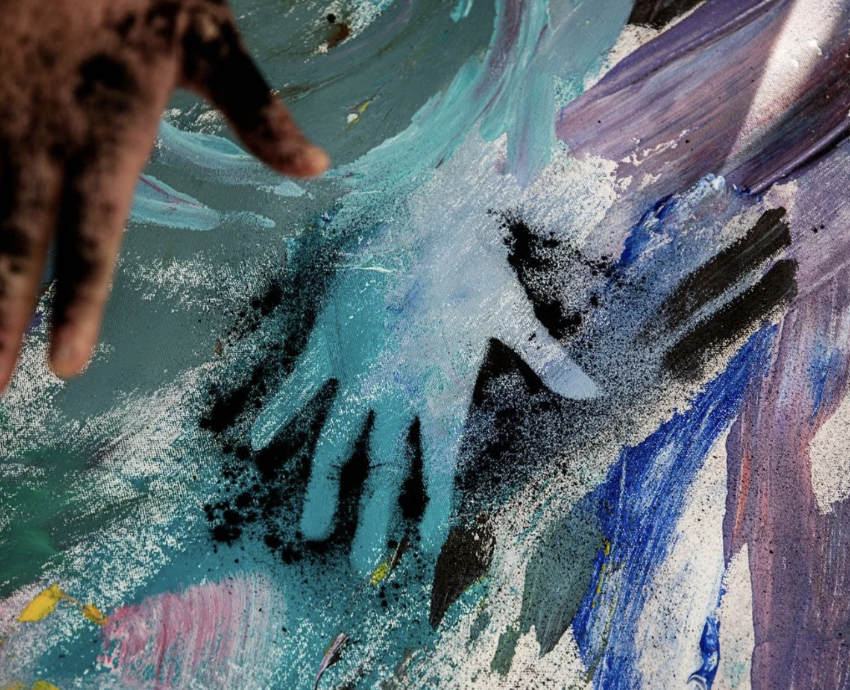
Photography by Ness Vandeburgh Photography
The Great Southern BioBlitz (GSB) is a southern-hemisphere biodiversity event held each spring that invites communities to document as many species as possible over one long weekend using platforms like iNaturalist. Local groups host walks, workshops, and mini-surveys; participants upload what they find; volunteer identifiers help name species; and the pooled results give scientists and land managers a richer picture of local ecosystems. We collaborate with GSB to connect our Tarkind walks and art sessions to this wider effort, so every observation we make together becomes part of a bigger, shared map of life in our region.
Next event: Magical Farm × Great Southern BioBlitz × Magical Farm Landcare Group, Sunday 26 Oct 2025, 10:00–2:30. We’ll gather at Magical Farm, convoy to Allens Rivulet Track for the Bioblitz, then return for a shared lunch, Tarkind community art, and a short planting. Bring iNaturalist, warm layers, water, a plate to share, and an art canvas (large or small) + paints. Families welcome. Message me for details.
Tarkind is a reminder: when we live with life, the future stops being an abstraction and becomes something we can touch, tend, and paint together.
The human world hums with tension. Meetings flare into argument, social feeds crowd into outrage, and kitchens, workplaces, and councils echo with competing voices that rarely feel heard. Con Viv, which simply means “with life,” treats this heat as living energy rather than waste. In living systems disturbance is not an error but information, so the real question becomes whether we can build vessels strong enough to hold that energy and transform it into insight, relationship, policy and practice.
Jung’s insight is helpful here. When two poles lock against each other, a “third” thing is missing. The “Third” is not a bland compromise but a new form that appears only when opposites are consciously held long enough to reveal a creative synthesis. Our public life often fails at this, since we either suppress conflict in the name of peace without truth, or inflame it in the name of truth without peace. If we want to move beyond that binary, we need containers that invite the Third to appear, which is a cultural and institutional task rather than a purely emotional one.
Anthroposophy offers a clear shape for healthy community life. It says culture thrives with freedom, our shared rules should treat people as equals, and our economy should be based on mutual support. When we mix these up, trust breaks down. When we keep them distinct and in balance, love becomes something you can build with. Roles are placed where they fit, relationships are cared for, and decisions follow a steady rhythm so care can move through a community reliably. Con Viv turns this into practice through head, heart, and hand: seeing clearly, meeting each other warmly, and making things together. We move through a simple cycle of notice, hold, transform, and act. The aim is not to remove conflict but to guide its heat into learning and useful patterns.
On the ground this looks ordinary and practical. Listening spaces give people a way to speak without fear so that heat turns into information that everyone can use. Rights containers make decision paths visible with transparent timelines, rotating facilitation, small trials that run for a set period, and a public review that invites revision rather than punishment. Mutual-aid prototyping redirects arguments into safe-to-try projects such as verge care, herb plots, walking routes, tool libraries, and shared maintenance days, so trust grows sideways through work done together. Creative activation turns disputes into raw material for theatre, music, murals, and story-gathering, since new forms often appear first in image or gesture before they can be legislated. Individual containment gives each person a way to hold strong feeling through journaling, contemplative movement, boundary practice, or a quiet walk, which is less about private self-help and more about civic hygiene that prevents projection from flooding the commons.
The virtue that names the tone of this work is Michaelic courage, a clear and warm quality of attention that meets the dragon without becoming one. In practice this looks like precision instead of blame, imagination instead of cynicism, and rhythm instead of rush. It is a kind of heart-thinking where understanding is shaped by interest in the other, which keeps the social field from hardening into camps and slogans. Conflict will not vanish, nor should it, since friction keeps systems alive. What changes is the destination of that energy. Within a living container the spark falls into a wider field and can ripen into a third thing, perhaps a pattern other places can reuse, a pilot that becomes policy, or a poem that restores language where it had collapsed.
This is the seed-vision here… Love becomes infrastructure that shapes decision making, convivial governance, and everyday interaction, while Con Viv offers a choreography for the passage from heat to practice. Jung gives us the organ of perception for the Third, and Anthroposophy gives us a social anatomy that keeps freedom, equality, and mutuality in honest relationship. Together they sketch a future life system that is robust enough to hold our heat and gentle enough to help us grow. Here, friction is fuel and the vessel that turns it into life is made, maintained, and renewed in common.
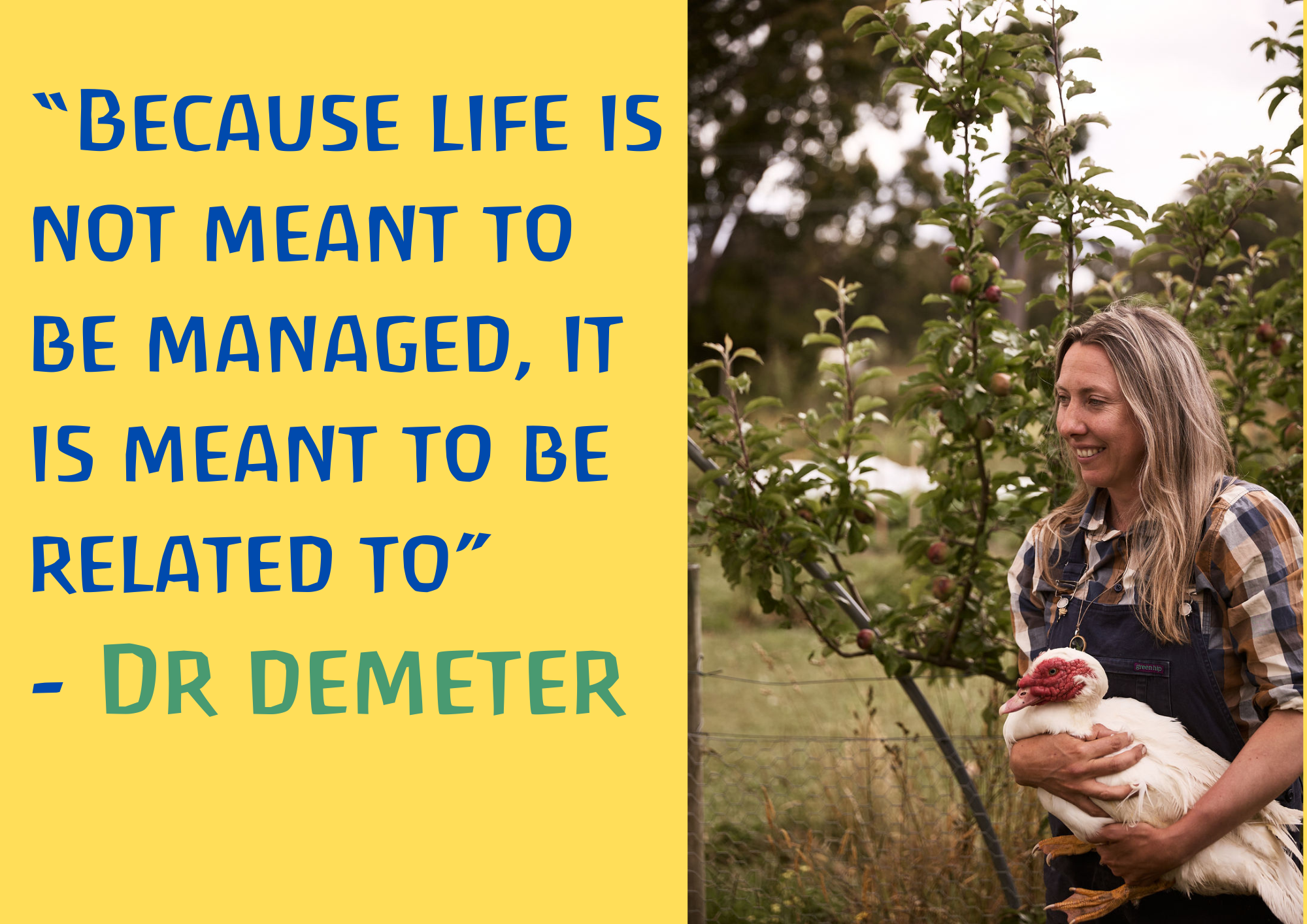
Photography by Ness Vanderburgh