Stop Funding PDFs. Start Funding Patterns.

Australia doesn’t have a shortage of climate, local food and resilience strategies. For example, the university of Sydney legal team mapped 2,266 local-government food policies and plans across NSW and Victoria and found the same priorities repeating across councils (University of Sydney, Law & Food Systems Lab, Policy Database assessment, 2024). The ideas aren’t the problem; the translation is. We need fewer PDFs and more living patterns in everyday life. By “patterns,” I mean reusable design moves that are human-scale solutions to recurring problems, drawn from 1970s architect Christopher Alexander’s A Pattern Language. They’re not rigid plans but living templates you can adapt and combine so good practice spreads.

At the same time, Canberra has launched big resilience funds. The Disaster Ready Fund (DRF) commits up to $1 billion over five years from 1 July 2023 (Australian Government, National Emergency Management Agency, DRF Program Guidelines, 2023). Before that, the Preparing Australia Program was $600 million for risk reduction (Australian Government, Home Affairs/NEMA, Preparing Australia Program Overview, 2021). Are these necessary? Yes, absolutely. The trouble is the money still arrives as big, stop-start programs routed through state channels which are paperwork-heavy and practice-light, so we end up with glossy program sheets and thin local muscle memory. So why don’t we flip it? By reserving a small, steady slice for place-based facilitation, prototyping, and pattern-writing on the ground, so people can try, learn, and repeat safely, creating true local capability, beauty and resilience.

Add to that an ongoing appetite for external advice, federal consultancy contracts approaching $1 billion in 2024-25 despite pledges to reduce reliance (Commonwealth procurement data; ANAO briefings, 2024–25), and it’s easy to see why many communities feel resilience happens on paper. Reports multiply while practice stalls. Meanwhile, Tasmania’s ‘local government reform’ debate is consumed by boundary maps and amalgamation talk rather than the everyday practices, skills, and permissions communities and councils need to host small experiments and build & enable local capability.

What if we funded patterns, not PDFs?

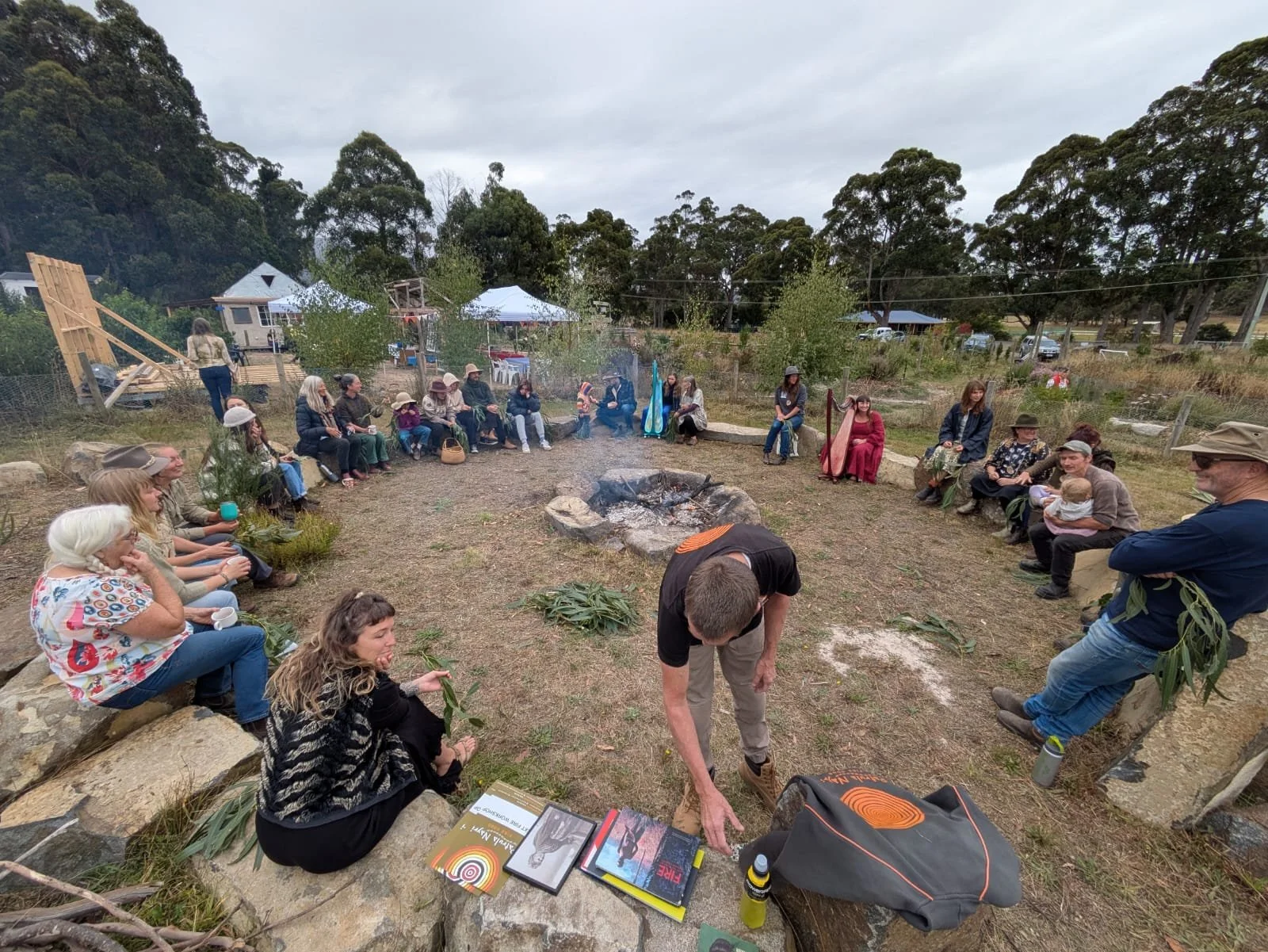
A pattern is a small, hosted experiment that takes one sentence from a policy and turns it into a safe, try‑it‑now activity that people can run next month in a street, a hall, or on a farm. For example, you might set up a seed library with a simple crop‑swap that runs like a regular class; host a shared evening meal and organise a roster for a local food co-op; or in bushfire prone areas walk the neighbourhood together to tidy verges, check access points, and, where appropriate and led by a local knowledge holder, carry out a careful cultural burn that builds understanding and reduces risk. Each pattern stays small, has clear edges about time, numbers, noise and care, uses only a few light measures to see what changed, and finishes with short notes that others can follow. If it helps, you write a one‑page ‘how we did it’ so the next street can repeat it tomorrow.
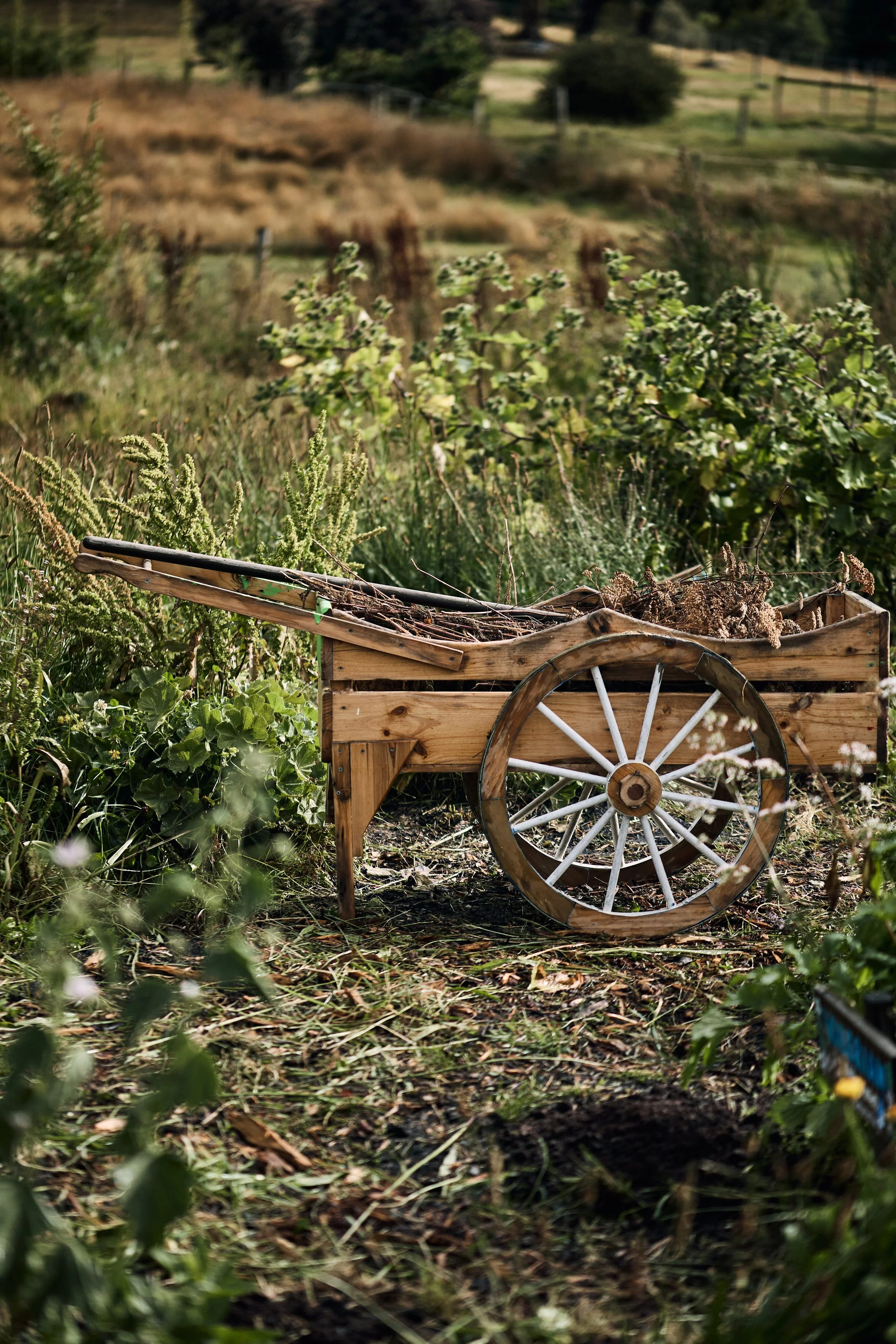
Photography of Magical Farm Herbs and Cart with a Heart by Ness Vandebourgh Photography

This is Con Viv, “with life”: keeping culture (freedom), rights (fairness), and economy (reciprocity) in rhythm (Threefold social theory; Con Viv fieldwork, 2010–2025). And it’s not theory, we’re doing it at Magical Farm: prototyping a cob herb-drying shed before a bigger barn; running a seed library that grew into a crop-swap; hosting regenerative workshops that build neighbour and community capability. Each trial is documented so others can repeat, adapt, and federate (link up as a commons network) enhancing local community (Magical Farm prototype notes, Regen Era Design 2024-2025).

The point is simple: we already spend enough to make the kind of work I am describing normal. The question is what slice of those budgets pays for local capability, facilitation, prototyping, and pattern-writing, so experiments can run safely and repeatedly without bureaucratic drag? The DRF’s billion could reserve even 1–2% as a Patterns Fund to seed hundreds of micro-trials nationally. Councils could match from existing climate/adaptation, community development, and economic development portfolios (City of Hobart Annual Plan & Budget 2025–26; Kingborough Operational Estimates 2025–26; Huon Valley Annual Plan & Budget 2025–26). States could underwrite insurance templates and light governance so trials are easy to host and easy to assess.

Would consultants still have a role? Sure, but as pattern stewards, not report factories: helping councils package what worked into simple, copy-ready guides; building the national pantry of patterns any town can draw from. Pay for reusable know-how and skills not shelfware. If this sounds small, that’s the point. Small is a safety feature. It’s fast, neighbourly, and honest. A micro-trial that doesn’t help can be retired without fuss; one that works can spread sideways, not from a press release but from a WhatsApp group and a one-page host sheet.

So let’s ask the only questions that matter right at this crucial point: Will we keep funding documents, or will we fund the ability to try things? Will we keep outsourcing resilience or will we grow local practices: the skills to host, measure lightly, and share patterns? Australia doesn’t need another plan to say “community matters.” It needs a permission culture that makes everyday experiments ordinary, with enough budget to back the people who host them, the templates that de-risk them, and the notes that help them travel.

Stop funding PDFs. Start funding patterns.

Dr Emily Samuels-Ballantyne is a regenerative designer, writer, and regenerative farmer based in southern Tasmania. Through Regen Era Design and Magical Farm Tasmania, she develops Con Viv, practical, hosted experiments that turn policy into everyday patterns. Her work focuses on community economies, convivial governance, and low-overhead ways to grow capability street by street. She led the award winning Huon Valley Food Hub project, which implemented Con Viv in practice.

Endnotes

  • Christopher Alexander, Sara Ishikawa, and Murray Silverstein, A Pattern Language: Towns, Buildings, Construction (New York: Oxford University Press, 1977).

  • University of Sydney, Law & Food Systems Lab, Policy Database assessment (NSW & Victoria), 2024.

  • Australian Government, National Emergency Management Agency, Disaster Ready Fund Program Guidelines, 2023.

  • Australian Government, Home Affairs/NEMA, Preparing Australia Program Overview, 2021.

  • Commonwealth procurement data summary; ANAO briefings on consultancy spend, 2024–25
New Moon Plantings: Imagining Governance Rooted in Care

As I tend hundreds of seedlings for the Magical Farm nursery…replanting rhizomes, stirring biodynamic preparations, making my living compost, I notice how plant rhythm steadies the day. Weeding, watering, planting: each gesture is a small prayer, a promise that care and reciprocity are the real foundations of community.

Alongside this, I’m navigating the maze of council planning. The demands, endless forms, fees that run into the thousands, compliance without care, reveal a system that separates rather than connects. Ratepayers fund these bureaucracies, yet the very people building homes, gardens, and farms find little guidance at the point of need. It’s a design that outsources stress back onto households and small farms.

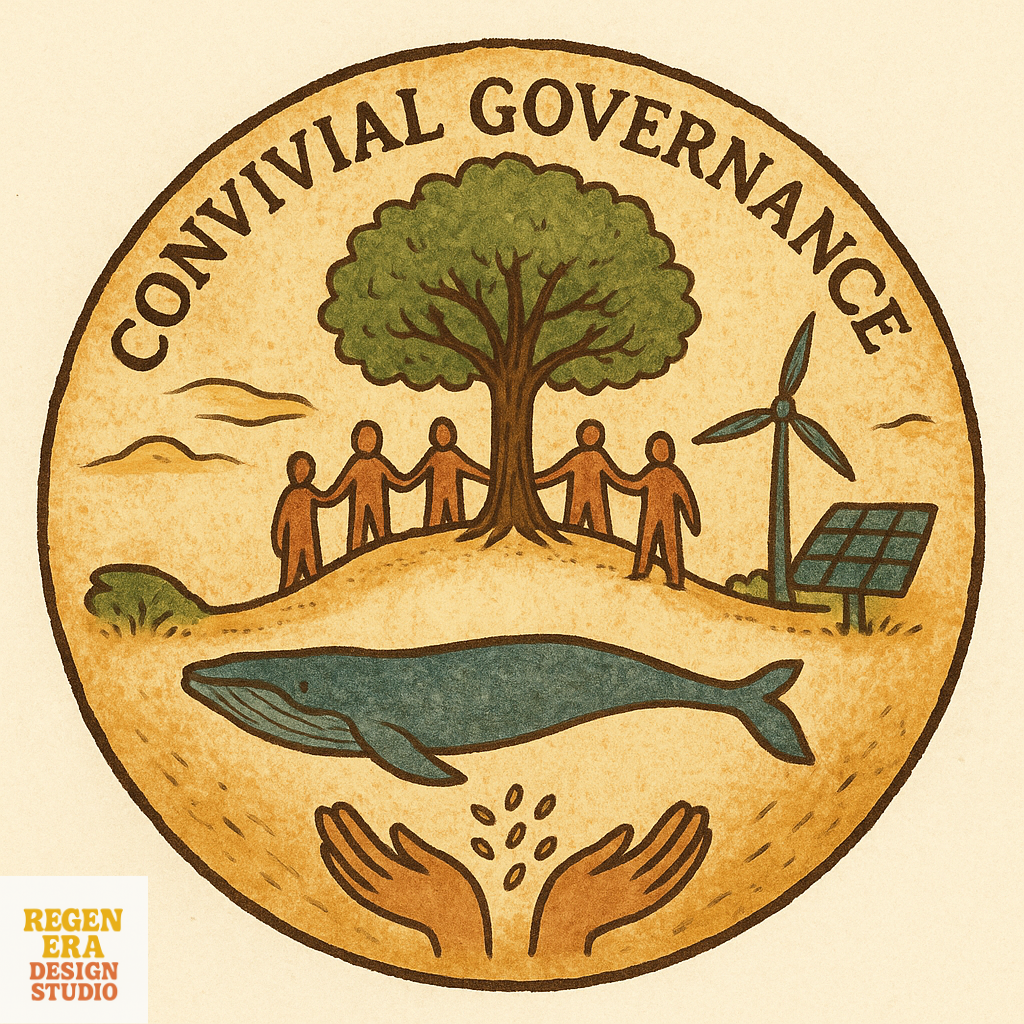
What if we turned the model on its head? What if planning became a service rooted in care? Imagine planners who walk alongside residents: site visits, practical advice written straight into a plan, co-design rather than nit-picking from afar. That is convivial governance: trust and reciprocity instead of suspicion and separation; service in place of control.

This Super New Moon in late Virgo invites a different rhythm of learning, one that moves like a living process. I want to acknowledge the Astro Priestess Roundtable, Cayelin Castell, Jaime Goldstein, and Mar Guerrero, for supporting me to listen for this season’s question. At the heart of our time is the call to be peacemakers, in our hearts, our homes, and our institutions. For me, that means bringing Michaelic courage: naming what harms without hardening the heart, meeting the system as it is while standing for what it can become.

So here are the seeds I’m planting:

  • From policing to partnering. Replace desk-bound critiques with on-site guidance and co-authored notes that become part of an application.

  • From opacity to clarity. Publish simple, visual checklists for common rural projects (nurseries, sheds, composting, no-dig beds).

  • From delay to rhythm. Introduce predictable timeframes and modest fees for small, regenerative works; scale support with community benefit.

  • From extraction to reciprocity. Measure success by soil health, safety, and community capacity, not just processed forms.

May this eclipse season help us remember that governance, like gardening, is sacred service. May we design systems that grow trust, reciprocity, and care. And may our collective roots find fresh ground.

With love,
🌿 Dr. Demeter (Emily Samuels-Ballantyne)

P.S. If this speaks to you, tell me one small policy “seed” you’d plant in your own street or council. Let’s practice, integrate, and share, so the learning reproduces and the garden grows. It’s so important to cultivate a new imagination and culture in this space.

Beyond Left and Right: A Life-Systems Politics for Our Time

By Dr. Emily Samuels Ballantyne | Magical Farm Tasmania

Do you sense the old binary abstracted labels have stopped making sense? Left. Right. Progressive. Conservative. None of them speak to the kind of politics I live, breathe, and grow.

I wrote my PhD in a permaculture garden while institutions told me my work was too plural, too holistic, not theoretical enough, didnt have a business model!? etc. For over a decade, I brought projects to life in small cracks between funding rounds and bureaucratic resistance. I created real impact, but always from the edges. I’ve joined herbal circles, I’ve made tea for Aboriginal artists and sat with their stories. I’ve worked in Italian community gardens and European Union policy forums in collaboration with a creative design studio in Brussels.

While others pursued careers in law or business to change the system from within, I chose another path: I became a systems theorist, regenerative designer, yoga teacher, a kinesiologist, a sword fighter who incorporated ancient martial arts approaches, a biodynamic practitioner, astrologer, a folk natural builder specialising in Cob, a folk herbalist, Jungian practitioner and a budding anthroposophical philosopher. I studied ancient cultures and learned from land and lineage. It wasn’t the conventional way but it was deeply disciplined, rooted in care and a fierce belief in alternative life systems.

The cost has been real... I’ve been rejected by reductionists in universities, dismissed by NGOs who shuffled paper or were too focussed on resistance, and told again and again that my work doesn’t “fit.” Not even so-called progressive spaces could hold me. And yet, I’m still here. Not because I was welcomed, but because I stayed true to my garden politics. Still, I rise. From the compost of rejection grows my conviction: we need a new way. I’m not here to climb the ladder I’m here to dismantle it and plant something different in its place. I campaign for a politics of decommodification, of beauty, of imagination, a politics rooted in gardens, in kinship, in Gaia. A politics that honours not just what we produce, but how we live.

And so I offer this not from a place of institutional power, but from the soil. I’ve felt the failings of the system in my own body and I know I’m not alone. What we need now is not reform, but we need regeneration.

Proposal of a convivial governance vision

Convivial governance names the shift from bureaucracy-for-its-own-sake to structures that serve life: clear roles, lean paperwork, transparent accountability, and decisions made as close to place as possible. It pairs with foundational economics, prioritising the everyday systems that actually hold a society together (care, food, energy, housing, local transport), so budgets and procurement nourish common goods rather than extract them. This is care governance and common-sense governance: organised, yes, but rewarded for outcomes in soil health, community wellbeing, cultural vitality, and fair livelihoods, not for shuffling paper. Across the world, good leaders on left and right, and philosophers at the fringes, are calling for fairer, justice-based systems; they sense what many communities already know: when public institutions are tethered to corporate interests, the social fabric is thinning. Realignment is due, toward the public interest, local economies and communities, and nature as a living creditor. Everyone has a role: councils and agencies, co-ops and farms, schools and households. The work can be peaceful and beauty-led, seasonal rituals, shared meals, dignified spaces, and practical tools that invite participation so governance becomes something people do with each other, not something done to them.

If leaders ignore this signal, the risk is not abstract: when people are shut out of decisions about food, energy, housing and land, systems grow brittle. Legitimacy thins, compliance drops, services fray and disinformation rushes into the gap, ruptures in social, cultural and economic realms leak. By listening now, many “big” problems can be defused with small, place-based fixes and clearer and transparent governance. Choosing convivial governance and foundational economics trades scandal cycles for trust cycles and keeps change peaceful, beautiful and shared.

Let me illistrate my point:

OIKOS = household. Both economy and ecology come from this root. A household works because money, care, and chores are close to the people affected. When budgets drift too far away, we lose the household sense—waste goes up, trust goes down. The fix isn’t anti-scale; it’s nested households: street → neighbourhood → town → region, each with a small, visible purse and clear stewards.

Run public money like a good kitchen:

  • Five jars on the bench: Food • Energy • Care • Learning • Commons. (A set % is locally controlled and can’t be siphoned off.)

  • Fridge-door ledger: one-page, weekly spend & forecast; names + phone numbers of stewards.

  • Shopping list first, receipts later: commit to outcomes (meals served, beds planted, kilowatts saved), not paperwork volume.

  • Seasonality rules: shift spend with the year (winter energy, spring planting, harvest festivals/markets).

  • Leftovers become tomorrow’s lunch: savings in one jar can top up another within the oikos (with a public note).

This is convivial governance + foundational economics in practice: small purses close to place, simple rules, public ledgers, and seasonal planning. Keep the big treasury, yes, but push predictable, ring-fenced envelopes down so streets, schools, clinics, and farm co-ops can act quickly and show results you can taste, touch, and tally.

Life systems politics

I’m coming out not as left or right, but as a life-systems political being, so my politics isn’t about opposition, it’s about composition. And Poli means People, its about Humans in place. It’s not about taking sides. It’s about taking root… I am interested in problem solving, creative dialouge with people from all walks of life.

This is a politics grounded in the soil, in care, in cycles of regeneration. I believe that the most important political acts happen in kitchens, community gardens, forest clearings, and co-designed circles where decisions are shaped by those who live their consequences. It’s a politics of collaboration not ideology and its purpose is not performance but transformation.

This is what I call foundational economics and convivial governance: a reclaiming of the essentials food, energy, housing, care, learning as public, shared, and regenerative. The term “economy” comes from the Greek OIKOS, meaning “the household,” a lineage brought forward beautifully by Gibson-Graham in their feminist reframing of economic life. In their work, the economy is not a machine, but a garden, tended through relationships, reciprocity, and responsibility.

This is not a fringe idea. It is already being practiced, quietly, powerfully by people across the world. Tyson Yunkaporta reminds us that Indigenous systems of governance are not based on power-over, but on kinship, pattern, and place. Joanna Macy teaches that the Great Turning begins with seeing with new eyes, with feeling the grief of the world and choosing to act from love, not fear. Helena Norberg-Hodge offers a path of local futures, where real wellbeing arises from reweaving local food systems, community agency, and deep connection to place.

This is the politics I practice every day at Magical Farm Tasmania. It is not perfect. But it is alive. It listens… It grows…It heals…I’m no longer interested in polarised debates that harden the heart and soul and distract from the work. The real question is not who’s right, but what is sacred? What are we growing, together? What do we want to root, repair, and regenerate?

This is not about opting out of the system. It’s about composting the old to nourish the new - life systems informed institutions and governance. This is sacred activism. This is a politics of love, for ourselves, each other, and the Earth. It begins where all true economies do: at home, in the OIKOS.

About the Author
Dr. Demeter (Emily Samuels-Ballantyne) is an eco-philosopher, regenerative farmer, and founder of Magical Farm Tasmania. With over 20 years of experience in community economies, ecological design, and grassroots policy innovation, she weaves together deep listening, land stewardship, and life-systems thinking. Her PhD, Con Viv: Designing Convivial Food Systems in Everyday Life, explores relational design as a tool for transformation. Emily writes, grows, and teaches from her farm, where politics is practiced through care, creativity, and sacred activism

Imagining Healing: The Third Path for Tasmania

Tasmania is at a crossroads and there is a great opportunity to make this beautiful island a place of renewal. The debates that dominate our island aquaculture expansion, forestry, tourism, renewable energy, are often framed in binaries: jobs versus environment, growth versus preservation, progress versus collapse. These debates are real, but when they harden into opposites, something deeper is lost.

Rudolf Steiner called this the hardening of the soul. In modern life, thinking becomes mechanic and abstract, feeling grows dulled, and willingness is outsourced to bureaucracies and machines. Carl Jung described the same danger in psychological terms: when opposites split apart, we risk paralysis or rage unless we awaken the Third, a symbolic organ of integration, a space that can hold tension long enough for something new, whole, and healing to emerge. The challenge before us is not just political or economic but tis spiritual and psychological. Tasmania needs the Third. Not neutrality, not compromise, but the courage to imagine beyond the binary. 

The Third as Social Practice

The Third is not a theory, it is in fact a lived practice. It shows up in a community food hub, a biodynamic farm, a seed library, a convivial festival and even a thought process that holds complexity without jumping to a conclusion. ‘Third’ places and mindset are where imagination, justice, and reciprocity can breathe together. Third ways of thinking, being and doing act like acupuncture points in the social body: small but intentional mind and/or physical spaces that release vitality into the whole. Steiner’s vision of the threefold social organism gives us a map. A healthy society balances:

  • Cultural freedom: imagination, education, and spirit free to unfold.

  • Political equity: governance grounded in fairness and rights.

  • Economic mutuality: livelihoods based on reciprocity, not extraction.

Applied locally, these principles are deeply practical. They remind us that social healing begins not with abstract strategies but with lived experiments, participatory action, and transparent processes that keep head, heart, and hands together. I love the deep green design Prof Seaton Baxter (from Scotland) theory called “way of the prototype” - much of my work is based around this methodology. 

Local Government: From Strategy to Practice

Nowhere is this more urgent than in local government. Councils produce endless strategies, reports, and consultation papers, yet communities often see little translation into practice. Strategy is not an outcome and true outcomes happen when policies take form in gardens, services, cultural initiatives, housing solutions:  the fabric of everyday life. Fair local government means shifting from paperwork to practice. This doesn’t mean abandoning strategies, but holding them accountable to lived results. People in communities (rate payers) deserve transparency: to trace how decisions are made, where funds are spent, and how outcomes are measured. Without this, government risks serving mechanical and abstracted systems instead of people they are there to serve.

Imagine a local government that functions as an enabler, not just an administrator? Councils can support neighbourhood initiatives, co-design projects with residents, and facilitate cooperation across sectors. In this way, governance itself becomes a Third space: not caught between bureaucracy, process and populism, but a living practice that restores vitality to communities. Tasmania, small enough to be nimble and rich enough in imagination, has the potential to pioneer this. If we can re-root governance in action, ensure transparency, and honour community-led practice, we can show how local government can become not just functional, but regenerative.

Magical Farm Tasmania Festive Agriculture event 2025

Feminised Intelligence and Plant Allies

Ecofeminist thinkers remind us that what the world needs is not more domination but feminised intelligence: cyclical, regenerative, relational, rooted in care for land and community. This intelligence is already alive in Tasmania in community gardens, co-ops, and creative economies but it needs recognition, resourcing, and policy support. Even plants point the way. Yarrow teaches us to heal what is torn and to hold paradox. Rosemary sharpens memory and discernment. Nettle brings courage and vitality. Together they embody what the Third requires: integration, clarity, and action.

The task before us is not neutrality but imagination, beyond binaries. This heart shaped island Tasmania must reawaken the Third, and inspire other places to do the same. The Third is a space where grief can be honoured, paradox can be held, and new forms of life can be designed. The future of this island will not be built by choosing sides in collapse. It will be built in the Third space where we move from abstraction to life systems and community practice becomes the foundation of renewal.


The Wound, the Third, and the Healer: A Virgo New Moon Reflection

Under this Virgo New Moon, as the world turns its gaze toward conflict and complexity in the Middle East, we are invited into a quieter, deeper listening. Beyond political positions or media cycles, a deeper symbolic story is unfolding, one that asks not for sides, but for soul. One that asks us to become not louder, but more whole.

Virgo is the priestess of Earth, the keeper of the detail, the weaver of fragmented things. Her medicine is found in tending, in ritual, in what has been overlooked. It is fitting, then, that this New Moon arrives with the presence of Raphael, archangel of healing, the guide of breath, clarity, and the sacred ‘middle’ way. Together, they call us not to solve what is beyond us, but to participate differently: with presence, humility, and care.

This reflection offers seven symbolic threads, drawn from Jungian depth psychology, planetary wisdom, and current world events, that seek not to explain the Israel-Palestine conflict, but to witness it and to examine the psychic landscape surrounding it.

1. The Earth Priestess and the Forgotten Wound

Virgo teaches that healing begins in the small, the practical, the real. She is not a sign of abstraction, but of embodiment. She reminds us that care is political, and that repair starts in the soil, of land, of body, of psyche. This is a moment when a wound, long suppressed and twisted has erupted again in collective awareness. Not only in Israel and Palestine, but in each of us. It is the wound of disconnection: from one another, from nature, from the sacred, from history, and from paradox.

2. Raphael and the Element of Breath

Raphael, whose name means “God heals”, is associated with the element of Air, the realm of thought, language, and breath. In the flood of commentary and ideological fervour, we are reminded to return to breath, to clarity of heart, to the healing power of stillness. Raphael does not arrive with punishment or triumph. He arrives beside the wounded, offering presence. He calls us back to relationship and attentiveness to the other. His presence blesses those who walk toward complexity, not away from it.

3. The Wound as Portal

The land called holy is now a site of unbearable trauma. Each people involved carries a deep ancestral scar: exile, displacement, occupation and genocide. These are not historical footnotes, they are living psychic facts and each side believes its suffering is not seen. From a Jungian lens, this is the domain of Chiron, the Wounded Healer. The one who cannot heal himself but can, through his own suffering, guide others to healing. In this conflict, we see shared pain unacknowledged, so instead of becoming medicine, the wound becomes a weapon. But Chiron’s teaching is clear: the wound is the place where the light enters, if we can hold it long enough to learn.

4. The Loss of the Third

Jung warned of what happens when the psyche splits into opposites with no reconciling force: we lose the Third and the middle space collapses, and this is where that glue and connection of dialogue becomes impossible. Each side demonises the other and public discourse now reflects this binary psychosis. In symbolic terms, the Third is not a compromise, rather it is a sacred space where opposites meet and something new is born. It is the alchemical vessel, the fertile void, the room of imagination. Virgo’s gift is to restore this space through ritual, through exactness, through attention to what is real and alive. The Third may not yet exist as a shared political solution and the ground between remains scorched by history and division. But it must begin as a psycho-spiritual space within us, where paradox can be held and new possibilities imagined beyond the reflex of sides.

5. Projection and the Global Mirror

This conflict has become a projection screen for collective shadow. For some, it evokes unacknowledged guilt (from the Holocaust and from colonial histories); for others, suppressed rage or inherited trauma. People do not only respond to the conflict itself, they respond to what it touches in them. Jung called this “complex activation”: when an outer event triggers inner unresolved material within the human. This is why the discourse is so charged and so reactive. We are not speaking only of Israel or Palestine, we are speaking of ourselves, without knowing it. Discernment is Virgo’s core gift and is the medicine here. What part of this is mine? What am I projecting? What grief am I avoiding by becoming righteous?  Yes, this conflict touches something deep in me, my own grief, guilt, and longing for justice. I share these reflections not from a place of certainty, but as part of my own process of reckoning and return.

6. The Silenced Anima

In the deeper layers of our collective psyche, the Anima: the soulful, feminine energy of grief, care, and connection, has been pushed aside. What we see instead is a flood of harshness: arguments, ideologies, and certainty that leaves no room for feeling. But the Anima hasn’t disappeared and she lives in the cries of grieving mothers, in the silence of mourning, in the deep longing for peace.

Virgo, connected to this quiet, healing force, reminds us that real healing isn’t fast or loud. It’s slow, grounded, and tender and found in presence, in tending the land, in prayer, and in care. She gently asks us: What beauty will you choose to serve, even in the face of pain?

7. Becoming the Healer

Important work in this whole space is becoming part of a field where the psyche can begin to recollect itself. Where the story doesn’t collapse into sides and grief can be shared. To become the healer in this moment means to become a sanctuary. To hold paradox without flinching and to stop feeding the binary. The speak the beauty way into the broken field is a sacred act of healing inwards and outwards.

The number seven, echoing through this moon and this reflection, is the number of completeness, mystery, and cosmic rhythm. Seven days of the week. Seven chakras. Seven classical planets. Seven colours of the rainbow. Seven wounds of Christ. Seven biodynamic preparations. Seven times we fall and seven times we rise. It is the number of soulful return.

🌿 Closing Plant Allies: Yarrow & Rosemary

Let us close with two herbal essences that may help us anchor this reflection in the body and breath.

  • Yarrow (Achillea millefolium) is the plant of integration and boundary, sacred to Chiron, the Wounded Healer. It holds the paradox: it heals both wounds and walls. Named after Achilles, who was both warrior and healer, yarrow knows how to bind what has been broken, to hold the line without hardening the heart. Its essence supports us in holding contradiction, in weaving together what has been torn apart, within and without. You can purchase our beautiful essence at the Magical Farm Apothecary.

  • Rosemary is for remembrance and clarity and it clears the fog, brings warmth to the heart, and helps us honour what must not be forgotten. Rosemary essence supports right remembering, not of sides, but of soul, of life, of what we are here to protect. You can purchase this essence at the Magical Farm Apothecary.

Together, they offer a way to move through this time: with integration, memory, and sacred attention. May we hold paradox bravely, walk with discernment, devotion, and soul.
This is the call of Virgo.
This is the blessing of Raphael.
This is the healing path forward.

The Tao of the Chicken: A Virgo New Moon Reflection

Tapping in will forces, healing currents, and unexpected teachers under the new moon and royal star

Regulus, one of the four Royal Stars of ancient Persia, shines as the healer’s guide, connected with Archangel Raphael and the direction of the North…the place where higher destiny calls us. I have written about the way finding whale also going North. Under this Virgo New Moon we are invited to open to the Divine within (Virgo is connected to the high priestess and sacred ceremony). We are reminded to listen to the heart-centered intelligence that unfailingly guides us toward beauty, truth, healing, and connection.

Astrologer Tami Brunk reminds us: change is not the enemy. We must FLOW. As I opened my farm gate this evening (day of this new moon), I looked at a sign I have there with the word flower on it. I saw FLOWer, and now I will think about flowers with yet another dimension. Resistance is so often just the trembling before the unknown. What if we are more ready than we realise? And it is only the mind that lags behind the body, the spirit, the soul?

This moon asks us to soften, to trust, to allow the currents of life to carry us, especially when we feel clumsy, resistant, or unsure. I’m reminded how often I forget that I don’t have to hold it all together, or force a path forward. Sometimes, the clarity comes not from pushing, but from surrendering into the moment as it is. May we each awaken, again and again, to the colossal field of love that holds us, even when we tense up and even when we forget…. lets get into the flow of it all.

Here at Magical Farm, the new moon has already delivered its first lesson, and I have a funny story to share. Earlier today, six rogue chickens, wing-strong, garden-scratching, and impossible to catch…became my unexpected teachers. For 90 determined minutes, I leapt, chased, and wrestled until, one by one, I caught every single one. Their will forces were immense, but I discovered mine too. This afternoon, I was reminded of my own endurance and determination, not on a fencing piste, not in a policy meeting, nor while designing futures through my studio, but here on the farm, where the forces of life make themselves known. The Tao of the Chicken: when the time comes, strength meets strength, and balance is restored.

Even more beautifully, my son Raphael joined me in the chase! Full of passion, support, laughter, and determination. With Archangel Raphael’s star shining above and Raphael’s hands beside me, I felt the healing current of will, love, and joy moving through us both.

So may this Virgo New Moon gift you too with the will forces to complete what needs finishing, and to initiate what longs to be born. We are powerful beings, woven into rhythms larger than ourselves.

If you would like to tune into your will forces consider Dandelion Flower Essence from Magical Farm to support you.

See link to the farm’s FLOWer Essence Shop here: 🌼 Dandelion Flower Essence for Strength in Flow: Hand-harvested at Magical Farm, this essence captures the spirited resilience of dandelion thriving even in wild places, just like the unexpected lessons of farm life. Dandelion helps release tension stored in the body from over-effort or resistance, supporting you to meet life’s challenges with grounded determination rather than force. It’s the perfect ally when your will is strong, but your muscles are tight reminding you that true strength moves with the current, not against it. Take when life feels like a wrestling match, and you’re ready to find power in the now.

With love, soil and soul…
Dr. Demeter

High Magic in the Soil: Planting a Venus - Jupiter - Sirius Intention for Gaia

By Dr. Demeter | With gratitude to astrologer Jaime Lee Goldstein for illuminating the cosmic timing of this moment

This week, as astrologer Jaime Lee Goldstein describes, the two brightest planets Venus and Jupiter, draw near to the brightest star Sirius! Such a conjunction, seen by ancient eyes, was not just an astronomical event; it was an opening, a moment of high magic. The benefic planets joined the “Wishing Star” in a rare, exalted union which was a signal to seed what must endure, what must be blessed, what must be healed.

At Magical Farm, I feel this “high magic” most keenly in the soil and across the farms glow. The paddocks hold the happy ducks, geese and chickens, laughter of my children, those who have convened here in joyful moments, the soft night-steps of wallabies. Here, the farm is not only a livelihood but a hearth, a place to hold family, community, and the prayers I carry for the wider world.

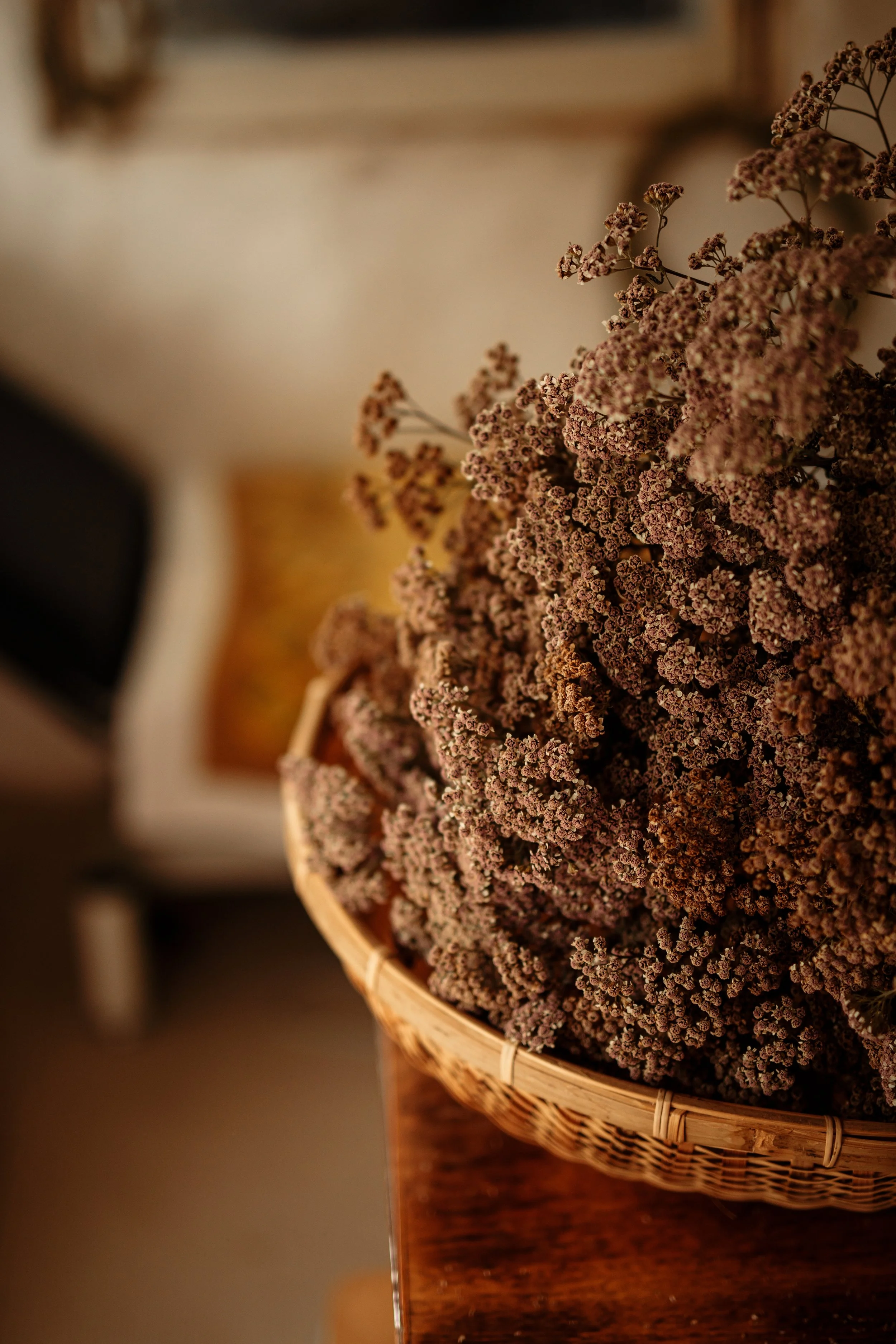
Yarrow basket at Magical Farm Photography by Ness Vandebourgh Photography

Rudolf Steiner spoke of imagination as the first stage of spiritual knowing, and in the Michaelic path, imagination becomes courage: the will to picture a better world and bring it into form. In biodynamics, this is lived daily, stirring the preparations, planting to the moon, tending soil as a living being, each act a quiet magic in service to the whole.

In this rare alignment, I sense a vision wanting to be planted:

  • Fields alive with bees and wildflowers, from my farm, across Tasmania, Australia and the world

  • Economies that serve the people places and planet

  • Governance as a weaving of many voices and traditions

  • A political will that bends toward beauty, justice, and reciprocity

  • A living Gaia where soil, sea, and sky are cherished kin

A High Magic Practice for August 11 and 12th…!

  1. At dawn, face the eastern sky. If you can see Venus and Jupiter, greet them; if not, close your eyes and feel their light entering you. Sirius will be near, carrying the higher heart’s purpose.

  2. Hold a seed, from your own land if possible and feel it as a vessel for your intention.

  3. Speak one clear sentence for your home, for your community, and for the earth. Keep it as distilled as the seed itself.

  4. Plant it in the soil. If you can, stir water in a figure-eight to awaken its life forces before you pour it over the planted seed.

A Collective Circle
I invite all who read this to join me, wherever you are in planting your own intention at this rare conjunction. Imagine our seeds, scattered across continents, joined by a filament of light running from Sirius through Venus and Jupiter into the soil of the Earth. This is high magic: intimate, domestic, and cosmic all at once.

The ancients knew that the brightest lights in the sky speak also to the brightest visions within us. This is high magic for the world we are willing to tend together.

✨ Magical Farm Yarrow ‘Acelia’ Essence
Gather the rare blessings of Venus, Jupiter, and Sirius into your own heart. This gentle yet powerful ally weaves protection and openness, so what is seeded in love may endure and flourish. Take it as a prayer in liquid form, a bridge between heaven’s light and the fertile soil of your life.
→ Order Yarrow ‘Acelia’ Essence from Magical Farm

✨ Full Set Offering

The Magical Farm Alchemy Set
For those who wish to journey deeper, this complete set of 17 Demeter’s Drops is handcrafted in Tasmania from herbs grown in our fresh, vibrant landscapes, infusing each drop with the life and rhythm of the land. Serving as your compass through the seasons of life, each drop supports integration, clarity, protection, and heartful action, creating a tapestry of living medicine to guide and harmonise body, mind, and spirit. Explore the full set and carry the farm’s magic, grounded in Tasmanian soil, wherever you go.
→ Order The Magical Farm Alchemy Set

Beyond the Hashtag: Why Progressive Platforms Must Build Futures, Not Just Protest

In today’s hyperconnected world, moral outrage travels fast. From War and injustice to salmon farms and destruction to ancient forests. Activists and leaders with platforms flood social media with sharp critique and heartfelt calls for justice. Yet, for all the powerful voices and viral hashtags, the conversation often stops short of what comes next. Moral clarity is necessary but not sufficient.

“When progressive leaders wield their megaphones only to condemn without creating pathways forward, they cede the future to corporate boards, militaries, and political hardliners”

The real challenge is not just to name what’s wrong but to build convivial governance, systems where communities are invited into genuine conversation, co-creating the institutions they will live within. Convivial governance treats imagination as an organ essential to democracy. It insists that governance must be of the people, not imposed from above; it thrives on dialogue, shared responsibility, and an openness to diverse futures. This methodology is urgently needed in places like Tasmania, where industrial salmon farming disrupts ecosystems and silences community voices; in forests under threat of over-extraction; and in global hotspots like Gaza, where decisions are made far from the lived experience of those most affected.

“These struggles, though geographically distant, share a common thread: the failure of top-down governance and the absence of meaningful participatory design”.

Tools for convivial governance already exist.

Yet, too often, influential thinkers like Naomi Klein illuminate the systemic roots of injustice without stepping into the generative space of scenario-building and solution design. She speaks powerfully about global crises but rarely opens her platform to the messy, grounded work of co-creating alternatives with affected communities.

Progressive leaders with reach bear an ethical responsibility: to shift from reactive outrage to proactive convivial conversation, inviting followers into structured, inclusive spaces where futures are imagined, tested, and refined together. This is how movements mature and how change becomes sustainable. Without this shift, the “day after” will always belong to someone else.

It is time to move beyond the hashtag, toward using our imagination as the most important organ of our time.

✨ Magical Farm Rosemary Essence
Awaken the clarity and courage to move from outrage to action. This bright, grounding ally sharpens vision and memory, helping you see the pathways forward and walk them with purpose. Take it when you need to weave truth into the architecture of a more just and participatory world.
→ Order Rosemary Essence from Magical Farm

✨ Full Set Offering

The Magical Farm Alchemy Set
For those who wish to journey deeper, this complete set of 17 Demeter’s Drops is handcrafted in Tasmania from herbs grown in our fresh, vibrant landscapes, infusing each drop with the life and rhythm of the land. Serving as your compass through the seasons of life, each drop supports integration, clarity, protection, and heartful action, creating a tapestry of living medicine to guide and harmonise body, mind, and spirit. Explore the full set and carry the farm’s magic, grounded in Tasmanian soil, wherever you go.
→ Order The Magical Farm Alchemy Set

About the Author
Dr Emily Samuels-Ballantyne (also known as Dr. Demeter) is an eco-philosopher, farmer, and author of the forthcoming series The Spiral Shelves: Living Library of Magical Farm Tasmania. Her work bridges policy design, ecological healing, and the spiritual-cultural renewal of place. She works at the intersection of community resilience, regenerative governance, and embodied stewardship, inviting new myths and models for living well together in times of great change.

Holding Paradox, Healing Wounds, and Bridging Inner and Outer Worlds

In a world fractured by war and ideology, this essay explores the psychological, spiritual and manifested cost of binary thinking, especially in relation to the Israel-Palestine conflict. Drawing from Jung’s concept of the transcendent function, Marx’s critique of alienation, Levinas’ ethics of eye contact, Escobar’s pluriversal design is not about flattening difference, but about making room for many worlds to co-exist and the symbolism of Chiron and Venus, it calls for the restoration of the “Third”, a space where paradox and pain can coexist without annihilation. Dr Demeter weaves personal reflection with collective insight, highlighting how language itself can wound or heal, and how imagination, as described by Steiner and Einstein, is a vital organ for integration and transformation. Yarrow, specifically Achillea millefolium, is offered as both a literal and symbolic remedy for those seeking to hold complexity, bridging intellect and embodiment, activism and reverence.

Ultimately, the essay invites a shift from slogans to soul, from splitting to staying, and from conclusion to container, where a new, reconciliatory future might take root. Visit https://magicalfarm.org/herbs-floweressences/yarrow-flower-essence or get in touch via info@magicalfarm.org.

Read more

Who Counts As a Farmer? And why it matters for the future of our regions. 

This piece by Dr Demeter explores the urgent need to redefine who counts as a farmer in Australia’s evolving agricultural landscape. It highlights how current government support programs like the Farm Household Allowance largely exclude small-scale, regenerative, and community-based farmers, many of whom are young people building resilient regional economies through diverse, place-based food systems. The article calls for policy reform that values ecological health, social wellbeing, and cultural vitality alongside traditional economic measures, urging recognition and support for the farmers shaping a sustainable future.

✨ Magical Farm Rosemary Demeter’s Drop
For clarity, courage, and rooted action in the face of systemic obstacles. Handcrafted in Tasmania from herbs grown on our vibrant farm, this drop supports young farmers and community pioneers to stay grounded, resilient, and visionary as they nurture land, community, and local economies. Take it when you need courage to step forward and create meaningful change.

Flower Essence for this blog: https://magicalfarm.org/herbs-floweressences/rosemary-flower-essence

Read more

Sword, Soil, Silence and Soul: Speaking from the Wound during Chiron Retrograde

by Dr Demeter | Magical Farm Tasmania | August 2025

There are some wounds that never fully close, not because we are broken, but because we are still listening. During this Chiron retrograde, I’ve been reflecting on a quiet ache that has followed me through many seasons. It’s the ache of trying to speak from a living, plural, and embodied place in a world that often only recognises binaries. Right or wrong, fast or slow, professional or emotional…

This ache isn’t just intellectual. I feel it in my throat, in my belly, and in the soil beneath my feet. It appears when I try to express something that matters, something layered and regenerative and it gets flattened, misheard, or pushed aside. Not because it lacks value, but because it doesn't fit into the dominant way of listening.

Often, the systems we are asked to work within seem unable to hear what doesn’t follow linear logic, individualism, or urgency. They struggle to hold nuance, community truth, or ideas that come from lived experience rather than institutional authority.

For me, this is where Chiron’s wound lives: in the longing to be truly heard and deeply held, even while speaking in ways that don’t conform to what the world rewards. We all have different Chrion wounds depending on where in our chart.

I’ve found guidance in unlikely places:

The sword teaches me how to hold boundaries with precision and grace, how to speak clearly, without attack.

The soil reminds me that everything meaningful takes time, decay, and transformation.


The silence shows me how to trust what is not yet fully formed.

And the soul? The soul carries the memory of what it feels like to be fully met, and keeps reaching for it, no matter how many times it has not been.

Chiron in Taurus, especially in the house of communication 3rd house, which is the case for me, invites us to stay with the discomfort of not being immediately understood. It reminds us that speaking with integrity is not about winning arguments or performing knowledge. It’s about being in relationship, with the land, with language, with each other.

This wound is not mine alone. It’s shared by many who are speaking from the edges of systems, from in-between spaces, or from bodies and traditions that are routinely dismissed. But within that wound is a medicine: the capacity to listen deeply, to honour what doesn't fit, and to compost the patterns that silence us.

So I offer this reflection as a marker in the morphic field, not to solve anything, but to signal resonance. If you have ever felt like you are both too much and not enough, too complex and too slow, or simply misunderstood for the way you communicate care, then know you are not alone.

There is another way emerging. It’s quieter, slower, more relational. It’s already growing in the compost, in the fencing hall, in the kitchen garden, in the shared breath of those willing to listen differently.

And you, my love, are part of it.


YoFence sessions, flower essence support, and regenerative farming workshops dialogue offerings are here to support you. All are welcome.
📞 0473 378 445 | 🌐 magicalfarm.org