What Is Your Business Model, Local Government?
By Dr Emily Samuels-Ballantyne (Dr. Demeter), Magical Farm Tasmania | Regen Era Design

A Poem to Begin: 

“The Land of Forms in Triplicate”

 They paved the way with paper,
and called it governance.
Ink spilled where rivers once ran.
Strategies replaced stories.
Budgets replaced breath.

 In this land of forms in triplicate,
spirit became ‘stakeholder,’
soil became ‘asset,’
and the commons became a ‘commodity’.

Community is something to be ‘engaged.’
Healing, is something to be ‘workshopped.’
And care, is nowhere in the budget.

 But place remembers.
The roots remember.
The gardens and gutters, the creek behind the depot, they wait.

And we, people of compost and complexity are remembering too.
That governance is not a meeting: It is a meal shared, a neighbour helped and a harvest honoured.

 So we ask again:
What is your business model, Local Government?

Because if Local Government cannot hold the life of this place, it is not fit to hold our future.

Composting the Brief

For nearly twenty years, I’ve sat in fluorescent-lit rooms, usually across from a local government officer, clipboard in hand who looks me in the eye and asks: “What’s your business model?”

On the surface, the question seems reasonable. But when applied to regenerative projects such as social gardens, food prescriptions, community harvest festivals, First Nations land care, shared meals, it becomes something else entirely. It becomes a subtle but powerful form of erasure. Behind it lies an ideology that insists all value must be extractable, measured, and packaged for reporting. That care must be justified. That soil must have a spreadsheet. That festivals must become outputs.

After decades of working with, alongside, and occasionally in resistance to local government, I believe it’s time to turn the question around:
What is your business model, local government?

Too often, what I see is not governance, it is performance. Policy schemes are launched in Canberra, filtered through state policy teams, passed to local councils, and translated into glossy reports by consultants. Somewhere in that chain, the actual work, the living, breathing regeneration of people and place is lost.

“We are governed by a machinery of abstraction”.

These are not “projects” to be measured by quarterly deliverables. They are civic acts of repair. They nourish relationships, regenerate ecosystems, and rebuild the social fabric that holds communities together. They are precisely what public service should exist to support. Because taxpayer funds, from all tiers of government, are not just for roads and rubbish. They are for the shared infrastructure of life: food, care, culture, and belonging.

Or are they?

If the local government insists that its role is limited to “rates, roads, and rubbish,” then we must confront a hard truth: it is abandoning its purpose. But we must also look upstream. Because much of the abstraction, bureaucracy, and performance culture we see at the local level is a direct result of state and federal frameworks, schemes designed in distant offices, bound by KPIs, and filtered through layers of reporting and compliance.

In this model, local government becomes a delivery arm, not a site of innovation or regeneration. Officers are trained to manage grants, produce engagement plans, and commission consultants and not to nurture relationships, co-design with community, redistribute resources, or respond to real-world complexity.

So we must ask: if our current system of governance cannot meet the needs of this time, if it cannot support the work of resilience, justice, and renewal, then what is it for?

Because the deeper work of climate adaptation, food system transformation, and social healing cannot be boxed into three-year funding cycles or flattened into “outputs.” It must be rooted, relational, and long-term. And it must be governed by those who live it.

This does not mean we abandon public institutions. It means we transform their role. It means shifting from control to trust. From managing community to co-creating with it, which means there is a shift from performance to participation.

If local, state, and federal governments are willing to evolve, to fund what matters, to cede power where needed, to become stewards of community-led change then there is immense hope. If not, communities will continue to build parallel systems: land trusts, energy co-ops, food commons, healing spaces. Not as resistance, but as necessity.

This essay is an invitation…

The Machinery of Abstraction

Australia has 566 Local Government Areas (LGAs). In theory, these councils should be the closest and most responsive tier of government. In practice, they are often the most entangled in the bureaucratic performance of care, not the delivery of it.

Let us say a new federal scheme is announced and it is focused on “community resilience.” It originates in Canberra. State agencies translate it into frameworks, templates, and planning guides. These are passed down to councils, where internal staff or external consultants are tasked with “community engagement.”

Engagement is held, then reports are written, diagrams are made and rarely, if ever, is meaningful funding directed to the real work the policy claims to support. The idea becomes a product and its power diluted by process. As theorists like Guy Debord, Ivan Illich, and Henri Lefebvre remind us of spectacle, abstraction, materialism and performance culture:

  • Debord wrote of governance becoming spectacle, performance over substance.


  • Illich warned of tools turning into systems of control.


  • Lefebvre described the rise of abstract space, where lived experience is overwritten by bureaucratic grids.

This is not a crisis of intention. It is a structural condition. But conditions, like soil, can be composted. And that is the work I’ve been quietly doing for well over a decade, redirecting policy briefs toward life.

A Tactic of Integrity: Redirecting the Brief

Twelve years ago, I began applying a concept I learned from the philosopher and design theorist Tony Fry: redirection of the brief. Rather than rejecting state frameworks outright, I learned how to bend them and reground them and in turn redirect them, so they served life, not paperwork.

One example: the Huon Valley Food Hub.
Originally, the council budgeted $70,000 for consultants to conduct “community engagement,” and just $10,000 for implementation. I flipped the model. We ran engagement and co-design in-house, and redirected funds into community activation.

With that $70,000, we delivered:

  • Ten farm-gate blitzes across the valley


  • A regenerative food prescription program for twelve families


  • A First Nations-led garden activation at Sacred Heart College


  • The Growing Together festival: four seasonal dinners, markets, and seed libraries


This was not just a budget tweak, it was a philosophical pivot which moved funds from consultation to participation in the community. Shifted the culture of outputs towards outcomes.

Grounded in Strategy: A Tasmanian Opportunity

The Future of Local Government Review (2023–24) presents a once-in-a-generation opportunity to shift how local governance works. With 37 reform recommendations, ranging from voluntary amalgamations and regional service-sharing to participatory democracy and structural review, Tasmania is on the cusp of change.

The Priority Reform Program (2024–26) charts a roadmap for implementation ahead of the 2026 council elections. It offers five key pillars: governance, accountability, democracy, funding, and structure. But success depends on depth, not just design.

The Local Government Association of Tasmania (LGAT) rightly warns that top-down reform risks eroding the very local nuance councils are meant to protect. Likewise, journalists and citizens across Tasmania have resisted forced amalgamations and centralised planning power. We must be careful. We must ask not just how government is structured, but why, for whom, and to what end.

The Officer as Facilitator: Beyond Structural Reform

It’s time for a wake-up call. How can council officers, managers, planners, executives continue to prioritise paperwork over place? Strategy over soil? Reports over relationships?

This isn’t a failure of individuals. It’s a failure of the system, but systems can change.

Too often, local government reform debates get stuck on “how things are carved up”: amalgamations, shared services, and administrative boundaries dominate the conversation. Yet the more fundamental questions about what local government actually does, how it does it, and why these essential activities remain sidelined.

I hear the refrain all too often: “Local government doesn’t have enough funds.” Yet I also see bloated bureaucracies, roles created to shuffle papers rather than nurture communities, and funding lost to endless consultants and reports that gather dust.

No one is calling out the elephant in the room: the culture of local government itself. If local government is to transform, it must start with honest reckoning: recognising waste, shedding performative practices, and shifting budgets away from bureaucracy toward community resilience. Public funds must be reclaimed to support the living, breathing work of care, not the maintenance of paperwork.

In a regenerative future, council officers are not gatekeepers of grants or custodians of compliance. They become facilitators of public trust, partners in community-led change, and stewards of resources that nourish people and place. This requires reform that moves beyond rearranging structures to transforming culture, function, and purpose.

Public money must not simply “deliver programs.” It must build capacity, belonging, and resilience. Here is my usual style I offer some imaginative and practical solutions through a design methodology of scenarios: 

Seven Regenerative Scenarios for Local Government

The following scenarios offer a regenerative expansion of Tasmania’s reform process, grounded in lived examples and place-based activation.

1. Local Co-Governed Food & Health Hubs
Reform lever: Reallocate “engagement” budgets into long-term community infrastructure.
Example: Huon Valley Food Hub
Outcome: Funding follows participation, not paperwork. Healing is enabled through food, culture, and care.

2. Community-Owned Energy & Infrastructure Commons
Reform lever: Enable councils to support community-led solar, battery storage, and energy hubs.
Example: Scenario Two: Powering Regeneration (Regen Era Design Studio)
Outcome: Energy becomes a local commons. Resilience becomes a civic responsibility.

3. Regional Planning Alliances for Liveability
Reform lever: Foster inter-council collaborations across bioregions and catchments.
Example: Greater Hobart planning alliances, extended to rural and cultural corridors.
Outcome: Planning is no longer siloed. Local government plans for culture, care, and country, not just roads and bins.

4. Scaled Shared Services with Local Identity
Reform lever: Share admin services while preserving localised leadership and identity.
Example: Regional hubs for climate adaptation, emergency preparedness, asset management.
Outcome: Economies of scale without cultural erasure.

5. Place-Based Co-Design & Workforce Development
Reform lever: Reform officer training; create new jobs rooted in facilitation, regeneration, and cultural capacity.
Example: Co-design fellows, Indigenous planning roles, food system facilitators.
Outcome: Councils grow talent that knows how to work with (not manage) communities.

6. Transparent Accountability & Participatory Democracy
Reform lever: Enshrine a “Charter of Place” in legislation.
Example: Community hearings, budget transparency dashboards, regenerative indicators.
Outcome: Trust rebuilt. Communities become co-authors of their future.

7. Living Policy Pilots for Regeneration
Reform lever: Bundle grants into flexible “living lab” experiments.
Examples: Healing yards, food festivals, seed libraries, tool shares.
Outcome: Pilots judged by lived impact, not admin metrics.

Reclaiming the Public Brief

The word “brief” once meant a letter of trust, an invitation to act on behalf of the common good. What if we reclaimed that? What if the next “policy brief” was not a checklist, but a compost heap: rich with place-based wisdom, complexity, and care?

Let us name what no longer serves: the over-reliance on reports, consultants, abstraction and let us grow what will: capacity, relationship, and shared stewardship.

So I ask again:
What is your business model, local government?

Because mine is this:
Care for place and people.
Participation that grows roots, not paperwork.
Regeneration that feeds both soil and soul.

This is not just a model. It is a way of life.

And if councils adopted even a portion of this approach, we would begin to see a new kind of public service emerge, one rooted in trust, and capable of holding the complexity and beauty of real life.

About the Author

Dr Emily Samuels-Ballantyne (also known as Dr. Demeter) is an eco-philosopher, farmer, and author of the forthcoming series The Spiral Shelves: Living Library of Magical Farm Tasmania. Her work bridges policy design, ecological healing, and the spiritual-cultural renewal of place. She works at the intersection of community resilience, regenerative governance, and embodied stewardship, inviting new myths and models for living well together in times of great change.
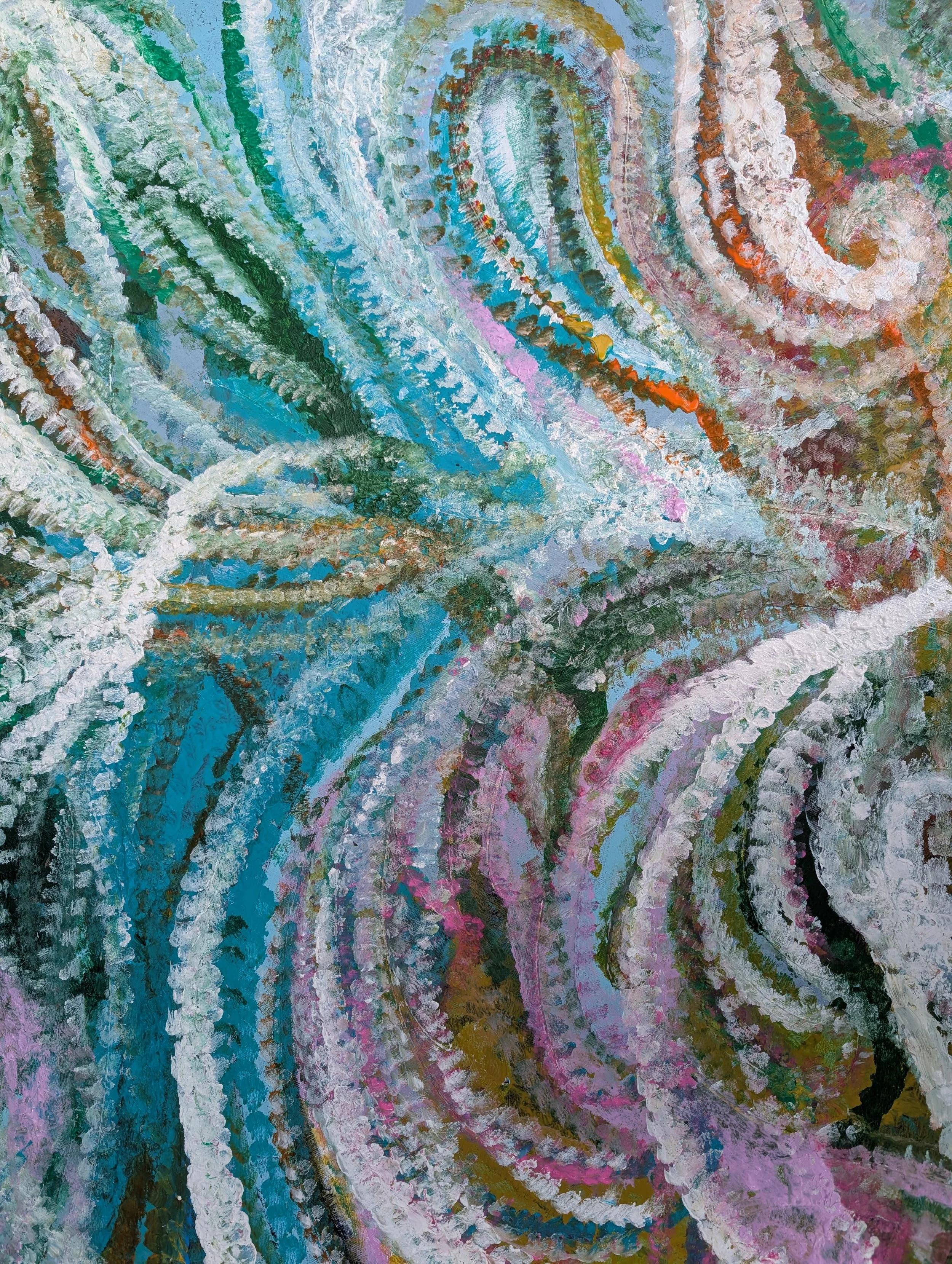
Dr Demeter – Here in the brushstrokes,the unseen becomes seen.

When Whale Dreaming and Bush Plum Dreaming Meet

Accompanying the painting below by Emily / Dr Demeter

The whale carries the songs of the deep,
vibrations that move through water, memory, and bone.
The bush plum holds sweetness in its small, unassuming body,
a burst of nourishment, a map of seasons and soil.
Between them flows a songline, invisible, luminous
where grief and love entwine as one current.

Whale Dreaming reminds us that time is not linear;
it moves in waves, spiraling through generations.
Bush Plum Dreaming grounds that motion,
feeding life where it touches earth,
rooting the cosmic into the intimate.
Together, they form a navigation system of the soul:
a compass not of the mind,
but of the heart awakened.

Each initiation along this songline
is not a single moment,
but a pattern emerging through many lives,
many places,
many hands laying down dots of remembrance.
These dots, on canvas, in soil, in story
are the cells of a larger organism,
a living system dreaming itself whole again.

And in this painting, Key that Opened the Loch
the heart itself is unlocked,
a sacred vessel of feeling
guides beyond thought,
toward the deeper intelligence of love.

To follow this line is to surrender to wonder,
to listen to whales through the tides of grief,
to taste bush plums in the renewal of love,
to recognise that both longing and loss
are portals to presence.

When we allow the heart to lead,
we find that the world itself begins to speak
in dots, in songs, in breath,
in the shimmering pulse that joins sky and sea,
root and star,
you and I.

This is the remembering.
The weaving.
The living system within and beyond us
Con Viv.

Poem 2 The unseen becomes seen.

The cells of life speak in dots,
not isolated, but woven,
like the constellations above
and the mycelium below.

In this living tapestry,
each mark tells a story
as First Nations art has always known,
each dot a breath,
each curve a songline
of ancestors and stars,
of country and kin.

Look into the microscope:
life dances in fractals.
Peer through the telescope:
the cosmos pulses in patterns.
And here in the brushstrokes,
the unseen becomes seen.

This is a remembering,
a message passed
from sky to soil,
from pigment to presence.
It is not new,
It is always.

Con Viv

painting by Emily Samuels-Ballantyne / Dr Demeter

Key that Opened the Loch was painted on the lake at Loch Sport, where wind, tide, and feeling meet. Spiral strokes track the push–pull of currents and the work of holding heat without hardening. Turquoise and green carry the breath of the etheric; rose warms the heart field; rusts steady the will. The name plays on loch/lock: a place and a threshold, what holds, what opens. painting by Emily Samuels-Ballantyne / Dr Demeter

The Tree That Spoke: A Living Message from the Roots

Dr Demeter: Listening to the land beyond sides, beyond slogans, toward wholeness.

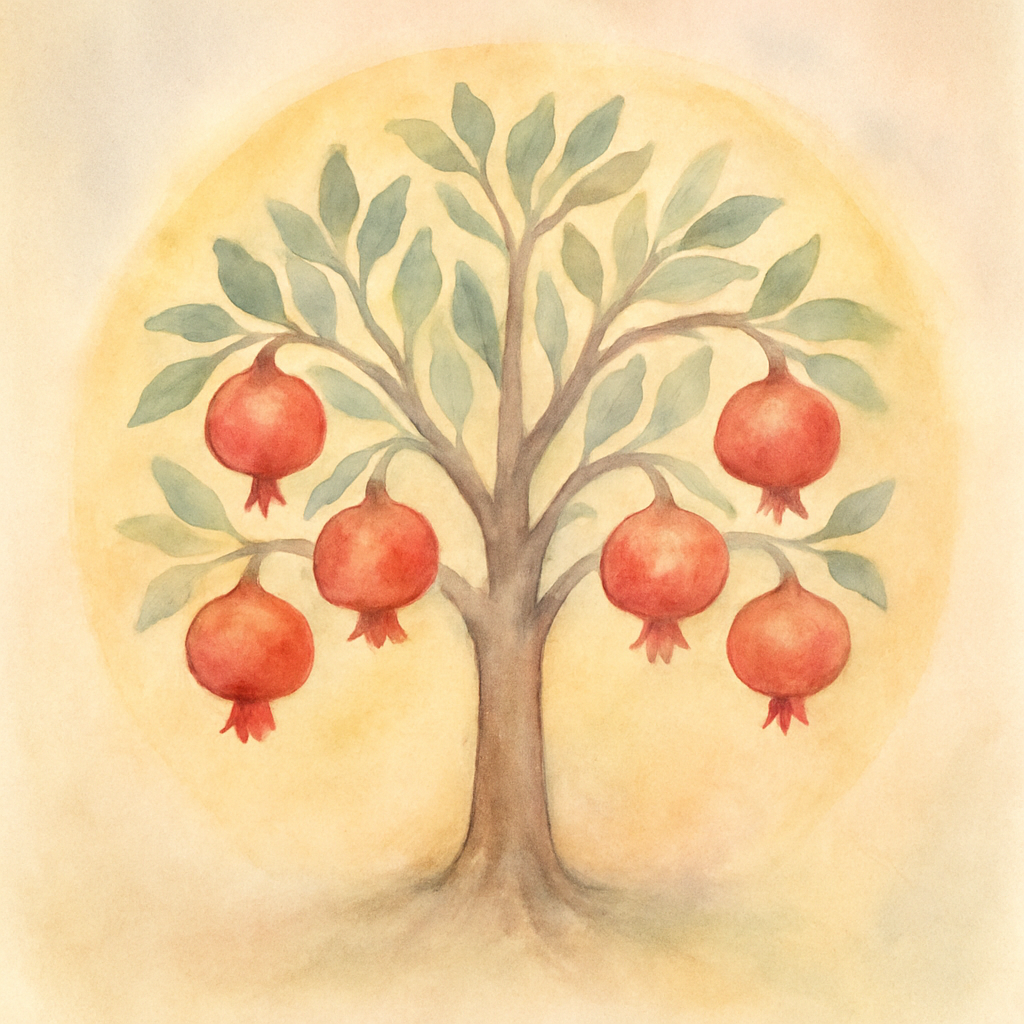
In January year, as part of a land healing workshop, I found myself sitting beside a pomegranate tree. I hadn’t gone seeking visions or answers. I was simply sitting. Breathing. Letting the earth speak in her own time.

Then, without warning, something stirred. A soft, clear message emerged, not in sound, but in knowing:

“I am in misery,” the tree said.

This was not a metaphor, the tree was literally looking unwell. At its base, a fungal infection had taken hold. The trunk was split. And on one side, growing into the tree’s very body, was a piece of plastic, long embedded. A human intervention, likely intended to help, had become part of the wound.

As I sat with the tree, listening with more than ears, an image arose:

The left side of the tree was one people. The right side was another.

Two limbs of the same being. Split, but not separate.

The left was discoloured, twisted, compromised by synthetic interference. It held movement, emotion, and the ache of dispossession. The right stood straighter, more rigid, offering structure and strength, but needing the left to breathe, to flow. Neither side could live without the other. 

I asked the tree: Do you want to be pruned?
A firm no.

What was needed wasn’t division. It was healing. Not isolation, but restoration.

The tree gave me five messages from the left: change, loss, resistance, grief, yearning.
And eight from the right: resilience, stability, defence, safety, endurance, tradition, fear, and loss.
Then came the number six for both. A balance. And one word that pulsed through the roots:

Love.

Not sentimental love. Not conditional love. But the kind that lives in root systems. That remembers we belong to each other, even in pain. 

As a regenerative farmer and practitioner of biodynamics, I knew what to do. I prescribed a tree paste, a gentle, living salve made with yarrow, the warrior-healer plant. Not to remove the wound, but to protect it. To allow the tree’s own healing wisdom to rise again.

Because that’s the thing about trees: They don’t divide, they integrate. They don’t perform politics, but they live season by season.

We live in a time where people are expected to choose sides. To perform outrage or prove virtue. But the tree offered another story.

It said:

“The foundations of life are in the seed” (this was the clear message I channelled).

In reflection… “The foundations of life are in the seed” is not just a truth of nature, it is a radical invitation to reimagine how we live. From the outside, the seed may seem small, humble, even invisible, but within it lies a profoundly different resonance, one that carries the sacred codes of renewal, interconnection, and life beyond domination. This message is a call to shift our power source, from control and reaction, to reverence and regeneration, planting new ways of being that grow slowly, but transform everything.

What if we remembered that?

What if activism became a balm, not a blade?

What if we built peace the way we heal trees,
By tending the roots,
Not severing the limbs?


by Dr. Demeter
Eco-philosopher and regenerative farmer
Founder of Magical Farm Tasmania

A tree channeling by Dr Demeter…a message from the unseen


This is the Reckoning: What Ancient Wisdom and Living Systems Science Demand of Us Now

By Dr. Demeter, Magical Farm Tasmania

Con Viv

We were never meant to be alone,

The earth speaks still, in root and stone.

Four hundred years, the thread was torn,

But deeper truths are being reborn.

This is not the end, but a beginning of a reweaving,

There will certainly be much conceiving!

Of compost, courage, soil, and heart.

Awaken! It's time to wake up to life for a new start.

In a time when the earth trembles beneath our feet (the Fault Line Series I am writing certainly reflects this), ecologically, economically, politically, spiritually we are called to remember something ancient and vital: that we are not separate from life, but participants in a great, dynamic whole. This is not merely metaphor, but a cosmological orientation held across millennia by First Nations peoples the world over. And not only First Nations: all ancient cultures, from the Andes to Anatolia, from Aotearoa to Africa, held interwoven cosmologies in which land, life, spirit, and human were inseparable.

Four hundred years ago, with the birth of modernity in Europe, it was a moment often tied to the Enlightenment, colonisation, Cartesian dualism, and the scientific revolution; the ancient and woven interconnected worldview was systematically shattered. The world was reclassified as inert. The soul was extracted from matter and nature was rendered lifeless, and so it could be owned, measured, and controlled. This shift was not progress it was amnesia.

“We need rewoven philosophies of life, I often refer to Con Viv! But there are many others we can weave with”.

In recent decades, systems theorists have begun to glimpse truths that ancient cultures never forgot: that life is relational, dynamic, complex, and sacred. First Nations ontologies have long known this sacred knowledge through Country, kinship, songlines and Dreaming…and living systems science and theory is just beginning to name.

This essay explores the profound resonance between First Nations worldviews and living systems theory, and asks what it would mean to take these ontologies seriously, not as symbolic nods or ethical aspirations, but as foundations for redesigning our lives, institutions, and futures. This is not a polite invitation to explore, I propose it is a necessary reckoning…the time to wake up is now.

Living Systems and Living Country

James Grier Miller’s Living Systems Theory outlines seven nested levels of life: cell, organ, organism, group, organisation, community, society, and supranational system. Each level interacts through flows of energy, matter, information and is self-organising, adaptive, and open. In parallel, First Nations ontologies speak of relational flows between all things: humans, land, ancestors, animals, weather systems, spirits, and laws. In Australia, Country is not a passive backdrop but an animate, sentient being with agency. You don't own Country…you belong to it.

This worldview dissolves and mends the Cartesian separation of mind and body, subject and object, human and nature. It collapses the Western notion of the isolated individual and instead foregrounds what Miller would call the “relational interiority of systems”. You are not in relationship, you are relationship. And until we digest this perspective and live and feel it in our bones we will continue designing systems that kill what they claim to serve.

A Different Ontology of Time and Responsibility

In many First Nations epistemologies, the past does not lie behind us but lives within us. The Dreaming is not a closed chapter of history but a living, breathing force animating the present moment. Elders remind us that the Dreaming is at once ancestral archive and ever-unfolding story: law and pattern, song and relation. It moves in silence, in ceremony, and through those who embody its ways.

Margo Neale, editor of the First Knowledges series and senior Indigenous curator at the National Museum of Australia, does not proclaim the Dreaming with grand declarations but lives it through her presence. To her, Country is kin, not abstraction; those who walk beside her sense stories woven into her bones and guidance rising in her breath. As she moves across the land, Country itself seems to listen. Her enactment of justice is not about platforms or punishment but about reweaving the unseen threads that bind people to land, spirit to soil.

With Margo Neale, living systems are never abstract concepts but lived realities. She teaches without formal lessons, showing that the Dreaming is not confined to the past or to ritual, it lives in the way one sits by a river, listens to the wind, or speaks to a child. To carry the Dreaming as she does is to become a bridge across generations, across worlds.

This ontology of time and presence resonates deeply with living-systems theory: in both, meaning emerges through patterns, feedback loops, and relationships; the past and the future coexist in dynamic tension with the present; and the deepest form of knowledge is not mere information but embodied integration.

This is not mysticism but an urgent invitation to decolonise our land, our thinking, our language, and our institutions. It is time to relearn what our systems have forgotten.

Repatterning the Self and Society

If we took seriously the convergence of these two ontological frameworks, the implications are radical:

  • The Self becomes less about ego and more about eco. We reinhabit our bodies not as private containers but as microcosms of place, memory, and spirit.

  • Family expands from a nuclear unit to a web of intergenerational, multispecies kinship. Grandmother trees, river cousins, star siblings.

  • Community becomes not a service recipient but a dynamic living system, held together by ritual, reciprocity, and shared story.

  • Institutions must evolve from extractive bureaucracies to regenerative infrastructures. Schools become places of initiation into life’s patterns. Hospitals, spaces for soul-tending as much as symptom-management.

  • Economy ceases to be a measure of growth and becomes a practice of nourishment. Circular, foundational, seasonal, and enough!!

  • The Cosmos is not out there it is in here. Astronomy returns to cosmology; physics finds its complement in myth.

  • The Soil is not dirt, but the oldest ancestor. We listen before we plant.

“To ignore these transformations is not neutral, it is violence by neglect. We must be fierce in naming the unseen systems that are severing the roots of life. And we must be bold in creating new ones”.

Implications for Design, Policy, and Praxis

To live as if this ontology were true because it is would mean a wholesale reorientation of systems thinking from mechanistic management to sacred stewardship. It invites the co-creation of what Colombian scholar Arturo Escobar calls the pluriverse: a world where many worlds fit.

We would reimagine:

  • Education as initiation into living systems and Country.
    Governance as facilitation of local wisdom, not enforcement of central plans.

  • Health as coherence across inner and outer ecologies.

  • Justice as relational repair, not retribution.

  • Economics as a layered and grounded foundational movement of resources an organ-sation of life, not a system of extraction.

  • Activism as a regenerative force, not only resistance, but reimagining. Less protest against, more living for. A call to become composters of culture and midwives of the future.

  • Art and Story as central nervous systems of collective transformation, no longer peripheral, but essential. Through image, sound, myth, and symbol, we reweave our imaginations and seed the futures our souls remember. as a regenerative force, not only resistance, but reimagining. Less protest against, more living for. A call to become composters of culture and midwives of the future.

Importantly, it is not enough to translate First Nations knowledge into Western terms. The invitation is to unlearn, to humble ourselves before epistemologies that have held resilience across fire, flood, invasion and genocide.

Returning to Belonging

We are now living in what the ancient I Ching calls Period Nine, a time of fire, vision, feminine leadership, and truth-telling. But it is also a time of composting. Systems are breaking down. Myths are decomposing. False certainties are decaying. This is not a crisis, it is a rite of passage.

At Magical Farm Tasmania and Regen Era Studio, we have committed to this work of composting. For nearly twenty years, we have been dreaming, growing, fermenting, and tending the conditions for a regenerative way of life to emerge. And now, as Period Nine unfolds over the next two decades, we recognise this as a planetary composting cycle, clearing the old to make fertile ground for what is to come.

This is a sacred practice of continuity, rooted in land, love, and living systems. It is our offering to the cycle. And when Period One returns, it will not be as it was before but renewed by the compost of this time.

We are here to support the turning. We are not starting from scratch but we are remembering.

The convergence of First Nations ontologies and living systems theory is not just a conceptual insight. It is a threshold moment and a call to restore reverence, reciprocity, and responsibility. It asks us to remember that we are not systems managers, but participants in a sacred dance of emergence and decay.

When we re-pattern our sense of self and society through this lens, we begin to heal the split at the heart of modernity. We move from disconnection to belonging, from extraction to regeneration, from domination to deep listening.

In the language of my farm, we begin again with soil and soul.

Dr. Demeter is an eco-philosopher, farmer, and author of the forthcoming series The Spiral Shelves: Living Library of Magical Farm Tasmania. Her work bridges policy design, ecological healing, and the spiritual-cultural renewal of place.

GLOSSARY

Ontology
The branch of philosophy concerned with the nature of being, existence, and reality, what kinds of things exist and how they can be grouped and related.

Epistemology
The study of knowledge: how we know what we know, the limits and sources of knowledge, and criteria for belief and justification.

The Fault Line Series: What Is Your Business Model?

By Dr. Demeter, Magical Farm Tasmania

For nearly 20 years, I’ve sat in fluorescent-lit rooms, usually across from a middle manager, clipboard in hand, who looks me in the eye and asks: What’s your business model?

The question appears benign. But when applied to regenerative community projects, like social gardens, food prescriptions with regenerative produce, food hubs, harvest festivals, and healing gardens, it reveals more than it asks. Behind it is an ideology that says value must be extractable, quantified, and packaged for reporting.

After decades of designing alongside, within, and around local government, both as a community builder and policy writer, I now feel it’s time to turn the question around: What is your business model, local government?

Because from where I sit, too often the business of governance has become a business of performance. Schemes are launched in Canberra, handed to state policy units, filtered into local strategy, and finally passed to consultants who produce reports. Somewhere in that long chain, the actual work of regeneration is lost.

But it doesn’t have to be.

The Machinery of Abstraction

Australia has 566 Local Government Areas (LGAs). In theory, these should be the closest and most responsive tier of government. In practice, they are often the most entangled in layers of policy choreography.

Let us say there is a new federal scheme focused on "resilience." It originates in Canberra, crafted with national objectives. This is then dispatched to state-level policy officers, who produce frameworks, templates, and research documents. These are then sent to the local government, where internal staff and external consultants are engaged to translate these frameworks into engagement strategies and planning briefs.

In this process, consultants are hired, community sessions are held, reports are produced, and graphics are designed. Yet rarely is meaningful funding directed toward the tangible outcomes that the policy itself claims to support. The idea becomes commodified, its meaning diluted through layers of abstraction.

Drawing on the work of theorists such as Guy Debord, Ivan Illich, and Henri Lefebvre, we can see this clearly:

  • Debord reminds us that governance has become spectacle: a theatre of documents, dashboards, and launch events.

  • Illich critiques the institutionalisation of care and life, naming how tools meant to serve living systems become means of control.

  • Lefebvre speaks of "abstract space," where lived reality is erased by grids and schedules.

This is not a crisis of bad intention, it is a structural condition. But conditions can be composted. And that is what I’ve spent the past decade doing, and through Regen Era Design plan to do further composting work. 

A Tactic of Integrity: Redirection of the Brief

Twelve years ago, I began applying a concept I learned from Tony Fry: Redirection of the Brief. It means strategically redirecting the purpose of a project or policy, not to subvert it, but to realign it with life.

One example is the Huon Valley Food Hub. The original budget allocated around $70,000 for community engagement and only $10,000 for on-ground outcomes. I flipped that model. We ran engagement and co-design in-house, and redirected the funds toward community activation.

With the $70,000, we delivered:

  • Ten farm gate blitzes across the valley

  • A regenerative food prescription program for twelve families

  • A First Nations garden activation at Sacred Heart College

  • The "Growing Together" Harvest Festival featuring four seasonal dinners, markets, and seed library installations

This was not just a tactical shift, it was a philosophical one. From consultation to participation. From paper to practice. From performance to presence.

Deep Roots: Rethinking Governance from the Soil Up

Helena Norberg-Hodge has long critiqued the impacts of global trade and centralised systems. She shows how even local governments, under pressure to "perform," replicate corporate metrics and market-based models. The result is a hollowing out of public life. Seed libraries become KPIs. Community gardens become pilot programs. Festivals become outputs. But the living relationships that sustain a place? These are rarely recognised, let alone funded.

We need a shift in governance: not toward more management, but toward regenerative participation. We need a life systems worldview that sees communities not as service recipients, but as co-creators. This means investing in what is slow, rooted, and relational. It means resourcing the invisible infrastructure of care, trust, and local knowledge.

A New Brief for the Public Good

The word "brief" once meant a letter of trust, an invitation to act on behalf of something larger than oneself. What if we reclaimed that meaning? What if the next time we crafted a policy brief, it was not a checklist but a compost heap rich with complexity, local flavour, and the wisdom of those who live it?

So I ask again:

What is your business model, local government?

Because mine is this:

  • Care for place, people and planet.

  • Participation that grows roots, not paperwork.

  • Regeneration that feeds both soil and soul.

  • Local nutrient dence food supplied to schools and those who really need it.

And that, to me, is not just a business model. It is a way of life. Because ultimately, taxpayer funds are meant for the public good. Whether or not a project fits a conventional profit model, public funding should serve people, place, and planet not just generate documents and paperwork.

In future writing, I will offer more 'scenarios' for how local government might evolve toward regenerative practice. But first, we must begin the composting process, naming what no longer serves, and imagining what might grow in its place. And that starts by being clear about what the problem really is. Because ultimately, taxpayer funds are meant for the public good. Whether or not a project fits a conventional profit model, public funding should serve people, place, and planet not just generate documents and paperwork.

If local governments changed their business model even slightly to reflect this, our entire society would begin to shift. We would see the emergence of a new kind of public service: one rooted in care, participation, and tangible outcomes. This would mean a workforce skilled not only in administration, but in co-design and place-based activation design.

It would also mean that policy schemes must begin with ground-up knowledge not the siloed abstractions of policy wonk worlds, but the lived wisdom of those who know the land, know the people, and know what actually works.

Dr. Demeter (Emily Samuels-Ballantyne) is an eco-philosopher, regenerative designer and farmer, and founder of Regen Era, a consulting and design studio working to reimagine public systems for the 21st century. With over 20 years of experience in community economies, policy design, and ecological regeneration, she collaborates with local, state, and federal governments to embed place-based activation, co-design, and living systems thinking into public strategy. From community gardens to climate policy, she helps redirect the brief, away from paperwork and toward people, place, and planetary wellbeing.

An Ode to the Bread Man

by Dr. Demeter, Magical Farm Tasmania

A Poem to Begin
He came each week with bags of bread,
No trumpet sound, no words were said.
Just loaves for birds, for geese and hen,
And care unseen by policy men.
A quiet trade, a thread of grace,
The Bread Man’s gift to time and place.

For several years, a man has come quietly to share bread with my farm. He delivers bags of out-of-date bread, not for sale, not for waste, but for my chickens, ducks, and geese. His visits have become a gentle ritual, one of those small, consistent acts that knit together the fabric of community life.

This simple act such as bread for birds is more than just an exchange. It is a living expression of the circular economy in action. What would otherwise become landfill becomes nourishment. In turn, my animals fertilise the soil, lay eggs, and play their role in the symphony of regenerative farming. All of it kept in motion by a relationship, by trust and care.

But recently, I learned that the Bread Man’s family-run business is going under. Despite years of service, of quiet contribution to the community, there is no support. No government safety net. In fact, in some ways, the systems in place have actively made it harder for small businesses like his to survive.

While global corporations receive generous subsidies, navigate regulations with armies of lawyers, and get propped up in the name of “jobs,” small-scale, heartful businesses are folding. One by one. These are not merely businesses, they are stories and places of care. They are part of the hidden relational infrastructure that actually keeps life going.

Here, I think of Ivan Illich, who wrote of conviviality, not as a nostalgic return to the past, but as a radical reclaiming of tools, relationships, and knowledge systems that support human freedom and mutuality. Illich warned us decades ago that when tools, be they economic, technological, or institutional, cease to be convivial, they become destructive. They erode autonomy. They sever relationships. They make life harder under the guise of making it more efficient.

The Bread Man’s generosity is a convivial act. A countercurrent to the extractive logic of industrial food systems. He models what Illich called tools for conviviality: systems scaled to the human hand, embedded in relationships, rooted in place, and governed by mutual trust rather than distant authority.

The irony is painful: the very policies that claim to secure our futures are making it impossible for the people who actually care for life, be it through food, community, or craft to survive. Bureaucratic churn is replacing these beautiful human-centered businesses. Data replaces wisdom and compliance replaces care.

And so, this essay is a call: To bring relationships back into economics…To resist the seduction of streamlining and mechanisation and to honour the artisans, the growers, the givers, the oddballs, the ones who remember your name.

Let’s bring back the market stall, the hand-tool repairer, the baker who knows your bread. Let’s revive the practices that make life rich, not just efficient. The erosion of society is happening in these small disappearances. We must not sleep through it.

So here’s to the Bread Man!
And to every quiet contributor.
To those who still live and give with life.
May our choices, from where we shop to how we share, create a society that truly nourishes.
Not just profits, not just scale, but soul.

Con Viv in Bloom: Herbs, Community & Pluriverse Visions

By Dr. Demeter, Magical Farm Tasmania

For five consecutive years, a circle of us have gathered in the wilds of remote Tasmania: women, herbalists, permacultralists, earth-lovers, and seekers of slow, sacred ways. In these gatherings, under eucalypt canopies and beside crackling fires, we have shared food, stories, skills, seeds, and silence. Throughout the year, our connection continues through an online thread a lifeline of recipes, insights, tears, and laughter. What holds us together is not just our shared love of plants, but a collective inquiry: How do we live well and wisely in a world unraveling?

One evening, amidst this beloved circle, a question rose …. What herbs do we need to change the world?
“Comfrey,” said one herbal friend... “It reminds us of connection of knitting back what’s been torn.”…“Yarrow,” another offered…. “For integration it grows in the in-between places, like a bridge.” Then, after a soft pause, a wise herbal elder spoke. Her voice was slow and strong, rooted like a tree:
“We need all the herbs.”

Her words pierced something deep in me an echo of an ancient truth. They reminded me of the beautiful teaching of Arturo Escobar, who, drawing on Indigenous South American wisdom, speaks of “designs for the pluriverse.” He reminds us that healing will never come through one universal model but through many worlds, many ways, woven together in mutual respect and interdependence.

This circle, and this moment, encapsulate the heart of my philosophy: ‘Con Viv’ to live with life. Yes, I write often about the critique of the machine, the bureaucracy, the hollowing out of meaning by data and spin. But critique alone is not enough. We must also imagine, propose, and practice. And more than anything, we must listen to the more-than-human world. The plants our kin are not just medicine, metaphors, teachers and symbols.

To speak of comfrey, yarrow, chamomile, nettle, mugwort, elder, and calendula is to speak in the language of repair. Each herb is a thread in a wider tapestry, a mycelial strategy for healing. As fungi weave unseen networks beneath the soil, binding forests together, so too do we need a web of diverse responses to the crises we face: ecological, social, spiritual.

In that circle, we weren’t just naming herbs. We were naming possibilities. Remembering that diversity is resilience and it is not one solution, or one campaign, or one way of knowing that will heal this earth, but many.

All the herbs.

All the people.

All the ways of seeing.

May our gatherings, our gardens, our grief, and our gratitude continue to be part of this pluriversal healing. May we root deeply, reach widely, and remember that living with life means honouring complexity, not fearing it. The future is not yet written, but if we listen closely, the earth is whispering the next chapter through the plants.

With herbal hope,
Dr. Demeter
Magical Farm Tasmania

Whisper to the Earth for the World’s Wellbeing by Dr Demeter


A Blessing of Balance: Fire, Water, Earth, Air & Spirit. We gather at the edge of this moment…

By the light of Temperance,
we remember the sacred balance.
The gentle art of mixing what was broken
into something whole again. (Fire / Spirit)

By the warmth of the Sun,
we call forth joy without apology,
clarity without cruelty,
life without fear. (Fire)

By the hope of the Star,
we trust in renewal.
Even in darkness,
something luminous guides us home. (Air)

By the grace of the Waters,
we soften.
Tears, tides, and time all cleanse.
We bless the rivers, the oceans, the wombs. (Water)

By the roots of the Earth,
we come home to the body of belonging.
May our hands grow what is needed.
May our feet remember the song of the soil. (Earth)


We breathe into the ache of the Earth,
And offer our presence, not our panic.
From the East, clarity.
From the South, joy.
From the West, healing.
From the North, renewal.

May the children of tomorrow walk lightly.
May the elders of now speak gently.
May the seeds know we remembered them.

So be it.

“The Gate That Opened”

A quiet story of threshold and transformation. Amidst the winter stillness of Magical Farm, Dr Demeter reflects on an unexpected moment that opens something ancient in the heart, a remembering.
Through land, silence, and synchronicity, this piece reflects on the kind of presence that awakens us through resonance.

“The Gate That Opened”
By Dr. Demeter, Magical Farm Tasmania

There are some moments that don’t ask to be understood but only felt. Like a change in the wind, or the way light softens just before dusk. 

At Magical Farm, we speak of thresholds. Not the ones built with hinges and latches, but those invisible ones where a breath becomes a prayer, or a glance becomes a key. The heart knows when it has crossed one, even if the mind can’t explain how.

This one came quietly, a person, a pulse, a series of moments, events, synchronicities, patterns.
My body had a recognition, even an ancient memory before the event, amongst all the modern structures and routines. There were silent witnesses that have come to the surface, the land, yarrow kin, two whales, a special friend from Central Australia. These witnesses are from past, present across wide timelines, all woven together into a silent tune, a wayfinding song that is in my bones. 

A frequency, a tuning and a moment of warmth where my inner soil shifted and there was no turning back. 

What followed was not longing, but listening. To the farm, to the sky, to the parts of myself I had placed on a high shelf for safekeeping. They did not take them down. But their presence reminded me they were still there.

And so I walked more slowly. Breathed more deeply.  Planted seeds with less ambition, but more intention. The soil seemed to meet me differently, as if it too had heard something in that encounter.

Some people arrive like a storm and others like a soft bell. And some like a mirror you didn’t know you needed. They reflect back the part of you that longed for illumination and the large shadow that needed to softly dissolve.

At Magical Farm, we say the land remembers what we forget and in fact life, all life whatever shape, form or timeline can make us remember too. 

Conviv and Happy Winter Solstice x

Composting the Day: Energetic Hygiene in an Unwell World

By Dr. Demeter, Emily Samuels Ballantyne, Magical Farm Tasmania

There are days when speaking the truth feels like eating stones.

When your words, born from reverence and care, meet blank stares, passive aggression, or institutional walls. When the energy around you shifts not because you’ve done harm, but because you’ve revealed what others are unwilling to see.

The body feels heavy. Not with self-doubt, but with the imprint of unreceived presence.

In anthroposophical understanding, this is a kind of soul gravity. The astral body, when exposed to harsh energetic or moral dissonance, may recoil leaving the physical form to hold the echo. The ache. The weariness. The sense that something has landed in your bones that doesn’t belong to you.

Its important to find ways to release and renew and not resent. As we are all on a healing path and need to have compassion for the complexity we are living in. At Magical Farm, we call energetic cleansing work “composting the day”.

It is both a practice and a prayer: to take what was difficult, even degrading, and turn it into insight, humility, and fuel for the future. To remember that inner fire, like outer fire can both destroy and illuminate.

The Weight of the Unspoken: A Somatic Field Note

You are not wrong to feel heavy.

This is the weight of having integrity in a world that often rewards performance.

It’s not always our pride that suffers when we challenge dominant systems. Sometimes, it’s our nervous system. The sympathetic surge of being ‘othered’ in a meeting. The quiet adrenaline of holding your ground. The way the body holds that tension even after the mind has let go.

In anthroposophy, the body is not separate from the soul, it is its house and instrument. What we do not release becomes residue. What we do not compost becomes rot. So please compost!

🌿 A Ritual for Releasing the Weight of the Day

To support this composting process and digestion, I offer a small, simple ritual:

Evening Grounding Tea & Earth Offering

Ingredients:
– Skullcap (to calm the mental chatter)
– Marshmallow root (to soften the inner edges)
– Lemon balm (to lift the heart field)

  1. Prepare a small pot of this blend and steep for 10–15 minutes.

  2. As it brews, step outside barefoot if possible. Place your hand on the soil, a stone, or a tree.

  3. Say quietly: “What does not serve may return to earth. May the energetic weight I carry become compost for the world’s becoming.”

  4. Sip the tea slowly. Let the body feel received. Let the sky and earth take what is no longer yours to hold, they will support you to transmute.

Compost Prayer

Let the words I could not speak
sink down into the soil.
Let the weight I did not ask for
become a seed, not a burden.

May the ache in my neck and shoulders
be a sign I still care.
May the fire in my belly
light the hearth, not the war.

I give back what is not mine.
I keep only what roots.
The rest peacefully goes to,
to earth, to time, to stars.

and finally:

In the ancient Hawian Ho‘oponopono tradition, a profound practice of reconciliation and forgiveness is a traditional four-line prayer which you can repeat:

I'm sorry. Please forgive me. Thank you. I love you.

These phrases can be directed toward another person, oneself, or even toward land, memory, or spirit. In essence, it’s a practice of deep energetic cleansing.